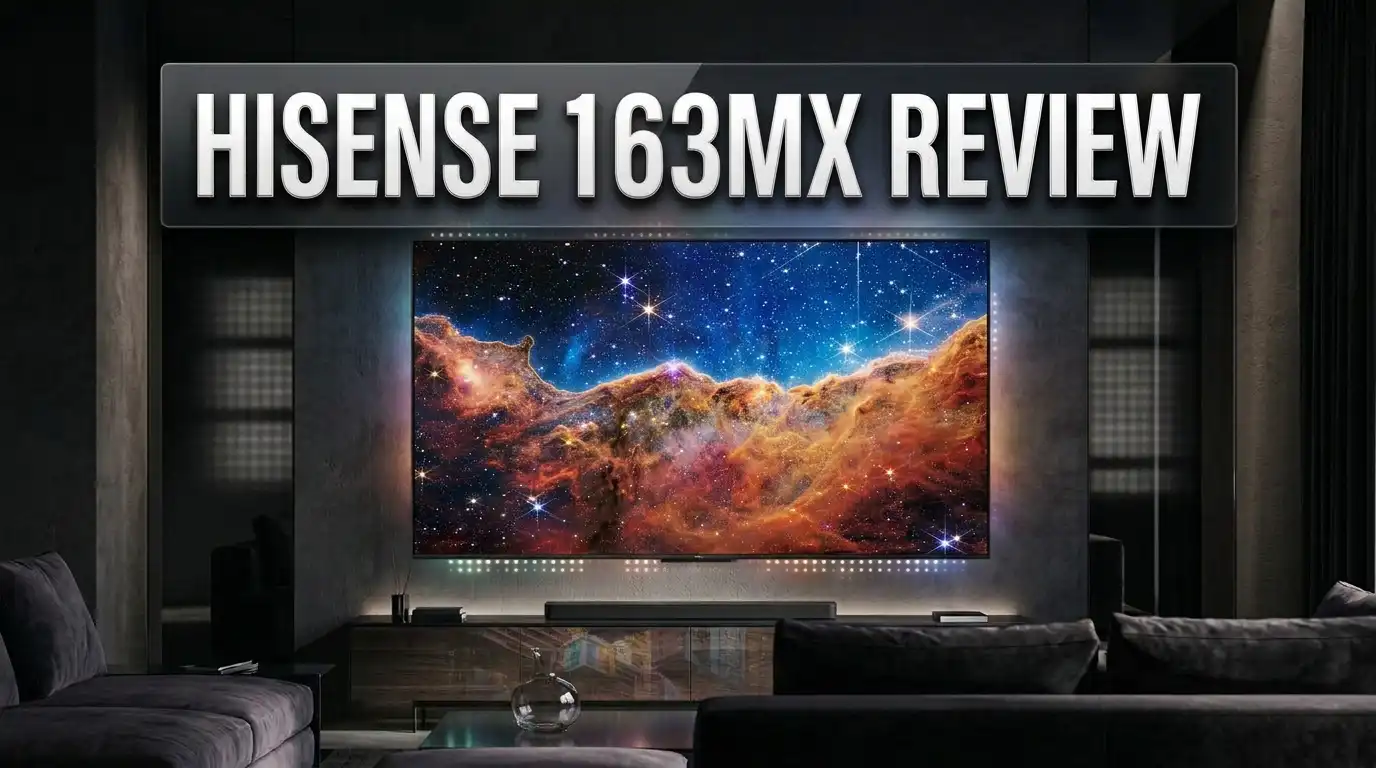
Hisense 163MX Review: RGBY MicroLED TV That Stole CES 2026
Imagine a television the size of a garage door. Now imagine it glows with colors your eyes have never seen on a screen before.
That is the Hisense 163MX. It measures 163 inches across, and it uses a brand new four color MicroLED panel.
Hisense showed this display at CES 2026 in Las Vegas. Judges handed it a Best of Innovation Award almost immediately.
Most large screen TVs chase brightness. The 163MX chases something harder, which is perfect color.
It adds a yellow subpixel to the usual red, green, and blue setup. That small change fixes a problem MicroLED engineers have argued about for years.
This review breaks down every part of the 163MX. You will learn what RGBY means, how the panel performs, what it likely costs, and whether anything else comes close.
Grab a coffee. This screen deserves a long look.
In a Nutshell
Short on time? Here are the key facts about the Hisense 163MX.
- Screen size and build: The 163MX is a 163 inch tiled MicroLED display. The body measures just 32 mm thick, which is slim for a panel this large. A precision zero gap wall mount presses it flat against the wall.
- RGBY MicroLED is the headline: Hisense added a fourth yellow subpixel next to red, green, and blue. This fills the spectral gap between 500 and 600 nanometers, the exact range where human eyes notice the most detail.
- Color coverage hits the ceiling: Hisense claims up to 100% of the BT.2020 color space. Premium OLED panels reach around 90%. Standard RGB MicroLED sits between 75% and 95%.
- Massive subpixel count: The panel manages 33.17 million subpixels. Hisense uses advanced color management to keep brightness and color even across the whole surface.
- Self emissive means infinite contrast: Every MicroLED lights itself. There is no backlight, so blacks are truly black and there is zero blooming.
- Price and release are not confirmed: Hisense has not announced either. The smaller 136MX sells in the US for $99,999, so expect the 163MX to sit well above that.
What Is the Hisense 163MX?
The Hisense 163MX is a 163 inch MicroLED display. Hisense calls it a display rather than a TV, and that wording matters.
MicroLED panels use millions of microscopic LEDs. Each one produces its own light and its own color.
There is no backlight. There is no liquid crystal layer. The pixels simply glow.
The 163MX is built from tiles. Hisense joins these modules so precisely that you cannot see the seams from a normal viewing distance.
This model follows the 163 inch UX MicroLED that launched in China during 2025. The 163MX replaces the old RGB structure with the new RGBY structure.
Think of it as a second generation product rather than a first attempt. Hisense already learned the hard lessons on tiling, heat, and uniformity.
The company positions the 163MX for penthouses, private cinemas, showrooms, and luxury yachts. It suits any space where the screen becomes architecture.
You will not find this at your local electronics store. Purchases run through specialist dealers with white glove installation.
Hisense also showed the 136MX alongside it at CES 2026. That model keeps classic RGB MicroLED and already ships in the United States.
The 163MX sits above it as the technology showcase. It proves what Hisense can build when cost is not the first question.

- RGB-MiniLED | Up to 8000 nits Peak Brightness | 20000+ Color Control Units: Take your Mini-LED up a level with...
- 3D Color Master Pro: Watch the game, show, or movie in purer, richer color thanks to the TV’s specialized...
Last update on 2026-09-24 / Affiliate links / Images from Amazon Product Advertising API
RGBY MicroLED Technology Explained Simply
Standard displays mix three colors. Red, green, and blue combine to make every shade you see.
That system works well, but it has a weak spot. LEDs struggle to produce efficient, pure light between 500 and 600 nanometers.
This band covers yellows, ambers, golds, and many skin tones. Engineers call it the green gap or the color ceiling.
Your eyes are most sensitive in exactly this range. So errors here look obvious, even to casual viewers.
On a normal RGB panel, a gold trophy can look slightly flat. A sunset can lose its warmth. Faces can drift toward orange or pink.
Hisense solved this by adding a real yellow MicroLED. The panel now emits four primary colors instead of three.
The yellow subpixel does not simulate warmth. It generates it directly.
This is the first four primary MicroLED architecture in the industry. Nobody else has shipped one.
The result is wider color coverage and better accuracy inside that coverage. Hisense claims up to 100% of BT.2020, the reference standard for HDR mastering.
There is a second benefit worth noting. A dedicated yellow emitter reduces the load on the red and green LEDs.
Lower load can mean better efficiency and longer life. It can also mean steadier color at very high brightness levels.
Picture Quality and Color Performance
Color is where the 163MX separates itself from every other screen. I will explain what you actually see.
Skin tones look correct. Not warm, not cool, just correct.
Gold and brass surfaces gleam instead of glowing orange. Amber lighting in a film keeps its depth.
Sunsets show the full run from deep red to pale yellow. On RGB panels, that run often collapses into two or three visible bands.
The 163MX shows gradations most screens simply cannot produce.
Green also improves. Grass, forests, and sports fields look layered rather than painted.
Hisense manages 33.17 million subpixels with careful luminance and chromatic control. That matters on a tiled panel, because uneven tiles are the classic MicroLED flaw.
Demo footage at CES showed no visible tile lines. Solid color test slides stayed even from edge to edge.
Motion handling looked clean on fast content. Self emissive pixels switch almost instantly, so there is no LCD style smear.
Viewing angle is another quiet win. MicroLED holds color and contrast from far off center.
You can sit at the extreme side of a wide room. The image does not wash out.
One honest caveat applies. The panel is 4K, which is a modest pixel density across 163 inches.
Sit too close and you will notice the pixel structure. Plan your seating distance accordingly.
Brightness, Contrast, and Black Levels
MicroLED gives you both ends of the range at once. That is the part LCD cannot match.
Each pixel turns fully off. A black pixel emits nothing at all.
So contrast is effectively infinite. Star fields, night scenes, and letterbox bars look genuinely black.
There is zero blooming. No halo appears around white subtitles on dark backgrounds.
MiniLED sets fight this problem with thousands of dimming zones. MicroLED removes the problem entirely.
On brightness, Hisense has not published a confirmed peak figure for the 163MX. The related 136MX reaches 10,000 nits peak, and multiple CES reports cite the same figure for the MX MicroLED line.
That number is extreme. Most premium OLED televisions peak between 2,000 and 4,000 nits.
High brightness matters more than most people think. HDR highlights only look real when the screen can actually produce them.
Specular reflections, sunlight on water, and explosions gain physical punch. The image stops looking like video and starts looking like a window.
Brightness also helps in bright rooms. A 163 inch screen usually lives in a large space with windows.
The MX line includes an antireflective treatment. Combined with huge peak output, the panel stays readable in daylight.
Full screen sustained brightness will be lower than peak. That is normal and expected on every self emissive display.
Top 3 Alternatives for Hisense 163MX
Most people cannot buy a 163MX. These three giant screens are available right now, and they deliver a large share of the experience.
The Hisense 116UX is the closest thing on the market. It uses RGB MiniLED with a three color backlight, reaches around 8,000 nits, and runs a native 165Hz panel.
- RGB-MiniLED | Up to 8000 nits Peak Brightness | 20000+ Color Control Units: Take your Mini-LED up a level with...
- 3D Color Master Pro: Watch the game, show, or movie in purer, richer color thanks to the TV’s specialized...
Last update on 2026-09-24 / Affiliate links / Images from Amazon Product Advertising API
The TCL 115QM891G brings 115 inches of QD MiniLED with more than 5,000 local dimming zones. It pairs that with a 120 watt Onkyo audio system and Google TV.

- 4K UltraHD Resolution - Experience incredible detail with 4X the resolution of 1080p Full HDTVs.
- QD-Mini LED ULTIMATE - With 20,000 local dimming zones, and precise zone control utilizing the powerful TCL...
Last update on 2026-09-24 / Affiliate links / Images from Amazon Product Advertising API
The Hisense 100U8QG is the value pick of the group. You get 100 inches, MiniLED Pro, up to 5,000 nits, native 165Hz, and Dolby Vision IQ for a fraction of flagship money.

- MINILED PRO WITH UP TO 5000 NITS PEAK BRIGHTNESS AND UP TO 5600 LOCAL DIMMING ZONES: See the realism of every...
- HI-VIEW AI ENGINE PRO: Enjoy the game from home, but feel like you’re there. Powered by the Hisense...

Last update on 2026-09-24 / Affiliate links / Images from Amazon Product Advertising API
Each option trades MicroLED perfection for real availability. None reach infinite contrast, but all three deliver serious scale.
The 116UX gets closest on color. Its RGB backlight is the MiniLED answer to the same problem RGBY solves.
The TCL wins on sound out of the box. The Onkyo system needs no soundbar for casual viewing.
The 100U8QG wins on price per inch. It is the sensible choice for a normal living room.
Design, Thickness, and Wall Mounting
A 163 inch screen is furniture. Hisense designed the 163MX with that in mind.
The body measures 32 mm thick, or about 1.26 inches. That is remarkably slim for a tiled MicroLED panel.
Older modular MicroLED walls were far bulkier. Many needed deep frames and service access from behind.
Hisense also built a precision zero gap wall mount. The screen sits flush against the wall with no visible shadow line.
The goal is simple. The display should read as a surface, not as an appliance.
There is no stand option here. A screen over four meters wide belongs on a wall or in a custom recess.
Bezels are essentially absent. The image runs to the physical edge of the panel.
Cable management runs through the mount. Installers route power and signal so nothing shows.
Hisense uses a clean dark finish on the frame. When the screen is off, it reads as a dark rectangle rather than a glossy mirror.
Weight is significant. Your wall will need proper structural support, and professional installation is mandatory.
Heat is handled inside the chassis. Tiled MicroLED runs cooler than you might expect, because each LED is tiny and efficient.
One practical note. At 32 mm deep, the 163MX can integrate into millwork or a plaster recess without awkward gaps.
Sound System and Devialet Audio
Hisense partnered with Devialet for audio on its premium models. That partnership extends to the MX MicroLED line.
Devialet is a French audio company known for dense, powerful speakers in small enclosures. Its tuning favors clarity and controlled bass.
Hisense has not released full speaker specifications for the 163MX. Channel count, driver layout, and wattage remain unconfirmed.
What we do know is the intent. The screen is meant to sound credible on its own.
A 32 mm chassis limits cabinet volume, so deep bass will still need help.
Demo audio at CES sounded wide and clean. Dialogue stayed centered and clear even at high volume.
In practice, most 163MX buyers will run a dedicated system. A screen at this level usually pairs with in wall speakers and a proper subwoofer array.
Hisense premium sets typically support Dolby Atmos and eARC. Expect the 163MX to pass full bitrate audio to an AV receiver.
Built in audio still matters for casual viewing. Nobody wants to fire up a 7.2.4 rig to watch the news.
The Devialet tuning covers that scenario well. It handles voices, music, and everyday content without harshness.
If you plan a dedicated cinema room, treat the built in speakers as a backup. If the screen lives in a living room, they will likely satisfy.
Gaming Features and Connectivity
Gaming on a 163 inch screen is an experience. It is closer to a simulator than a television.
The 136MX includes HDMI 2.1 ports with 4K at 120Hz, VRR, ALLM, and FreeSync Premium Pro. The 163MX should match or exceed that set.
Hisense has not confirmed the full port list for the 163MX. Treat the 136MX spec as the reliable baseline.
MicroLED brings one huge gaming advantage. Pixel response is near instant, so there is no motion blur from the panel itself.
Input lag on Hisense flagship models typically sits in the low teens of milliseconds in Game Mode. That is competitive with dedicated gaming displays.
Perfect blacks change how games look. Space scenes, caves, and night maps gain real depth.
Very high peak brightness also transforms HDR gaming. Muzzle flashes and sunlight feel physical rather than simulated.
There is one thing to consider. At this size, you cannot see the whole screen at once from a close seat.
Competitive players may find that a disadvantage. Cinematic single player games benefit enormously.
Console players should check the port count before purchase. Large premium sets sometimes limit full bandwidth to two ports.
PC gamers get a bonus. FreeSync Premium Pro support means smooth frame delivery from AMD cards.
Smart TV Platform and Everyday Use
Hisense has not confirmed the operating system for the 163MX. Its US flagship televisions run Google TV, so that is the most likely choice.
Google TV handles the basics well. You get every major streaming app, voice search, and a clean home screen.
The MX line is built as a premium display first. Hisense equips it with strong processing to match.
Upscaling matters enormously at 163 inches. Low quality sources have nowhere to hide on a screen this wide.
Feed it a 4K Blu ray and the result is breathtaking. Feed it a compressed cable channel and flaws multiply.
Hisense processing on flagship models handles noise reduction and detail enhancement competently. Expect similar or better performance here.
Pantone certification appears on the 136MX. It signals color accuracy verified against a known standard.
Picture presets should include Filmmaker Mode. That setting disables processing and follows the creator intent.
Everyday use will be shaped by the room, not the software. A screen this big dominates any space it occupies.
Many owners will use ambient art modes during the day. A 163 inch canvas makes a convincing digital artwork.
Remote control, app loading, and menu speed should feel quick. Hisense has improved processor performance significantly across recent generations.
Price, Availability, and What You Actually Pay
Hisense has not announced a price or a release date for the 163MX. That is the honest current position.
We do have useful reference points. The 136 inch 136MX sells in the United States for $99,999, with free delivery included.
That model launched in China first at around 799,999 Yuan, roughly $110,000. The US price came in slightly lower.
Industry estimates put MicroLED at roughly $800 to $1,000 per inch. Apply that math to 163 inches and you land above $130,000.
A realistic expectation sits somewhere between $130,000 and $180,000.
Compare that to rivals. Samsung sells a 110 inch MicroLED at about $155,000, and LG has offered a 136 inch model near $300,000.
Seen that way, Hisense is the aggressive value player in an absurdly expensive category. That is a strange sentence to write, but it is accurate.
Installation costs sit on top. Structural wall reinforcement, calibration, and delivery add meaningful expense.
Availability will start with select markets. China and the United States are the likely first stops.
Dealers will handle sales rather than retail websites. Expect a consultation process rather than an add to cart button.
If you want the technology without the price, the 116UX exists. It uses RGB MiniLED and costs a small fraction of the MX.
Hisense 163MX vs 136MX: Which Makes More Sense?
Hisense showed both models at CES 2026. They serve different buyers.
The 136MX uses classic RGB MicroLED with 24.88 million self emissive LEDs. It hits 10,000 nits peak and carries Pantone certification.
It also ships today. You can buy one in the United States right now for $99,999.
The 163MX uses the new RGBY structure with 33.17 million subpixels. It adds 27 inches of diagonal and the four primary color advantage.
The 136MX is the practical choice. The 163MX is the aspirational one.
Size difference is dramatic in person. The 136MX measures 3.45 meters diagonal, while the 163MX exceeds four meters.
Room requirements scale accordingly. The 163MX needs a wall of serious width and a viewing distance beyond five meters for comfort.
Color performance favors the 163MX clearly. Full BT.2020 coverage beats the roughly 75% to 95% typical of RGB MicroLED.
Both share the tiled construction approach. Both deliver infinite contrast and no blooming.
Connectivity on the 136MX is confirmed and complete. The 163MX specification sheet is still partially unknown.
My take is straightforward. If you need a screen this year, buy the 136MX.
If you are building a home in two years and want the best panel available, wait for the 163MX.
Pros and Cons of the Hisense 163MX
Here is the balanced view.
Pros
- First RGBY MicroLED panel in the industry adds a real yellow subpixel and fixes the 500 to 600 nanometer color gap that limits every RGB display.
- Up to 100% BT.2020 coverage beats premium OLED at around 90% and standard RGB MicroLED at 75% to 95%.
- Infinite contrast with perfect blacks because every pixel is self emissive with no backlight and no blooming.
- Extreme peak brightness in the MX line, reported at 10,000 nits, which makes HDR highlights look genuinely physical.
- Slim 32 mm body with zero gap wall mount lets a 163 inch screen integrate into architecture instead of dominating it.
- CES 2026 Best of Innovation Award winner, which reflects genuine engineering achievement rather than marketing noise.
- Devialet audio partnership delivers credible built in sound for casual viewing.
- Competitive pricing for the category, since Hisense undercuts Samsung and LG MicroLED by a wide margin.
Cons
- No confirmed price or release date, which makes planning difficult for serious buyers.
- Expected cost above $130,000, placing it far outside normal consumer reach.
- 4K resolution across 163 inches means lower pixel density, so close seating reveals pixel structure.
- Full specifications remain unpublished, including peak brightness, port layout, and operating system.
- Professional installation is mandatory, and your wall needs structural support.
- Room size requirements are severe, since a four meter screen needs a very large viewing space.
- Tiled construction may still show subtle uniformity differences in specific test patterns.
Who Should Buy the Hisense 163MX?
This is not a mainstream product. Hisense knows that, and says so plainly.
The 163MX suits a small group of buyers. Let me describe them clearly.
Private cinema owners are the core audience. If you are building a dedicated theater room, this replaces a projector with no compromise on black level.
A projector cannot produce 10,000 nits. It cannot produce true black either.
Luxury home builders form the second group. Architects specifying a media wall in a high end residence will find the 32 mm profile genuinely useful.
Commercial showrooms and flagship retail spaces make a strong case. A 163 inch MicroLED display draws attention in a way nothing else does.
Color critical professionals are a niche but real audience. Full BT.2020 coverage matters for grading suites and review rooms.
Yacht and jet interiors round out the list. Slim depth and flush mounting solve real problems in those environments.
Who should skip it? Almost everyone else.
If your room is under six meters wide, the screen is too big. If your budget is under six figures, the math does not work.
Normal enthusiasts have better options. The 116UX, the TCL 115QM891G, and the 100U8QG deliver enormous screens at sane prices.
There is no shame in that. Those sets are excellent.
Final Verdict on the Hisense 163MX
The Hisense 163MX is the most interesting display announced at CES 2026. It earns that title through real engineering, not size alone.
Adding a fourth primary color is a genuine advance. It targets a specific, measurable weakness in every three color display ever made.
Full BT.2020 coverage was a theoretical goal for years. Hisense claims to have reached it.
Combine that with infinite contrast, extreme brightness, and a 32 mm body, and you have a landmark product.
The problems are practical rather than technical. Price is unannounced but certainly enormous, and the release date is unclear.
Specifications remain incomplete. Hisense has confirmed color performance and dimensions, but stayed quiet on brightness, ports, and software.
I would call this a technology showcase with a production path. The 136MX proves Hisense can actually ship MicroLED to customers.
The 163MX will follow the same route, just at a higher price. Expect availability through specialist dealers within the next year.
Should you wait for it? Only if you are in the tiny group it was built for.
Everyone else should watch what happens next. RGBY technology will trickle down, exactly as MiniLED did.
In five years, four primary color panels may be normal. The 163MX is where that story starts.
Rating for what it is: an extraordinary achievement with an extraordinary price attached.
Frequently Asked Questions
What makes the Hisense 163MX different from other MicroLED TVs?
The 163MX is the first display to use a four primary RGBY MicroLED structure. It adds a yellow subpixel alongside red, green, and blue.
This fills the spectral gap between 500 and 600 nanometers. Hisense claims up to 100% BT.2020 color coverage as a result.
How much does the Hisense 163MX cost?
Hisense has not announced a price. The smaller 136MX sells for $99,999 in the United States.
Industry estimates of $800 to $1,000 per inch suggest the 163MX will exceed $130,000.
When will the Hisense 163MX be released?
No release date has been confirmed. Hisense showed the model at CES 2026 as an award winning technology demonstration.
The 136MX is already on sale, which suggests the 163MX will follow through similar dealer channels.
How bright is the Hisense 163MX?
Hisense has not confirmed a figure for the 163MX specifically. The 136MX in the same MX MicroLED line reaches 10,000 nits peak brightness.
Several CES reports cite 10,000 nits for the MX MicroLED range overall.
Is the Hisense 163MX better than OLED?
For contrast, both deliver perfect blacks. For brightness and color, MicroLED is far ahead.
The best OLED panels cover around 90% of BT.2020, while the 163MX claims up to 100%. OLED wins decisively on price and availability.
How thick is the Hisense 163MX?
The body measures 32 mm, or about 1.26 inches. It also includes a precision zero gap wall mount for a flush installation.
What size room do I need for a 163 inch TV?
A 163 inch screen measures over four meters diagonally. Comfortable 4K viewing generally needs a seating distance of five meters or more.
You also need a clear wall width of roughly 3.7 meters plus clearance.
Can I buy a Hisense MicroLED TV today?
Yes. The 136 inch 136MX is available in the United States for $99,999 with free delivery.
It uses standard RGB MicroLED rather than the new RGBY structure.
What is the best affordable alternative to the Hisense 163MX?
The Hisense 116UX is the closest option, using RGB MiniLED with roughly 8,000 nits and a 165Hz panel. The TCL 115QM891G and Hisense 100U8QG offer strong value at smaller sizes.
Does the Hisense 163MX support gaming features?
The related 136MX includes HDMI 2.1 with 4K at 120Hz, VRR, ALLM, and FreeSync Premium Pro. The 163MX is expected to match that, though Hisense has not published the final port list.

DK is a technology expert who specializes in AI tools, software, and tech gadgets. He writes for How to Tech Info, providing detailed reviews and practical guides. DK helps readers discover the best AI applications, navigate new software, and choose the right tech gadgets.