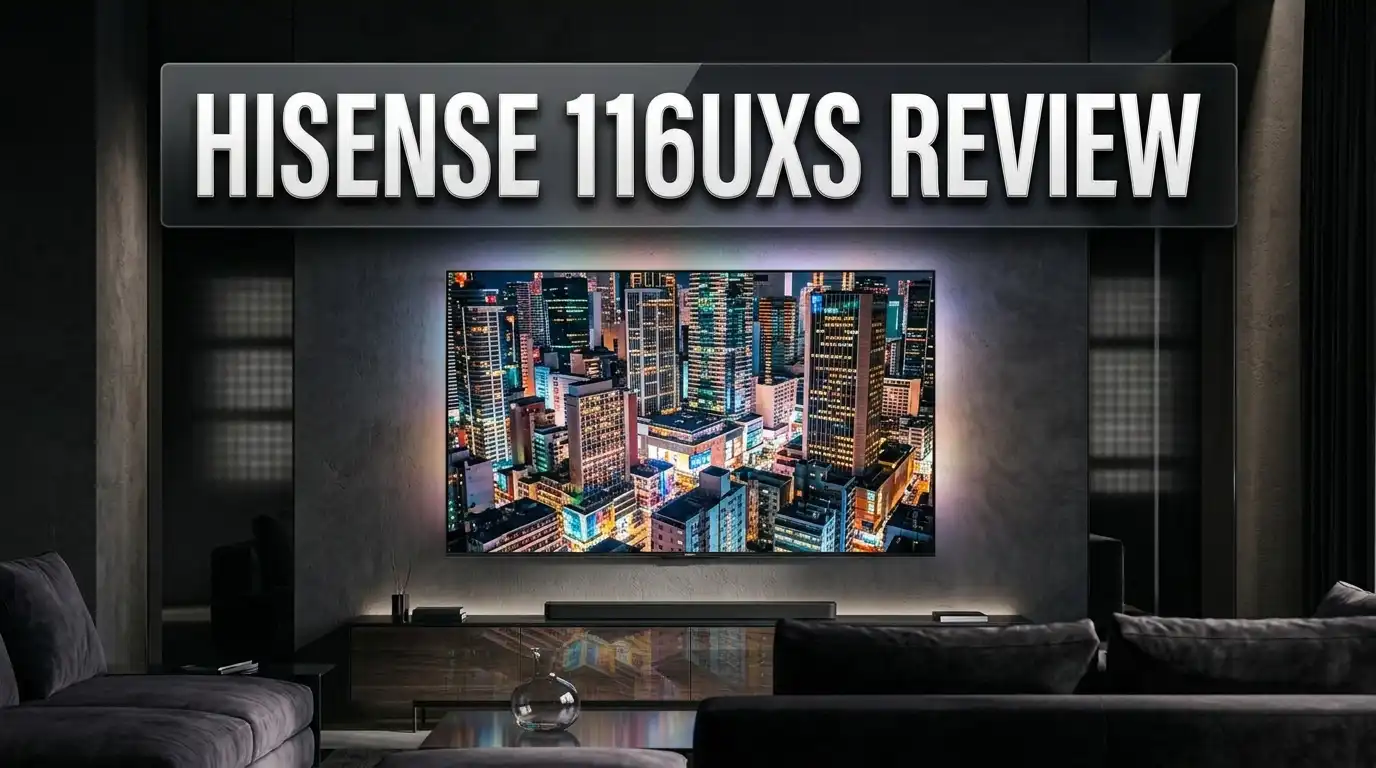
Hisense 116UXS Review: RGB Mini LED Evo & 5,000 Nits?
Hisense just did something bold. It took the biggest TV it has ever built, then added a fourth color to the backlight. The result is the Hisense 116UXS, a 116 inch monster that debuted at CES 2026 and walked away with an Innovation Award honoree badge plus a pile of “Best of Show” mentions.
This review breaks down what the 116UXS actually offers, how it improves on the 116UX that came before it, and whether the new cyan LED is real engineering or clever marketing. I have pulled together hands on impressions from CES, official Hisense specs, and practical buying advice so you know exactly where this TV stands.
Fair warning before you scroll. This is not a normal television. It is a piece of furniture that happens to display 4K video. Let us get into it.
In a Nutshell: Hisense 116UXS Quick Summary
Short on time? Here is everything that matters, packed into six points.
- RGB Mini LED Evo is the headline feature. Hisense added a cyan LED to the existing red, green and blue backlight zones. That fourth color takes pressure off the blue LED, which improves color purity and shadow detail.
- Peak brightness sits at 5,000 nits with tens of thousands of color dimming zones. Hisense has not confirmed the exact zone count yet. Color coverage is claimed at 110% of BT.2020, which is enormous.
- The screen measures 116 inches and only 1.57 inches thick, with a nearly bezelless frame. It looks almost identical to the 116UX, right down to the perforated side tubes that house the speakers.
- Audio comes from a built in 6.2.2 channel Devialet system with Dolby Atmos and DTS:X. This is genuine Devialet hardware, not just tuning. Most owners will skip the soundbar entirely.
- Dolby Vision 2 arrives here first. The 116UXS is among the earliest TVs to support Dolby’s next generation HDR format, alongside the UR9, UR8 and U7 models.
- Pricing is not announced. The 116UX launched at roughly $29,999 in the US and £24,999 in the UK. Expect the 116UXS to land in similar territory when it ships in late 2026.
Hisense 116UXS Overview: What You Are Actually Buying

- RGB-MiniLED | Up to 8000 nits Peak Brightness | 20000+ Color Control Units: Take your Mini-LED up a level with...
- 3D Color Master Pro: Watch the game, show, or movie in purer, richer color thanks to the TV’s specialized...
Last update on 2026-09-24 / Affiliate links / Images from Amazon Product Advertising API
The 116UXS is Hisense’s 2026 flagship and the successor to the 116UX. Both sets share the same 116 inch panel size, and Hisense offers no smaller version. You buy this size or you buy something else.
This TV exists to prove a point. Hisense wants to be seen as the company that invented consumer RGB Mini LED, not the company that follows Samsung and LG. It showed the first RGB Mini LED concept at CES 2025, shipped the 116UX later that year, and arrived at CES 2026 with a fourth backlight color while rivals were still launching their first RGB sets.
The core specs are straightforward. You get a native 4K panel, a 165Hz refresh rate, the new Hi View AI Engine RGB processor, and support for every major HDR format including Dolby Vision, Dolby Vision 2, HDR10+, HLG and IMAX Enhanced.
The backlight is where the money goes. Hisense claims 5,000 nits peak brightness and tens of thousands of dimming zones. For comparison, the 116UX advertised up to 8,000 nits with 3,584 zones, so the new model trades raw peak output for far finer control.
Since the 116UXS is not on sale yet, the 116UX above remains the closest model you can actually order today.
RGB Mini LED Evo Explained in Plain English
Here is how backlights normally work. A blue LED fires light into a quantum dot layer. That layer converts blue into white. The white light then passes through a color filter, and the filter blocks whatever you do not need. Blocking light wastes light.
RGB Mini LED changes that. Instead of one blue LED, each zone contains separate red, green and blue LEDs. The backlight already produces the color you want, so the filter does far less work. You get purer colors and much brighter colors, not just brighter whites.
The Evo version adds cyan. This matters more than it sounds. In a standard RGB setup, the blue LED handles a heavy workload because blue sits at the edge of the spectrum and feeds into many mixed shades.
Splitting that job between blue and cyan means cleaner mixing and more accurate brightness across the whole picture. Blue stays vivid when the scene calls for it, and cyan handles the transitions.
Hisense says the result is more natural color with smoother shadow detail. Reviewers at CES broadly agreed, though most noted the demo content was heavily saturated computer generated footage rather than real film.
The skeptics have a fair point too. CNET raised the old Sharp Quattron comparison, where adding a yellow subpixel pushed blues toward cyan and made colors look off. Hisense will need to prove its calibration holds up on real content.
Design, Build and That 1.57 Inch Profile
Put the 116UXS next to the 116UX and you would struggle to tell them apart. Hisense kept the design language almost unchanged, which is not a criticism because the 116UX looked superb.
The frame is close to bezelless. From a few feet away the image appears to float, which is the only sane approach at this size since any visible border would be the width of a ruler.
Depth is 1.57 inches, or roughly 39.9mm. That is genuinely slim for a backlit LCD carrying this many LEDs plus a full speaker array. Hisense clearly spent real effort on thermal management here.
The left and right edges use perforated tubes. These are not decoration. They house a significant portion of the Devialet sound system, and they let the TV produce proper stereo width without an external bar.
Build quality at CES felt premium rather than plasticky, with a metal heavy chassis and tight panel gaps. At this price you would expect nothing less.
One practical note. A 116 inch panel is around 101 inches wide and 57 inches tall. It weighs enough that professional installation is mandatory, and most buyers will need the wall reinforced or a heavy duty floor stand.
Top 3 Alternative for Hisense 116UXS
If the 116UXS timeline or price does not work for you, these three big screen sets are available now and cover different budgets.

- 4K UltraHD Resolution - Experience incredible detail with 4X the resolution of 1080p Full HDTVs.
- QD-Mini LED ULTIMATE - With 20,000 local dimming zones, and precise zone control utilizing the powerful TCL...
Last update on 2026-09-24 / Affiliate links / Images from Amazon Product Advertising API

- Mini-LED Pro With Up to 3000 Local Dimming Zones And Up to 3000 nits Peak Brightness: See the realism of every...
- Native 165Hz Panel With Game Booster 288: Turbo power your gaming! The Native 165Hz Panel has a Variable...
Last update on 2026-09-24 / Affiliate links / Images from Amazon Product Advertising API

- SUPER BIG SCREEN: Step into a world of unparalleled visual splendor with a 100-inch TV. Whether you're...
- DYNAMIC QNED COLOR: LG's Dynamic QNED Color with 100% Color Volume¹ and next-gen AI provides vivid color on...
Last update on 2026-09-24 / Affiliate links / Images from Amazon Product Advertising API
The TCL 115QM891G is the most direct rival. It uses QD Mini LED with over 5,000 local dimming zones and up to 5,000 nits peak brightness across a 115 inch panel. It also carries a 6.2.2 Onkyo audio system and a 144Hz native refresh rate.
It lacks the RGB backlight, so color brightness does not reach the same level, but real world picture quality is outstanding and the price is far friendlier than the UX series.
The Hisense 116U75QG gives you the same 116 inch footprint from the same brand for a fraction of the cost. It runs a standard Mini LED backlight with up to 4,000 nits, a native 165Hz panel, VRR up to 288Hz and a 6.2 channel speaker system.
This is the smart pick for gamers and sports fans who want scale without spending five figures. Street pricing has dropped sharply since launch.
The LG 100QNED85AUA covers the budget end of the giant screen market. At 100 inches it is the smallest of the three, but it brings QNED evo panel tech, the a8 AI processor, webOS and solid gaming support.
Picture quality sits below the other two, especially in bright rooms, but the value per inch is hard to beat.
Picture Quality and Real World Brightness
Brightness is the easiest thing to demo and the hardest thing to judge in a hotel suite. Still, the 116UXS made a strong impression at CES.
The claimed 5,000 nit peak is lower than the 116UX headline figure of 8,000 nits. Do not read that as a downgrade. Peak numbers usually come from tiny test windows, and sustained full screen brightness matters far more for actual viewing.
Highlights looked genuinely startling. Sunlight on water, neon signs and explosions all carried the kind of intensity that makes HDR worth having, and the panel held that intensity across large bright areas rather than dimming down.
Hisense also improved the anti glare layer this year. It is not a matte finish, which is good news because matte screens can wash out black levels. Instead it is a treatment that knocks down reflections while keeping blacks deep.
Sharpness across 116 inches is a real challenge, since 4K spread over that area means large pixels. Reviewers reported excellent clarity with smooth gradients and almost no visible banding.
Upscaling was a weak spot on the 116UX, particularly with lower quality streams. Hisense says the new Hi View AI Engine RGB addresses this, and early impressions were positive, though this needs proper testing at home.
Color Performance and the Cyan Question
Hisense claims 110% of the BT.2020 color space. That figure sounds impossible because BT.2020 is the reference target, but it reflects how much color volume the RGB Evo backlight can produce beyond that standard.
In practice, the benefit shows up in color brightness. Traditional Mini LED sets produce brilliant whites but colors lose punch as they get brighter. RGB backlights keep reds, greens and blues saturated even at high luminance.
The cyan LED refines this further. Skies looked cleaner at CES, with less of the slightly purple cast that RGB only sets sometimes show in deep blues. Skin tones held together well under bright lighting.
Red fringing was a known flaw on the 116UX. Fine white text against dark backgrounds could show a faint red halo. Hisense specifically targeted this with the Evo backlight, and early hands on reports suggest it is reduced.
There is still reason for caution. Adding a fourth primary color introduces new calibration risk, and history offers a warning in the form of Sharp’s Quattron panels.
Hisense has far better processing than Sharp had in 2010, and the cyan LED sits in the backlight rather than the pixel structure, which is a meaningfully different approach. Full reviews will settle the question.
Contrast, Black Levels and Blooming
This is where LCD traditionally loses to OLED, and it is where Hisense has narrowed the gap the most.
With tens of thousands of dimming zones spread across the panel, each zone controls a very small area. Smaller zones mean tighter control over where light appears and where it does not.
Black levels on the 116UXS looked better than most people expect from an LCD. Letterbox bars stayed genuinely dark, and starfields showed individual points of light without a grey haze around them.
Blooming has not disappeared entirely. Reviewers at CES noted visible halo effects when viewing from an angle, which is the classic weakness of any backlit panel.
Sit directly in front and the problem largely vanishes. Move to the side and bright objects against dark backgrounds start to glow at the edges. In a 116 inch TV, off axis seating is common in group viewing, so this is worth considering.
Shadow detail is the quieter win here. The cyan LED reportedly helps render smoother transitions in dark scenes, where cheaper sets crush everything into flat black.
For a room with any ambient light, the 116UXS will beat an OLED comfortably. In a fully blacked out cinema room, OLED still holds an edge on pure contrast.
Dolby Vision 2 and HDR Format Support
The 116UXS is one of the first televisions in the world to support Dolby Vision 2. Hisense is rolling the format out across its UX, UR9, UR8 and U7 lines for 2026, with TCL and Philips following.
Dolby Vision 2 builds on the original format with better handling of very bright displays. It gives content creators more control over how a picture adapts to a TV’s actual capability, rather than relying on generic tone mapping.
This matters specifically for a set like the 116UXS. When a display can hit 5,000 nits, standard HDR metadata often has no idea what to do with that headroom.
Format support here is complete. You get Dolby Vision, Dolby Vision 2, HDR10, HDR10+, HLG and IMAX Enhanced. Nothing is missing, which is rare even at the top of the market.
That completeness removes a common frustration. Samsung sets skip Dolby Vision, LG sets skip HDR10+, and buyers end up compromising. Hisense simply includes everything.
Content availability for Dolby Vision 2 is still thin in 2026. Treat it as future proofing rather than a reason to buy today, since the library will grow over the life of the TV.
Devialet Audio: The 6.2.2 System
Most TV speakers are an afterthought. This one is not.
Hisense partnered with Devialet, the French audio company known for its Phantom speakers, and the 116UXS carries full Devialet hardware. That means Devialet amplifiers, Devialet drivers and Devialet tuning rather than a branded sticker.
The configuration is 6.2.2. Six main channels, two subwoofers and two upward firing height channels for Dolby Atmos. DTS:X is supported as well.
Reviewers who heard the system in person described it as genuinely impressive, with real bass extension and enough dialogue clarity to follow quiet scenes without reaching for subtitles.
This is significant for one practical reason. On almost every TV, a soundbar is a required second purchase. Here it is optional, and a cheap soundbar would likely sound worse than the built in system.
The side mounted perforated tubes do most of the heavy lifting for stereo width. Because they sit at the extreme left and right edges of a 116 inch panel, the soundstage is naturally enormous.
If you do want more, the TV still supports eARC for an external system. But for a lot of buyers, the Devialet setup will be the end of the conversation.
Gaming Features and Performance
Big screen gaming is one of the strongest arguments for a TV this size, and Hisense has not skimped here.
The panel is native 165Hz, with Hisense claiming higher rates in certain modes. That covers console gaming at 120Hz with room to spare, and gives PC players proper high refresh support.
Variable refresh rate is included along with AMD FreeSync Premium Pro and Hisense Game Booster tools. Input lag on the 116UX measured well, and there is no reason to expect a regression.
Playing a modern game at 116 inches is genuinely different. Peripheral vision gets involved in a way it simply does not on a 65 inch screen, and racing or flight games become close to a simulator experience.
HDR gaming benefits most from the RGB Evo backlight. Games push far more saturated color than film does, and this panel can display that color at high brightness without dulling it.
One caution applies. At this size, you sit further back than usual, so the apparent resolution advantage over a smaller 4K set shrinks. Text in menus and HUD elements can look soft if your seating distance is wrong.
Plan for a viewing distance of around 12 to 15 feet for comfortable gaming.
Price, Release Date and Availability
Hisense has not announced pricing or a firm release date for the 116UXS. That is normal for a CES flagship reveal.
Based on comments from Hisense at the show, the set is not expected to go on sale until well into the second half of 2026. Some markets may see it later still.
Pricing will almost certainly track the 116UX. That model launched at £24,999 in the UK and around $29,999 in the United States, before falling to roughly £19,999 at some online retailers.
Expect the 116UXS to open somewhere in that same range, with discounts arriving within six to nine months of launch as always happens with flagship televisions.
There is a more interesting angle here. Hisense is bringing regular RGB Mini LED to mainstream priced ranges in 2026, only months after the 116UX arrived. The UR9 line runs roughly $3,500 to $9,000 across 65, 75, 85 and 100 inch sizes.
If that pattern repeats, RGB Mini LED Evo technology could reach affordable sets by 2027. Buyers who want the tech rather than the 116 inch spectacle may be better served by waiting.
For anyone who wants a giant screen right now, the 116UX and the alternatives above are the realistic options.
Hisense 116UXS vs Hisense 116UX
The two sets look nearly identical, so the differences live inside.
The backlight is the main change. The 116UX used three color RGB Mini LED with 3,584 dimming zones. The 116UXS adds cyan and jumps to tens of thousands of zones, though Hisense has not published the exact figure.
Brightness figures moved in an unexpected direction. The 116UX claimed up to 8,000 nits, while the 116UXS claims 5,000. In practice the newer set should look better because zone precision and color brightness matter more than peak window measurements.
Processing is new. The Hi View AI Engine RGB replaces the older chip and targets the 116UX’s two biggest complaints: red fringing on fine detail and weak upscaling of lower quality sources.
Dolby Vision 2 support is exclusive to the newer model. Anti glare handling has also improved for 2026.
Audio appears unchanged, which is fine since the Devialet system was already a highlight.
The honest summary is that the 116UXS is a refinement, not a reinvention. If you already own a 116UX, there is no need to upgrade. If you are buying fresh and can wait, the newer set fixes real flaws.
Pros and Cons of the Hisense 116UXS
Here is the balanced view based on hands on impressions and confirmed specifications.
Pros
- Spectacular brightness and color reach that holds up in bright rooms where OLED struggles, with color staying saturated at high luminance thanks to the RGB backlight.
- The cyan LED is thoughtfully integrated rather than bolted on, taking workload off the blue LED and producing cleaner color mixing and smoother shadow detail.
- Black levels are far better than typical LCD, with tens of thousands of dimming zones keeping letterbox bars dark and starfields clean.
- Complete HDR format support including Dolby Vision 2, HDR10+, HLG and IMAX Enhanced, so no content is left behind.
- The 6.2.2 Devialet audio system removes the need for a soundbar, which is rare enough to be a genuine selling point at any price.
- Strong gaming credentials with a native 165Hz panel, VRR, FreeSync Premium Pro and low input lag.
- Slim 1.57 inch profile and near bezelless design that looks far more elegant than the size suggests.
Cons
- Price will be extremely high, likely in the same range as the 116UX at roughly $29,999 at launch.
- Off axis blooming is still visible, with halos appearing around bright objects when you sit to the side.
- Launch is months away, with availability expected in the second half of 2026 and no confirmed date.
- Only one size is offered. If 116 inches does not fit your room, there is no alternative in this range.
- Installation is a serious project requiring professional mounting and a genuinely large wall.
- Dolby Vision 2 content is scarce in 2026, so that feature is future proofing rather than an immediate benefit.
Who Should Buy the Hisense 116UXS
Let us be realistic about the audience here.
This TV suits people building a dedicated home cinema room who want a giant screen without the compromises of a projector. The 116UXS is dramatically brighter than any projector and works fine with the lights on.
It also suits buyers who have already priced out a projector setup. A high end projector, a quality screen, a processor and a speaker package can easily exceed the cost of this TV once installation is included.
Sports fans with large living rooms are another natural fit. The brightness and motion handling make daytime sports viewing genuinely better than anything else available.
It does not suit anyone with a room smaller than about 20 feet deep. Sitting too close to a 116 inch panel is uncomfortable and reveals the limits of 4K resolution at this scale.
It also does not suit buyers who mainly want the new technology rather than the size. The Hisense UR9 range delivers RGB Mini LED in 65 to 100 inch sizes at a small fraction of the price.
Value hunters should look at the 116U75QG instead. Same size, same brand, standard Mini LED, and a price that has fallen dramatically since launch.
Final Verdict: Is the Hisense 116UXS Worth It?
The Hisense 116UXS is the most advanced television the company has ever built, and probably the most advanced LCD anyone has built.
The cyan LED is not a gimmick. It solves a real engineering problem by splitting the blue LED’s workload, and the early results suggest cleaner color with no obvious downside.
Combine that with tens of thousands of dimming zones, 5,000 nits, complete HDR support and a proper Devialet sound system, and you have a set that beats OLED in most rooms.
The remaining flaws are honest ones. Off axis blooming persists, the price will be enormous, and the launch is still months away with no confirmed date.
My advice is simple. If you have the room, the budget and the patience, the 116UXS will be worth the wait and should fix the specific complaints people had about the 116UX.
If you want a giant screen this year, buy the 116UX at its discounted price or the TCL 115QM891G, both of which deliver most of the experience for far less.
And if you simply want RGB Mini LED in a normal living room, wait for the Hisense UR9. That is where this technology becomes something most people can actually own.
Frequently Asked Questions
When will the Hisense 116UXS be released?
Hisense has not confirmed a release date. Comments made at CES 2026 suggest the TV will go on sale well into the second half of 2026, with some regions likely receiving it later.
How much does the Hisense 116UXS cost?
Pricing has not been announced. The previous 116UX launched at around $29,999 in the United States and £24,999 in the UK, so expect the 116UXS to arrive in a similar range.
What is the difference between RGB Mini LED and RGB Mini LED Evo?
RGB Mini LED uses separate red, green and blue LEDs in each backlight zone. Evo adds a fourth cyan LED, which reduces the workload on the blue LED and produces purer blues, cleaner color mixing and smoother shadow detail.
How bright is the Hisense 116UXS?
Hisense claims a peak brightness of 5,000 nits. That is lower than the 8,000 nit claim for the 116UX, but the newer set uses tens of thousands of dimming zones for better real world control.
Does the Hisense 116UXS support Dolby Vision 2?
Yes. The 116UXS is one of the first TVs to support Dolby Vision 2, alongside the Hisense UR9, UR8 and U7 models for 2026. It also supports Dolby Vision, HDR10, HDR10+, HLG and IMAX Enhanced.
Do I need a soundbar with the Hisense 116UXS?
Probably not. The built in 6.2.2 channel Devialet system uses real Devialet amplifiers and drivers, supports Dolby Atmos and DTS:X, and outperforms most entry level and midrange soundbars.
Is the Hisense 116UXS available in smaller sizes?
No. The UXS series comes in 116 inches only. For RGB Mini LED in smaller sizes, look at the Hisense UR9 range, which covers 65, 75, 85 and 100 inch options.
Is the Hisense 116UXS better than OLED?
In bright rooms, yes. It reaches far higher brightness and holds color saturation at high luminance. In a fully darkened room, OLED still has an advantage on absolute black levels and shows no blooming at all.
What is the refresh rate of the Hisense 116UXS?
The panel runs at a native 165Hz, with support for variable refresh rate and AMD FreeSync Premium Pro. This makes it well suited to both console and PC gaming.
Can I wall mount the Hisense 116UXS myself?
No. A 116 inch panel is around 101 inches wide and extremely heavy. Professional installation is required, and your wall will likely need structural reinforcement before mounting.

DK is a technology expert who specializes in AI tools, software, and tech gadgets. He writes for How to Tech Info, providing detailed reviews and practical guides. DK helps readers discover the best AI applications, navigate new software, and choose the right tech gadgets.