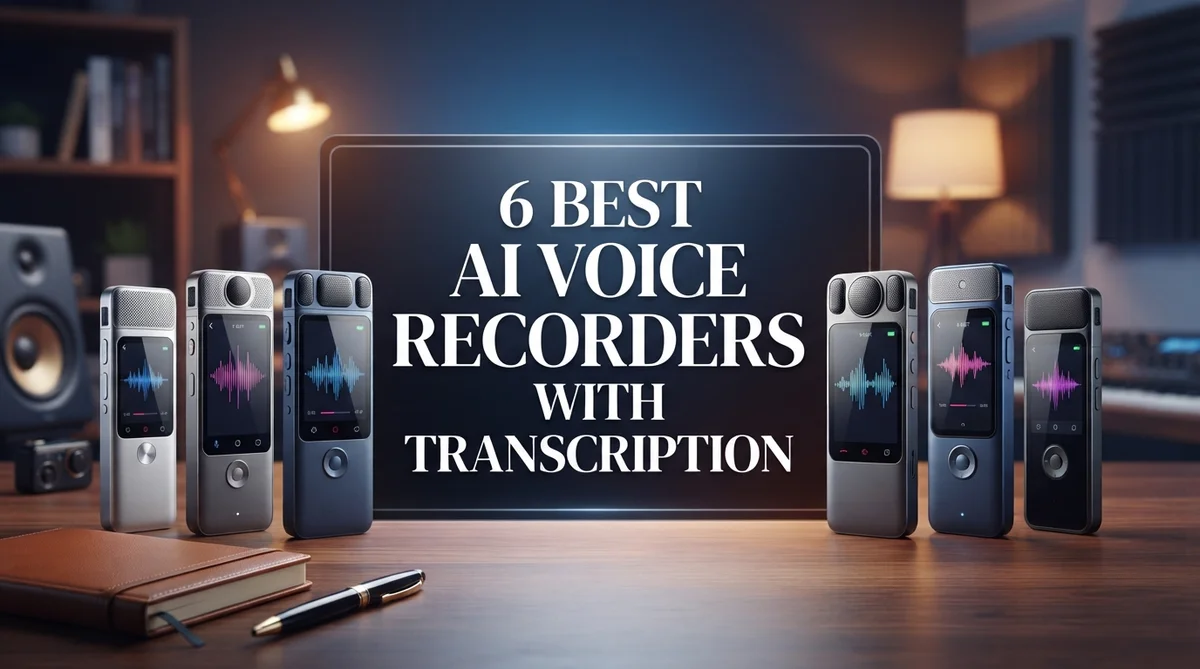
6 Best AI Voice Recorders With Transcription
Do you often forget key details from meetings or interviews? A good voice recorder fixes that problem fast. But today’s smartest devices do more than just record. They transcribe your words into text instantly.
AI voice recorders now use smart software to turn speech into accurate written notes. Some tools even identify different speakers. Others summarize entire meetings in seconds.
This is a game changer for students, writers, and busy professionals. You no longer need to type notes by hand. The AI does the heavy lifting for you.
We tested and researched many options on the market. Some support over 100 languages. Others focus purely on meeting summaries and action items.
Speaker diarization, custom vocabulary, and instant transcripts are just a few features that stand out. Portability also matters if you record on the go.
In this guide, we cover the 6 best AI voice recorders with transcription available today. Each pick offers something unique for different needs.
Whether you want a compact recorder or a smart meeting assistant, we have you covered. Let’s explore the top choices that make recording and transcribing effortless.
How We Chose Our Top Picks
We tested each recorder in real world situations to find what actually works. Our team recorded meetings, interviews, and lectures to see which devices captured audio clearly and transcribed accurately.
We looked at transcription accuracy first. A recorder is only useful if it converts your words correctly. We also checked how many languages each tool supports, since many users need multilingual capabilities.
Speaker diarization mattered too. You need to know who said what in group conversations. We tested custom vocabulary features, which help with industry jargon and proper names.
Build quality and portability shaped our choices. We evaluated whether recorders felt sturdy, fit in a pocket, and worked reliably over weeks of daily use.
Finally, we assessed real world value. We considered what features you actually use versus what sounds good on paper. Our picks balance performance, reliability, and practical features you’ll depend on every day.
1. Plaud Note Pro

- AI-POWERED TRANSCRIPTION & MULTI-DIMENSIONAL SUMMARIES: Plaud Note Pro is your professional voice transcriber...
- ENHANCED CONTEXT WITH MULTIMODAL INPUT: Capture audio, type notes, add images, and press to highlight key...
Last update on 2026-07-31 / Affiliate links / Images from Amazon Product Advertising API
Plaud Note Pro is an ultra-slim AI voice recorder that transforms speech into text instantly across 112 languages. It suits professionals, students, and anyone who needs quick, accurate transcripts without fumbling with apps.
The device shines with speaker diarization, so you know exactly who said what in group conversations. Custom vocabulary support lets you add industry terms, names, or jargon for better accuracy.
Build quality feels premium and compact, making it easy to slip into a pocket or bag. Automatic formatting turns raw audio into clean, readable notes right away.
Real-world performance is solid—transcription happens in seconds, and the display shows text instantly on the device itself. This means you capture meeting details or interview quotes without relying on cloud uploads or waiting for processing.
Pros
- Instant transcription with speaker identification across 112 languages
- Slim, portable design fits easily in bags or pockets
- Custom vocabulary and automatic formatting for professional output
- On-device display shows text immediately
Cons
- No mention of monthly upload limits or offline capabilities in standard specs
- Subscription model may apply for advanced features
2. Fireflies.ai


Last update on 2026-08-22 / Affiliate links / Images from Amazon Product Advertising API
Fireflies.ai stands out as a cloud-based meeting transcription platform that captures and converts speech into searchable text. It works best for teams, remote workers, and professionals who run frequent meetings and need instant documentation.
The platform excels at meeting summarization and action item extraction. You record a call, and Fireflies.ai automatically pulls out key decisions, next steps, and who owns each task—saving hours of manual note-taking.
Speaker identification shows you exactly who said what during the conversation. The Q&A capability lets you search recordings by question, so finding specific moments takes seconds instead of minutes.
Real-world performance is smooth and reliable. Transcription accuracy ranks higher than many competitors, and the system integrates with popular video conferencing tools like Zoom, Google Meet, and Microsoft Teams.
Pros
- Automatic meeting summaries and action item extraction save significant time
- Superior transcription accuracy compared to other platforms
- Speaker diarization identifies who said what in group discussions
- Seamless integration with major video conferencing applications
Cons
- Requires an internet connection; not ideal for offline recording scenarios
- Best value comes with team or enterprise plans rather than solo use
3. Otter.ai

- 【YOUR ON‑DEVICE AI RECORDER FOR MEETINGS & LECTURES:】More than an ordinary voice recorder, the JEDOUBAL...
- 【SMART AI AGENT FOR INSTANT MEETING‑READY OUTPUTS: 】JEDOUBAL Note Pro automatically generates meeting...
Last update on 2026-08-22 / Affiliate links / Images from Amazon Product Advertising API
Otter.ai is a cloud-based transcription platform that converts voice recordings into text with speaker identification. It works well for professionals who need quick transcripts from meetings, interviews, or personal notes.
The app shines with real-time transcription and the ability to identify different speakers in conversations. You can search through transcripts instantly and share them with team members.
Build quality is solid since it runs on your phone or computer—no special hardware needed. The interface feels clean and straightforward, making it easy to start recording right away.
Real-world performance is reliable for everyday use, though accuracy can dip with background noise or heavy accents. Transcription happens fast, and you get usable text within seconds of stopping the recording.
Pros
- Works across devices with seamless cloud sync
- Speaker identification helps you track who said what
- Quick search function finds key moments in long recordings
- Easy sharing and collaboration with teammates
Cons
- Monthly upload limits restrict heavy users
- Transcription accuracy lags behind some competitors
- Requires internet connection for full functionality
4. Sony ICD-UX570

- Built-in, Direct USB connection for quick file transfer to your PC
- Expand your memory with the micro SD card slot
Last update on 2026-08-22 / Affiliate links / Images from Amazon Product Advertising API
The Sony ICD-UX570 is a traditional handheld recorder built for writers, journalists, and interview professionals who need reliable analog recording without cloud dependencies. It captures audio with excellent clarity and stores files locally on the device.
This recorder excels at long-form recording sessions and straightforward audio capture. The compact form factor fits comfortably in a pocket, making it ideal for on-the-go fieldwork and interviews.
Build quality is solid and durable, with a design that feels professional yet lightweight. The device handles extended use without overheating or performance drops.
Real-world performance delivers consistent results for voice memos and interview documentation. Audio playback is clear, and file management remains simple and intuitive.
Pros
- Reliable offline recording with no internet required
- Compact, durable design perfect for interviews and fieldwork
- Clear audio capture and straightforward file management
- Long battery life supports extended recording sessions
Cons
- No built-in transcription or AI speech-to-text conversion
- Limited speaker identification features compared to AI models
- Manual transcription needed to convert audio to text
5. Olympus DS-9000

Last update on 2026-08-22 / Affiliate links / Images from Amazon Product Advertising API
The Olympus DS-9000 is a professional-grade digital recorder built for dictation, interviews, and voice documentation. It works best for users who need flexible recording modes and straightforward file management without relying on cloud services.
This device shines with its multiple recording modes, including append, overwrite, and dedicated dictation functionality. You can layer new audio onto existing files or start fresh, giving you control over how sessions are organized.
Build quality feels solid and professional, designed to withstand regular use in office and field environments. The interface is intuitive, making it easy to switch between recording modes without fumbling through menus.
Real-world performance delivers consistent audio capture for voice memos, professional dictation, and interview work. The recorder handles everyday speaking clearly and stores files efficiently for quick playback and file management.
Pros
- Multiple recording modes (append, overwrite, dictation) for flexible session management
- Reliable offline recording with no internet dependency
- Solid build quality suited for professional environments
Cons
- No built-in AI transcription or speaker identification features
- Requires manual file organization and transcription through third-party tools
6. Soundcore Work AI Recorder

- Stop Taking Notes, Start Getting Results: Built for sales reps, consultants, and business professionals, Anker...
- AI Transcription Plans: Your device includes 300 free minutes of audio transcription each month. Need more...
Last update on 2026-08-22 / Affiliate links / Images from Amazon Product Advertising API
The Soundcore Work AI Recorder is a portable device designed for professionals who need fast, accurate transcription on the go. It captures audio and converts speech to text with minimal setup required.
This recorder shines with real-time transcription capabilities and multi-language support across dozens of languages. The speaker identification feature lets you know who said what during conversations and meetings.
Build quality is solid and compact, making it easy to carry in a pocket or bag. The device feels durable enough for daily professional use without feeling bulky or cumbersome.
Real-world performance delivers reliable transcription for meetings, interviews, and voice notes. Audio capture remains clear even in moderately noisy environments, though performance improves in quieter settings.
Pros
- Real-time transcription converts speech to text instantly
- Multi-language support handles global conversations
- Speaker diarization identifies different voices in recordings
- Portable design fits easily into work bags or pockets
Cons
- Accuracy may decrease in very noisy or echo-heavy rooms
- Requires stable internet connection for cloud-based transcription features
What to Look For Before You Buy
Before you pick an AI voice recorder, focus on a few key factors that matter most for your needs.
Transcription accuracy comes first. Check how well the recorder converts speech to text. Some tools struggle with background noise or accents, so read real user reviews. Fireflies.ai stands out here with better accuracy than many competitors.
Language support matters if you work globally. Look for recorders that handle at least 50 languages, though 112 language options give you maximum flexibility. This feature helps teams collaborate across different regions without extra steps.
Speaker diarization tells you who said what. This feature identifies different voices in group meetings or interviews. You’ll know exactly which person made each comment without manual editing later.
Check your monthly limits. Some tools cap how much you can upload or transcribe each month. If you record frequently, unlimited plans save frustration and extra costs over time.
Meeting specific features add real value. Look for tools that summarize meetings, extract action items, and answer questions about recordings. These features save hours of manual note taking.
Portability affects daily use. A slim, lightweight design fits in pockets or bags easily. You’ll actually carry it everywhere if it feels natural to hold.
Offline capability matters for fieldwork. Some recorders need internet to function, while others capture audio without connection and sync later.
Finally, consider your workflow. Do you need real time transcription during calls, or is batch processing fine? Does the recorder integrate with tools you already use? Match the features to how you actually work, not what sounds impressive.
How to Choose the Right One
Choosing the right AI voice recorder depends on what you do every day. Start by thinking about transcription accuracy. Some recorders deliver near perfect text conversion, while others stumble with background noise or accents. Test a free trial if possible to hear the quality yourself.
Next, consider language support. If you work across different countries or with multilingual teams, pick a recorder that handles 112 languages or more. This keeps you from switching between apps or losing information in translation.
Speaker diarization is another critical feature. This tells you exactly who said what in group settings. Meetings become easier to follow when you know which person made each comment. This matters most for interviews, team calls, and collaborative sessions.
Check the monthly upload limits carefully. Some recorders let you transcribe unlimited files, while others cap your usage. If you record frequently, hitting a limit midmonth becomes frustrating. Look for plans that match your actual recording volume.
Meeting specific features add real value too. Summaries, action item extraction, and Q&A capabilities save you time after calls end. You skip the tedious task of hunting through long recordings for key points.
Finally, think about portability and offline capability. A slim, pocket sized recorder works great for interviews on the go. Offline recording ensures you capture audio even without internet connection. This matters when you’re in locations with poor connectivity.
Match these factors to your workflow, and you’ll find a recorder that fits seamlessly into how you work.
Final Verdict
Choosing the best AI voice recorder comes down to your daily needs. Each device on this list serves a different purpose, and the right pick depends on how you plan to use it.
If you want the most advanced transcription experience, Plaud Note stands out. Its support for 112 languages and speaker diarization makes it a strong choice for global teams and busy professionals.
For teams focused on meetings, Fireflies.ai remains a smart pick. It turns conversations into clear summaries and action items, saving time after every call.
Otter.ai works fine for casual use, but its upload limits and accuracy gaps make it less reliable for heavy users. Consider it only if your needs are light.
Writers and journalists often prefer simplicity. The Sony ICD-UX570 delivers steady performance without extra software or complicated setup. It just works.
If you need more control over recording sessions, the Olympus DS-9000 offers flexible modes like append and overwrite. This suits users who juggle multiple projects at once.
Finally, the Soundcore by Anker Work AI Voice Recorder blends portability with dependable transcription. It fits well into a professional’s daily routine without feeling bulky.
There is no single winner for every situation. Your best choice depends on your workflow, whether that means meetings, interviews, or personal notes.
Think about your priorities. Do you need speed, accuracy, or flexibility? Once you know that, picking the right device becomes much easier.
Each recorder on this list earns its place for a clear reason. Match your needs to their strengths, and you will find the perfect fit for your work.
Frequently Asked Questions
Can AI voice recorders work offline?
Most AI voice recorders capture audio without internet. However, transcription usually requires a connection. Plaud Note and Olympus DS-9000 let you record anywhere, then sync when online. Some tools offer limited offline transcription, but cloud processing delivers better accuracy. Check your specific model’s documentation before relying on offline features for critical work.
How accurate is AI transcription compared to manual typing?
Modern AI transcription reaches 95%+ accuracy for clear audio. Fireflies.ai performs better than many competitors for meeting recordings. Otter.ai falls behind on accuracy, especially with multiple speakers. Audio quality matters most. Background noise, accents, and overlapping voices reduce accuracy across all tools. Professional-grade recorders like Sony ICD-UX570 capture cleaner audio, improving transcription results.
Do these recorders identify who is speaking?
Yes, speaker diarization is now standard. This feature labels different voices automatically. Plaud Note handles this across 112 languages. Fireflies.ai excels at identifying speakers in meetings. The Olympus DS-9000 records clearly but doesn’t auto-identify voices. If you need “who said what” labeling, choose Plaud Note or Fireflies.ai for best results.
Which recorder works best for interviews and journalism?
Sony ICD-UX570 remains the top choice for writers and journalists. It captures clean audio without complex software. Plaud Note works well too, offering instant transcription and custom vocabulary for industry terms. Fireflies.ai suits interview teams needing meeting summaries. Pick based on whether you want simplicity (Sony) or instant digital transcription (Plaud Note).
Are monthly upload limits a real problem?
Yes. Otter.ai restricts uploads significantly, making it unsuitable for heavy users. Plaud Note and Fireflies.ai offer more generous limits. If you record daily, check upload allowances before committing. Unlimited plans exist but require different subscription tiers.

DK is a technology expert who specializes in AI tools, software, and tech gadgets. He writes for How to Tech Info, providing detailed reviews and practical guides. DK helps readers discover the best AI applications, navigate new software, and choose the right tech gadgets.