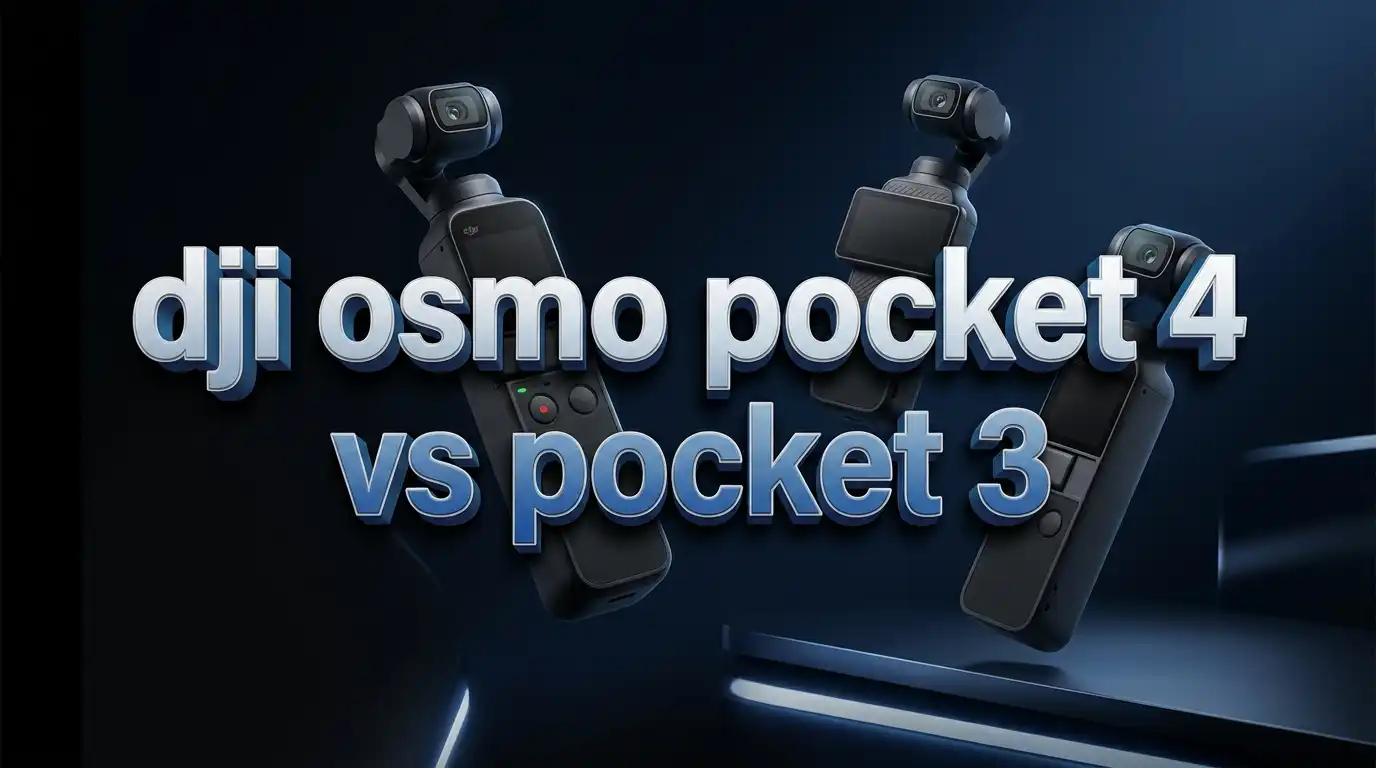
DJI Osmo Pocket 4 vs Pocket 3: Which Tiny Camera Wins?
If you love compact cameras, the DJI Osmo Pocket series has probably been on your radar. DJI just dropped the Osmo Pocket 4 on April 16, 2026, and it brings a stack of upgrades over the beloved Pocket 3. But is it worth the jump? Or does the Pocket 3 still hold its ground?
This comparison breaks down every difference that matters. We cover sensor quality, video specs, battery life, storage, tracking, price, and more. Whether you are a vlogger, traveler, or content creator, this guide will help you pick the right pocket camera.
Stick around because some of the changes might surprise you, and one detail about US availability could change your buying decision entirely.

Key Takeaways
- The DJI Osmo Pocket 4 features a stacked 1-inch CMOS sensor with 37 megapixels and 14 stops of dynamic range. The Pocket 3 uses a standard 1-inch CMOS with 9.4 megapixels and 12 stops of dynamic range. This is a huge leap in image quality.
- Slow motion doubles on the Pocket 4. It records 4K at 240fps. The Pocket 3 tops out at 4K/120fps. If you shoot action or cinematic slow motion, the Pocket 4 pulls ahead.
- 107 GB of built-in storage comes standard on the Pocket 4. The Pocket 3 has no internal storage and relies entirely on microSD cards.
- Battery life jumps to 240 minutes on the Pocket 4 (at 1080p/24fps). The Pocket 3 manages 166 minutes under the same conditions. That is 77 extra minutes of recording time.
- The Pocket 4 includes ActiveTrack 7.0, Wi-Fi 6, USB 3.1, and physical zoom and custom buttons. The Pocket 3 ships with ActiveTrack 6.0, Wi-Fi 5, USB 2.0, and a single record button.
- US availability for the Pocket 4 is uncertain as of April 2026. DJI has stated that US authorization is still pending. The Pocket 3 remains widely available on Amazon and other US retailers.
DJI Osmo Pocket 3 Overview

- Capture Stunning Footage - This vlogging camera features a 1-inch CMOS sensor and records in 4K resolution at...
- Effortlessly Frame Your Shots - Get the ideal composition with Osmo Pocket 3's expansive 2-inch touch screen...
Last update on 2026-07-01 / Affiliate links / Images from Amazon Product Advertising API
The DJI Osmo Pocket 3 launched in late 2023. It was a massive step up from the Pocket 2. DJI gave it a 1-inch CMOS sensor, which was a first for the Pocket series. It records up to 4K at 120fps and supports 10-bit D-Log M for color grading.
The Pocket 3 features a 2-inch rotatable touchscreen with 700 nits of brightness. This screen rotates between horizontal and vertical modes. Creators can frame shots for YouTube, Instagram, or TikTok without any adapters.
ActiveTrack 6.0 handles face and object tracking. It works well for solo vlogging. You point the camera at yourself, and the gimbal follows your movement. The 3-axis mechanical gimbal keeps footage smooth even during walks or runs.
The Pocket 3 weighs just 179 grams and measures 139.7 x 42.2 x 33.5mm. It fits in a jeans pocket. The 1,300 mAh battery provides about 166 minutes of recording at 1080p/24fps. It charges to 80% in just 16 minutes.
For audio, the Pocket 3 has three built-in microphones. The Creator Combo bundles a DJI Mic 2 for better sound quality. This combo remains one of the best vlogging kits under $700.
DJI Osmo Pocket 4 Overview

- Superior Low-Light Performance with 1/1.3-inch Sensor - Struggling with grainy footage in low light? Osmo...
- Pro-Grade Color Science - Worried your videos lack real-life colors? 10-bit color depth captures subtle...
Last update on 2026-07-01 / Affiliate links / Images from Amazon Product Advertising API
The DJI Osmo Pocket 4 arrived on April 16, 2026. It targets serious creators who want professional-grade footage from a pocket-sized camera. DJI upgraded almost every core component.
The headline feature is the stacked 1-inch CMOS sensor with 37 megapixels and 14 stops of dynamic range. This sensor captures more light and detail than the Pocket 3’s sensor. DJI also bumped slow motion to 4K/240fps, which opens up creative options for cinematic content.
DJI replaced D-Log M with a true 10-bit D-Log profile. This gives colorists a genuinely flat image to work with. The result is more latitude in post-production for highlights and shadows.
The body is slightly taller at 144.7 x 42.2 x 33.5mm and heavier at 198 grams. DJI added a zoom button, a custom button, and upgraded the joystick to a speed-sensitive analog design. These physical controls make shooting faster and more precise.
107 GB of built-in storage means you can start recording without any memory card. The Pocket 4 also supports microSD up to 1 TB. Wi-Fi 6 and USB 3.1 speed up file transfers. The standard combo starts at around $499 USD internationally.
Top 3 Alternatives for DJI Osmo Pocket 4
If the Pocket 4 is out of your budget or unavailable in your region, these three cameras offer excellent value for vloggers and content creators.

- Cinematic-Style Footage - Experience the power of Xtra Muse's 1-inch CMOS sensor, capable of recording...
- Ultra-Steady Shooting - No more shaky videos! Xtra Muse's advanced 3-axis gimbal camera stabilizer ensures...
Last update on 2026-07-01 / Affiliate links / Images from Amazon Product Advertising API

- Ultra-wide 18-50mm1 zoom lens gets it all in the frame
- Large 1.0-type sensor for professional results even in low-light

Last update on 2026-07-01 / Affiliate links / Images from Amazon Product Advertising API

- Sharper Action, Brighter Details - Osmo Nano's 1/1.3″ sensor captures more light for crisp, vivid shots...
- Ultra-Wide 4K Clarity - Record every moment in 4K/60fps with a 143° ultra-wide view. Ideal as a small action...
Last update on 2026-07-01 / Affiliate links / Images from Amazon Product Advertising API
The Xtra Muse is a strong budget option. It packs a 1-inch CMOS sensor, 4K/120fps recording, and a 3-axis gimbal stabilizer. It mirrors many Pocket 3 features at a lower price point around $419.
The Sony ZV-1 II is a compact vlogging camera with a 1-inch sensor, an 18-50mm equivalent zoom lens, and excellent autofocus. It does not have a built-in gimbal, but Sony’s electronic stabilization holds up well. It is a great pick if you want a wider focal range and interchangeable accessories.
The DJI Osmo Nano is DJI’s smallest wearable camera. It has a 1/1.3-inch sensor, 143-degree wide field of view, and records 4K/60fps. It is magnetic and clips onto clothing or gear. If you want a true action and POV camera, the Nano is hard to beat at $409.
Sensor and Image Quality Compared
The sensor is the heart of any camera. The Pocket 4 uses a stacked 1-inch CMOS sensor with 37 megapixels. The Pocket 3 uses a standard 1-inch CMOS sensor with 9.4 megapixels. That is nearly four times the resolution.
The stacked design on the Pocket 4 allows faster readout speeds. This reduces rolling shutter and improves performance during fast motion. It also helps with the jump to 4K/240fps without overheating issues.
Dynamic range is another big difference. The Pocket 4 captures 14 stops. The Pocket 3 captures 12 stops. Those extra two stops give you more detail in bright skies and dark shadows. For outdoor shooting in mixed lighting, this makes a visible difference.
Maximum ISO also increased. The Pocket 4 hits ISO 12,800 for photos and ISO 26,600 for video. The Pocket 3 tops out at ISO 6,400 for photos and ISO 16,000 for video. Low-light performance on the Pocket 4 should be noticeably better. Noise levels at higher ISOs will be reduced thanks to the stacked sensor architecture.
Video Recording Capabilities
Video specs tell a clear story here. The Pocket 4 records 4K at 240fps. The Pocket 3 caps at 4K at 120fps. That means the Pocket 4 can produce slow motion that is twice as smooth. For sports, dance, travel, and cinematic B-roll, this is a game-changing upgrade.
The Pocket 4 shoots exclusively in MP4 (H.265/HEVC) at 10-bit. DJI dropped H.264 support entirely. H.265 compresses video more efficiently, so files are smaller at the same quality level. The maximum bitrate reaches 180 Mbps.
The Pocket 3 supports both H.265 (10-bit) and H.264 (8-bit). The H.264 option is useful for older editing setups that struggle with H.265 decoding. However, most modern computers and phones handle H.265 without issues now.
DJI also moved from D-Log M and HLG on the Pocket 3 to a true D-Log on the Pocket 4. D-Log M was a hybrid profile. The new D-Log is genuinely flat, similar to what you get on cinema cameras. If you color grade your footage, the Pocket 4 delivers far more flexibility in post.
Stabilization and Gimbal Performance
Both cameras use a 3-axis mechanical gimbal for stabilization. The physical gimbal design has not changed dramatically between the two models. DJI’s gimbals are industry-leading, and both the Pocket 3 and Pocket 4 produce buttery smooth footage during walks, runs, and pans.
The Pocket 4 adds a speed-sensitive analog joystick. This joystick responds to how hard you push it. A gentle push creates a slow pan. A firm push speeds up the movement. The Pocket 3 uses a standard multi-function joystick that operates at a fixed speed.
This upgrade matters for filmmakers who want precise gimbal control. Smooth, gradual pans look more professional. The old joystick on the Pocket 3 sometimes felt jerky during slow movements.
The Pocket 4 also introduced a gimbal head protective cover in the box. This cover locks the gimbal in place during transport. It prevents accidental damage. The Pocket 3 did not include such a cover, and many users bought third-party protectors. DJI clearly listened to community feedback on this one.
Tracking and Autofocus
DJI upgraded the tracking system from ActiveTrack 6.0 on the Pocket 3 to ActiveTrack 7.0 on the Pocket 4. The newer version adds support for 2x and 4x zoom tracking. It can now track subjects even when you zoom in.
ActiveTrack 7.0 also improves subject recognition. It recognizes pets and vehicles in addition to faces and general objects. If you film your dog running in the park, the Pocket 4 will track it more reliably.
Both cameras use full-pixel fast focusing. The Pocket 3 already had impressive autofocus speed. The Pocket 4 maintains this and adds the improved tracking layer on top. For solo vloggers, the combination of better tracking and physical control buttons makes the Pocket 4 a much smoother experience.
The Pocket 4 also features a 2x lossless zoom. This gives you a tighter frame without losing resolution. The Pocket 3 offers digital zoom, but it crops into the image and reduces quality. Lossless zoom is a significant creative tool for vloggers who want close-up shots without moving closer.
Battery Life and Charging
Battery life is one of the most practical upgrades on the Pocket 4. The Pocket 4’s 1,545 mAh battery delivers 240 minutes of recording at 1080p/24fps. The Pocket 3 manages 166 minutes with its 1,300 mAh battery.
That is 77 extra minutes of recording time. For travel vloggers and event shooters, this extra runtime removes the stress of running out of power mid-shoot.
Charging speeds are similar. The Pocket 4 reaches 80% in 18 minutes and 100% in 32 minutes. The Pocket 3 hits 80% in 16 minutes and 100% in 32 minutes. The two-minute difference at the 80% mark is negligible.
Both cameras use USB-C for charging. The Pocket 4 upgrades to USB 3.1, which also means faster data transfers. You can dump large files to your laptop in a fraction of the time compared to the Pocket 3’s USB 2.0 connection.
Storage Options

- Capture Stunning Footage - Osmo Pocket 3 features a 1-inch CMOS sensor and records in 4K resolution at an...
- Effortlessly Frame Your Shots - Get the ideal composition with Osmo Pocket 3's expansive 2-inch touch screen...
Last update on 2026-06-09 / Affiliate links / Images from Amazon Product Advertising API
The Pocket 4 includes 107 GB of built-in storage. This is a first for the Pocket series. You can start recording straight out of the box without inserting a memory card. The internal storage supports write speeds up to 800 MB/s.
The Pocket 3 has no internal storage. It relies entirely on microSD cards (up to 1 TB). If you forget your card, you cannot record. This has been a common frustration among Pocket 3 users, especially during travel.
The Pocket 4 still accepts microSD cards up to 1 TB. So you get the built-in storage plus expandable storage. This is a best-of-both-worlds setup.
For creators who record long sessions, the combination of 107 GB internal + 1 TB microSD gives you over a terabyte of total storage. At 4K/120fps with H.265, you can record hours of footage before worrying about space.
The faster USB 3.1 connection on the Pocket 4 also means transferring those large files is much quicker. The Pocket 3’s USB 2.0 port bottlenecks file transfers, especially with 4K footage that runs into tens of gigabytes per session.
Design and Build Quality
Both cameras share the same width and depth at 42.2 x 33.5mm. The Pocket 4 is slightly taller at 144.7mm compared to the Pocket 3’s 139.7mm. The extra 5mm accounts for the larger battery and improved sensor module.
The Pocket 4 weighs 198 grams. The Pocket 3 weighs 179 grams. The 19-gram difference is barely noticeable in hand. Both cameras still fit comfortably in a pocket or small bag.
DJI added dedicated physical buttons to the Pocket 4. You get a record button, zoom button, and custom button. The Pocket 3 only has a single record button. The additional buttons reduce your dependence on the touchscreen during shooting.
The Pocket 4’s lens module is larger than the Pocket 3’s. Some early users have noted this could make the camera slightly more fragile. DJI addresses this with the included gimbal head protective cover. The Pocket 3 came with a simpler fabric case in the Creator Combo.
Both cameras retain the 2-inch rotatable touchscreen with 556 x 314 resolution and 700 nits brightness. The screen flips between portrait and landscape mode. The display quality and responsiveness are identical.
Connectivity and Software
The Pocket 4 upgrades to Wi-Fi 6 and USB 3.1. The Pocket 3 uses Wi-Fi 5 and USB 2.0. These upgrades matter for transferring footage to your phone or laptop.
Wi-Fi 6 offers faster and more stable wireless connections. If you transfer clips to the DJI Mimo app on your phone, the Pocket 4 will finish the job quicker. This saves time, especially when you want to edit and post on the go.
USB 3.1 is a huge upgrade for wired transfers. USB 2.0 on the Pocket 3 maxes out at 480 Mbps. USB 3.1 supports speeds up to 10 Gbps. With 4K/240fps files, this speed difference becomes very noticeable during offloading.
Both cameras work with the DJI Mimo app for remote control, live preview, and editing. The Pocket 4 also supports the DJI Mic 3 (included in the Creator Combo). The Pocket 3 Creator Combo comes with the DJI Mic 2. The Mic 3 offers improved noise reduction and longer wireless range.
DJI also added a magnetic fill light attachment on the Pocket 4. This small LED clips onto the gimbal head using magnets. It provides soft front-facing light for low-light vlogging. The Pocket 3 has no native fill light support.
Price and Value for Money
The DJI Osmo Pocket 3 standard version sells for around $499 on Amazon US. The Creator Combo goes for about $609. These prices have remained stable since launch.
The DJI Osmo Pocket 4 standard combo is priced at around $499 USD internationally (approximately RMB 2,999). The Creator Combo costs about $649 USD (approximately RMB 3,799). Interestingly, DJI has lowered the launch price compared to the Pocket 3’s original pricing.
However, there is a major catch for US buyers. As of April 2026, the Pocket 4 is not officially available in the US market. DJI states that “the application for authorization is still pending.” Some third-party sellers may offer it, but there is no official US retail presence yet.
For US-based creators, the Pocket 3 remains the safest buy right now. It offers proven performance, full warranty support, and easy access to accessories. International buyers who can purchase the Pocket 4 get a significant upgrade at a competitive price point.
Creator Combo Comparison
The Pocket 3 Creator Combo includes the DJI Mic 2, a battery handle, mini tripod, 1/4-inch threaded handle, wide-angle lens adapter, a rigid protective case, a carrying bag, and a PD charging cable.
The Pocket 4 Creator Combo includes the DJI Mic 3, a magnetic mini fill light, gimbal clamp, battery handle, mini tripod, 1/4-inch thread adapter, wide-angle lens adapter, a soft carrying pouch, a carrying bag, and a PD charging cable.
The biggest additions in the Pocket 4 combo are the DJI Mic 3 and the magnetic fill light. The Mic 3 is a newer wireless microphone with better noise cancellation. The magnetic fill light is unique to the Pocket 4 and adds a practical tool for indoor or nighttime shooting.
One downside is that the Pocket 4 combo uses a soft carrying pouch instead of the rigid protective case found in the Pocket 3 combo. If you travel frequently and need maximum protection, you may need to buy a hard case separately. This feels like a slight step backward in packaging.
Who Should Buy the Pocket 3?
The DJI Osmo Pocket 3 is the right choice for several types of buyers. If you live in the US, the Pocket 3 is your only official option right now. It ships from Amazon with full warranty and fast delivery.
Budget-conscious creators will also prefer the Pocket 3. At $499 for the standard model, it delivers excellent 4K/120fps video, a 1-inch sensor, and reliable 3-axis stabilization. The image quality holds up well for YouTube, Instagram Reels, and TikTok content.
If you use older editing software that struggles with H.265, the Pocket 3’s H.264 option gives you more compatibility. Not every creator has a powerful editing rig. The Pocket 3 lets you choose between efficiency and compatibility.
Beginners and casual vloggers will find the Pocket 3 easier to pick up. Its simpler button layout and lighter weight make it less intimidating. It does everything a typical content creator needs without overcomplicating the experience.
Who Should Buy the Pocket 4?
The DJI Osmo Pocket 4 is built for creators who want the best pocket camera available in 2026. If you shoot cinematic content, the 4K/240fps slow motion and true D-Log profile provide tools that rival cameras costing twice as much.
Frequent travelers will love the 107 GB of built-in storage. No more scrambling for memory cards. Start recording the moment inspiration strikes. The improved battery life (240 minutes) also means fewer interruptions during long shooting days.
Professional vloggers and filmmakers who color grade their footage will appreciate the flat D-Log profile and 14 stops of dynamic range. The jump from D-Log M to true D-Log gives you more room to push and pull exposure in post-production.
If you live outside the US and can purchase the Pocket 4 at its launch price of around $499, the value proposition is strong. You get a better sensor, faster connectivity, more storage, and longer battery life for the same or lower price than the Pocket 3’s launch cost.
Final Verdict: DJI Osmo Pocket 4 vs Pocket 3
The DJI Osmo Pocket 4 is objectively the better camera. It wins in sensor quality, video specs, battery life, storage, tracking, and connectivity. DJI delivered meaningful upgrades across the board rather than a minor refresh.
However, the Pocket 3 is still an excellent camera in 2026. It remains widely available, especially in the US. Its 4K/120fps capability, 1-inch sensor, and proven reliability make it a safe and satisfying purchase.
If you can buy the Pocket 4, buy the Pocket 4. If US availability or budget limits your options, the Pocket 3 will serve you well. Both cameras produce fantastic footage from a device that fits in your palm. You really cannot go wrong with either choice.
Frequently Asked Questions
Is the DJI Osmo Pocket 4 available in the US?
As of April 2026, the DJI Osmo Pocket 4 is not officially available in the US market. DJI has stated that the application for US authorization is still pending. The camera received FCC approval before the December 2025 cutoff, so some third-party retailers like B&H may carry it. Check current listings for the latest availability updates.
How much does the DJI Osmo Pocket 4 cost?
The DJI Osmo Pocket 4 standard combo is priced at approximately $499 USD (RMB 2,999). The Creator Combo costs around $649 USD (RMB 3,799). This is actually cheaper than the Pocket 3’s original launch prices. Pricing may vary by region and retailer.
Can the DJI Osmo Pocket 4 record without a memory card?
Yes. The Pocket 4 includes 107 GB of built-in storage with write speeds up to 800 MB/s. You can record 4K footage straight out of the box without inserting any microSD card. The Pocket 3 cannot record without a microSD card.
Is the DJI Osmo Pocket 3 still worth buying in 2026?
Absolutely. The Pocket 3 remains a top-tier pocket vlogging camera. It records 4K/120fps, has a 1-inch sensor, and offers excellent stabilization. It is widely available on Amazon US at $499 for the standard version. For most creators, it still delivers more than enough quality and features.
What is the biggest difference between Pocket 4 and Pocket 3?
The biggest difference is the sensor upgrade. The Pocket 4 uses a stacked 1-inch CMOS with 37 megapixels and 14 stops of dynamic range. The Pocket 3 has a standard 1-inch CMOS with 9.4 megapixels and 12 stops of dynamic range. This impacts resolution, low-light performance, and color grading potential.
Does the DJI Osmo Pocket 4 support external microphones?
Yes. The Pocket 4 Creator Combo includes the DJI Mic 3 wireless microphone. The camera supports DJI’s wireless microphone ecosystem for clear audio recording. It also has built-in microphones for quick recording without external accessories.

DK is a technology expert who specializes in AI tools, software, and tech gadgets. He writes for How to Tech Info, providing detailed reviews and practical guides. DK helps readers discover the best AI applications, navigate new software, and choose the right tech gadgets.