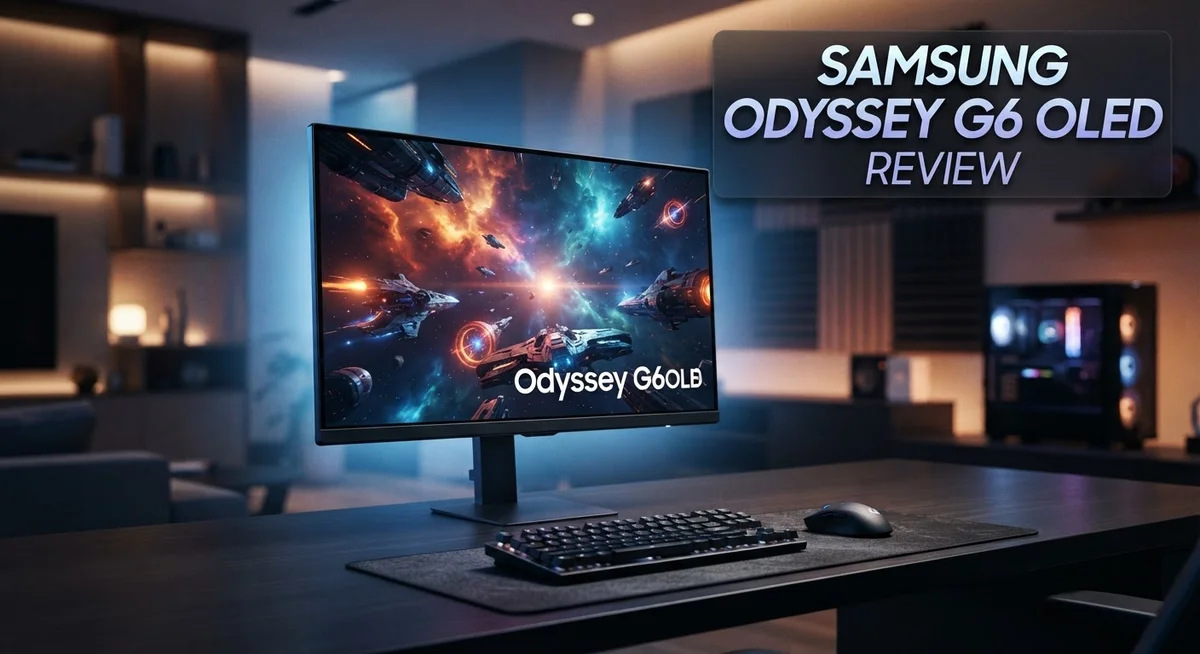
Samsung Odyssey G6 OLED Gaming Monitor Review: Worth It?
Gamers want fast screens. They also want deep, rich colors. The Samsung Odyssey G6 OLED promises both.
This monitor packs a 27 inch QD-OLED panel. It runs at QHD resolution for sharp, clear images. Speed lovers will love the 360Hz refresh rate.
Blacks look truly black on this screen. Colors pop with amazing vibrance. OLED technology makes every scene feel alive.
Is this the upgrade your setup needs? We tested the G6 OLED to find out. This review covers its display quality, speed, and design.
We also compare it to other OLED monitors on the market. You will learn its true strengths. You will also learn where it might fall short.
Let’s explore what makes this monitor special.
In a Nutshell
The Samsung Odyssey G6 OLED brings serious speed to your desk. Here is what stands out most.
-
360Hz refresh rate: Motion stays smooth even in fast paced games. Your reflexes get the support they deserve.
-
0.03ms response time: Ghosting becomes a thing of the past. Every frame feels sharp and clean.
-
AMD FreeSync Premium Pro: Screen tearing disappears during intense sessions. Gameplay looks steady and fluid.
-
Wide 178 degree viewing angles: Colors stay accurate from almost any seat. Friends watching beside you get the same great view.
-
Anti-glare coating: Reflections stay minimal under bright lights. Your eyes stay focused on the action, not the glare.
-
Burn-in risk exists with this panel type. Heavy static image use may cause issues over time.
This monitor suits gamers who value speed above all else. Careful use helps this screen last longer and perform better every day.
Display Technology and Panel Quality
The Samsung Odyssey G6 OLED uses a 27 inch QD-OLED panel with QHD resolution (2560×1440). This combination delivers exceptional picture quality for competitive gaming and content creation.
QD-OLED technology sets this monitor apart from standard LCD screens. Each pixel produces its own light, meaning blacks reach true black levels with infinite contrast ratios. You won’t see this depth on regular monitors because they use backlighting that always produces some gray tone in dark areas.
The panel maintains excellent uniformity across the entire display. This means colors stay consistent whether you look at the center or edges. Gamers benefit from this because crosshairs and UI elements appear the same everywhere on screen. Content creators appreciate uniform color accuracy for photo and video work.
Viewing angles stretch to 178 degrees horizontally and vertically. You can sit off to the side or at different heights without color shifts or contrast loss. This wide viewing area makes the monitor practical for shared gaming sessions or when multiple people need to see the screen.
The anti-glare coating reduces reflections from overhead lights and windows. This coating sits on top of the panel without making the image look grainy or washed out. Your screen stays readable in bright rooms without annoying reflections.
Response time measures just 0.03 milliseconds, making pixel transitions nearly instantaneous. Fast moving objects in games like shooters and racing titles appear crisp without motion blur. The 360Hz refresh rate works hand-in-hand with this speed to keep motion smooth and fluid.
Color vibrancy stands out on this panel. The QD-OLED technology produces saturated reds, greens, and blues without sacrificing accuracy. Games look visually stunning, and movies display with cinematic quality.
One important consideration involves burn-in risk. OLED panels can develop permanent image ghosting if static images stay on screen for extended periods. Samsung includes protective features, but you should use screen savers during breaks and avoid leaving the same image displayed for hours.
The brightness reaches 250 cd/m², which suits gaming in most indoor lighting conditions. Very bright rooms or outdoor use might feel limited compared to LCD monitors that reach 400+ cd/m².

- Samsung’s 27” Odyssey OLED G6 Gaming Monitor is engineered for perfection with a QD-OLED Display featuring...
- OLED Safeguard technology supports performance by actively helping to prevent burn-in with a thermal...

Last update on 2026-09-13 / Affiliate links / Images from Amazon Product Advertising API
Refresh Rate and Response Time Performance
When you’re gaming at high speeds, your monitor needs to keep up. The Samsung Odyssey G6 OLED delivers exactly that with its 360Hz refresh rate and 0.03ms response time.
Let’s break down what these numbers mean for your gameplay. A 360Hz refresh rate means the screen updates 360 times every single second. This creates buttery smooth motion, especially in competitive shooters and fast action games. Your eyes notice the difference immediately when you move your mouse or camera around the map.
The response time tells a different story. At just 0.03 milliseconds, this monitor ranks among the fastest available. Pixel transitions happen almost instantly. When a new frame arrives, each pixel switches to its new color without delay. This eliminates ghosting, where moving objects leave blurry trails behind them.
Together, these specs create a performance package built for competitive gaming. You won’t see motion blur during quick turns or rapid camera movements. Enemies stay sharp and clear even when things get chaotic on screen.
AMD FreeSync Premium Pro technology adds another layer of smoothness. This feature syncs your graphics card’s output with the monitor’s refresh rate. Screen tearing vanishes, and gameplay feels more fluid overall. Whether you’re running 200fps or 360fps, the monitor adapts seamlessly.
The 27 inch QHD resolution supports this speed without sacrificing detail. Your games run at 2560×1440 pixels, giving you sharp visuals alongside that rapid refresh rate. You get clarity and speed in one package.
One thing to understand: this monitor shines brightest for competitive gaming. If you play fast paced titles, you’ll feel the benefit of 360Hz immediately. The responsiveness becomes second nature during intense matches.
For casual gaming or everyday tasks, you might not notice a huge difference compared to 240Hz alternatives. But if you’re serious about competitive play, the speed advantage here is real. Your reaction time stays sharp because your monitor keeps pace with your gameplay.
Color Accuracy and Visual Clarity
When you look at the Samsung Odyssey G6 OLED, color accuracy jumps out immediately. The QD-OLED panel delivers colors that feel alive and true to life. Blacks appear genuinely deep because OLED pixels emit their own light and can turn completely off.
The 250 cd/m² brightness level handles most gaming scenarios well. You get punchy highlights without losing detail in dark areas. This balance matters when you’re playing games with mixed lighting conditions.
Color uniformity stays excellent across the entire 27 inch display. You won’t notice color shifts or brightness changes as your eyes move from center to edges. The 178 degree viewing angles mean colors remain accurate even when you sit off to the side.
The anti-glare coating plays a smart role here. It reduces reflections without washing out colors or creating a grainy look. Overhead lights and window glare won’t interfere with what you see on screen.
Visual clarity benefits from the QHD resolution (2560×1440) combined with the 27 inch size. Text stays sharp. Game details pop. You get enough pixels per inch for crisp visuals without requiring a powerful graphics card to maintain high frame rates.
Pixel responsiveness at 0.03ms means motion looks incredibly clean. When characters or objects move quickly, you see smooth transitions instead of blurring or ghosting. This matters in competitive shooters and fast action games where every frame counts.
The OLED technology itself enhances clarity in ways LCD monitors cannot match. Each pixel responds independently, giving you infinite contrast ratios. Dark scenes reveal details that LCD panels struggle to show.
One consideration involves brightness limitations for HDR content. While 250 cd/m² works great for SDR gaming, some HDR games might not feel as impactful as on brighter displays. For standard gaming and everyday use, however, the brightness proves sufficient.
Overall, the Samsung Odyssey G6 OLED delivers exceptional color accuracy and visual clarity that competitive gamers and creative professionals will appreciate.
Top 3 Alternatives
LG UltraGear OLED

- World's First 5K2K OLED Gaming Monitor - Gaming like never before with the world's first 5K2K WUHD (5120 x...
- 125 PPI: Sharp Text Clarity with Reduced Color Fringe - Designed with an updated subpixel layout, the 5K2K...
Last update on 2026-09-13 / Affiliate links / Images from Amazon Product Advertising API
The LG UltraGear OLED delivers stunning visuals with its self-emissive pixel technology. Each pixel produces its own light, giving you perfect blacks and infinite contrast ratios. This monitor excels at fast response times, making it ideal for competitive gaming.
The display offers vibrant colors and sharp details across the entire screen. You get smooth gameplay with high refresh rates. The OLED panel ensures no backlight bleeding or blooming effects. Gamers appreciate the rapid pixel transitions that eliminate ghosting during intense action sequences.
ASUS ROG Swift OLED

- World’s first 1440P 480Hz OLED gaming monitor
- 26.5” QHD 480Hz WOLED gaming monitor with 0.03ms response time for sharp and ultra-fast gaming visuals
Last update on 2026-06-17 / Affiliate links / Images from Amazon Product Advertising API
ASUS ROG Swift OLED combines performance with premium build quality. The monitor features advanced cooling technology to protect the OLED panel from heat damage. You’ll experience exceptional color accuracy and brightness levels.
The display supports high refresh rates for smooth, responsive gaming. The stand offers extensive adjustability for ergonomic positioning. ASUS includes gaming-focused features like customizable lighting and gaming modes. The panel delivers excellent viewing angles without color shifts. Response times remain incredibly fast, even during demanding gameplay sessions.
MSI MPG321UR-QD OLED

- 3rd Gen QD-OLED Panel – With stunning image quality and fast response time
- DisplayPort 2.1a (UHBR20) – Offering up to 80Gbps bandwidth, allowing gamers to enjoy native, lossless 4K at...
Last update on 2026-09-13 / Affiliate links / Images from Amazon Product Advertising API
The MSI MPG321UR-QD OLED brings professional-grade performance to gaming and content creation. The 32-inch screen provides ample workspace for multitasking. This monitor combines OLED technology with high resolution for stunning clarity.
The display supports wide color gamuts, making it suitable for color-critical work. Fast response times keep pace with competitive gaming demands. The monitor includes comprehensive connectivity options for various devices. Built-in calibration tools help maintain color accuracy over time. The large screen real estate gives you more room for windows and applications without sacrificing image quality or responsiveness.
Gaming Experience and Adaptive Sync Features
The Samsung Odyssey G6 OLED delivers gaming performance that adapts to your playstyle in real time. AMD FreeSync Premium Pro eliminates screen tearing and stuttering by syncing your monitor’s refresh rate with your graphics card’s output. This means smoother visuals during intense firefights and fast-paced action sequences.
The 360Hz refresh rate works hand in hand with FreeSync to create fluid motion. Your eyes perceive gameplay as continuous and responsive rather than choppy or delayed. When you’re tracking moving targets or executing quick turns, this synchronization becomes immediately noticeable.
Adaptive sync technology shines most in competitive titles where milliseconds matter. Games like CS2, Valorant, and Apex Legends benefit tremendously from the variable refresh rate support. You get consistent frame delivery without the visual artifacts that plague unsynchronized displays.
The 0.03ms response time pairs perfectly with these adaptive features. Fast pixel transitions prevent ghosting and motion blur that could otherwise undermine FreeSync’s smoothness. Your monitor responds instantly to input changes, keeping gameplay sharp and clear.
One practical advantage involves flexibility across different gaming scenarios. If your frame rate dips below 360Hz, FreeSync maintains smooth performance instead of causing stuttering. If your GPU pushes beyond the monitor’s maximum, AMD’s technology prevents screen tearing that would otherwise distract you.
The QHD resolution at 27 inches supports high frame rates without overwhelming your graphics card. You get sharp detail and smooth motion simultaneously, which matters for competitive and casual gaming alike.
Important to note: FreeSync Premium Pro requires a compatible AMD graphics card to function. NVIDIA users won’t access these adaptive sync benefits. However, NVIDIA cards still work fine with the monitor at full 360Hz performance.
The combination of fast response time, high refresh rate, and adaptive sync creates a responsive gaming environment. Whether you prioritize competitive advantage or smooth visual experience, these features work together to deliver consistent performance. The monitor adapts to your hardware setup rather than forcing rigid limitations on your gameplay.
Brightness Levels and Viewing Angles
The Samsung Odyssey G6 OLED reaches 250 cd/m² brightness, which handles most gaming situations effectively. This output sits in the middle range for gaming monitors. You’ll see vibrant colors and clear details during intense gameplay sessions.
The 178 degree viewing angles (both horizontal and vertical) mean you can sit off to the side and still see the screen clearly. This matters if multiple people watch your gaming or if you move around your desk. OLED technology naturally provides these wide angles without color shift or contrast loss.
Brightness performance shines most in darker environments. When you’re in a dimly lit room, the 250 cd/m² output feels more than sufficient. The deep blacks that OLED delivers make the brightness feel even more dramatic by comparison.
However, one limitation exists for HDR content creators or those who work in very bright rooms. The 250 cd/m² brightness doesn’t match some LCD alternatives that reach 500 cd/m² or higher. If you sit near a window with direct sunlight, you might struggle to see the screen clearly.
The anti-glare coating works alongside brightness to reduce reflections. This coating helps you see the display better without needing extreme brightness levels. The combination creates a balanced viewing experience for most users.
The QHD resolution at 27 inches maintains sharpness across the entire screen thanks to these viewing angles. You won’t see image degradation as you look from the center toward the edges. This consistency supports competitive gaming where you need to track action everywhere on screen.
OLED’s self-emissive pixels mean each pixel produces its own light. This technology eliminates the need for a backlight, which improves both brightness uniformity and viewing angles compared to LCD panels. You get consistent brightness whether you look straight ahead or from an angle.
The 360Hz refresh rate pairs well with these viewing characteristics. Fast motion appears smooth from any viewing position on the screen. This responsiveness combined with wide angles creates an immersive gaming environment where you stay competitive no matter where you sit.
Pros and Cons
Pros
- OLED technology delivers exceptional contrast with deep blacks that LCD monitors simply cannot match
- The 0.03ms response time keeps motion incredibly clean during fast paced gameplay
- 360Hz refresh rate paired with FreeSync Premium Pro creates fluid, adaptive performance across different games
- 178 degree viewing angles let you see the screen clearly even when sitting off to the side
- QHD resolution at 27 inches maintains sharp visual clarity without taxing your graphics card
Cons
- OLED panels carry a burn in risk over extended periods, especially with static images on screen
- 250 cd/m² brightness limits performance in very bright rooms or for HDR content work
- FreeSync Premium Pro requires a compatible AMD graphics card to unlock full adaptive sync benefits
Who Should Buy It
This monitor works best for competitive gamers who demand peak performance. If you play fast-paced shooters or fighting games, the 360Hz refresh rate and 0.03ms response time give you a real edge. Your opponents won’t have faster reaction times on their screens.
The Samsung Odyssey G6 OLED shines for esports players specifically. Professional gamers in titles like Valorant, Counter-Strike, and Apex Legends benefit most from these specs. You get the smoothest possible motion without motion blur or ghosting.
Content creators should think carefully before buying. The 250 cd/m² brightness works for video editing in normal lighting, but it falls short if you work in bright studios. OLED burn-in becomes a real concern if you keep static UI elements on screen for hours each day. Video timelines and toolbars could leave permanent marks.
This monitor suits console gamers with PS5 or Xbox Series X who want next-gen visuals. The QHD resolution and OLED colors make games look stunning. However, console support for 360Hz doesn’t exist yet, so you won’t use that full refresh rate.
Casual gamers might find this overkill. You don’t need 360Hz for single-player games or slower-paced titles. A standard 144Hz monitor handles those games perfectly well.
Avoid this monitor if you work in bright rooms. The 250 cd/m² brightness simply won’t compete with sunlight or office lighting. Glare becomes frustrating even with the anti-glare coating.
Streamers should reconsider too. Keeping overlays and chat windows stationary for hours creates burn-in risk. You’d need to constantly move elements around to stay safe.
The Samsung Odyssey G6 OLED targets one specific audience above all: serious competitive gamers who play demanding titles regularly and sit in controlled lighting. If that describes you, this monitor delivers performance that few alternatives match. For everyone else, the burn-in risk and brightness limits make other options safer choices.
Final Verdict
The Samsung Odyssey G6 OLED stands out as a focused gaming display. It delivers sharp motion, deep contrast, and reliable color accuracy in one package.
This monitor earns its place among top QD-OLED screens. It combines speed and clarity in a way few competitors match at this size.
Flicker free technology adds another benefit worth noting. Your eyes stay comfortable during long gaming sessions without added strain.
If you compare it to the ASUS XG32UCWMG, the G6 OLED trades screen size for a tighter, more desk friendly footprint. Some players prefer this smaller form factor for faster reaction times.
Samsung’s own lineup also offers alternatives. The Odyssey G61SD and G81SF share the same 27 inch frame, while the G80SD and G85SD step up to larger panels for players who want more screen space.
Choosing between these models comes down to your room setup and viewing distance. The G6 OLED fits smaller desks and closer seating positions well.
Overall, this monitor rewards players who value speed above all else. It handles fast paced games without hesitation and keeps visuals crisp throughout.
Durability remains the main tradeoff. Anyone worried about long term burn in risk should weigh this carefully before committing to daily use.
For gamers who rotate content and avoid static images for long periods, this concern becomes less pressing. Regular use patterns help reduce that risk naturally.
The Samsung Odyssey G6 OLED earns a strong recommendation for its target audience. It fits competitive play, esports training, and console gaming setups especially well.
Those outside this core group might find better value elsewhere in Samsung’s broader OLED range. Bigger panels or different brightness levels could suit specific needs better.
In short, this monitor delivers exactly what it promises. It performs where it matters most and stays consistent across demanding gaming sessions.
Frequently Asked Questions
Is the Samsung Odyssey G6 OLED good for console gaming?
Yes, it works well for PS5 and Xbox Series X owners. The 360Hz refresh rate and 0.03ms response time deliver smooth gameplay even though consoles max out at 120Hz. You get vibrant colors and deep blacks from the OLED panel. The QHD resolution stays sharp on a 27″ screen without demanding too much from your console.
One catch: the 250 cd/m² brightness may feel limited during daytime play in bright rooms. Console gamers in darker spaces will see the best results.
Will the screen get burn-in if I leave it on all day?
OLED burn-in is a real risk with extended static images. Static logos, UI elements, or taskbars can leave permanent marks over months of continuous use. The Samsung Odyssey G6 OLED includes flicker-free technology, but this doesn’t prevent burn-in.
You should use screensavers, change your wallpaper often, and avoid leaving the same content on screen for hours. If you game casually or rotate between different games, your burn-in risk stays low.
Can I use this monitor for photo editing?
It’s not ideal for professional color work. The 250 cd/m² brightness falls short for accurate HDR editing. The 178° viewing angles help when multiple people view your work, but brightness limits your ability to see shadow details properly.
Competitive gamers will love this screen. Content creators should explore other options with higher brightness and wider color gamut certifications.
How does the G6 OLED compare to the ASUS XG32UCWMG?
The ASUS model offers a larger 32″ screen, while the Samsung stays at 27″. Both use OLED technology for stunning contrast. The Samsung fits better on smaller desks and maintains excellent uniformity. The ASUS gives you more screen real estate if you sit farther back.
Your choice depends on your desk space and viewing distance.

DK is a technology expert who specializes in AI tools, software, and tech gadgets. He writes for How to Tech Info, providing detailed reviews and practical guides. DK helps readers discover the best AI applications, navigate new software, and choose the right tech gadgets.