
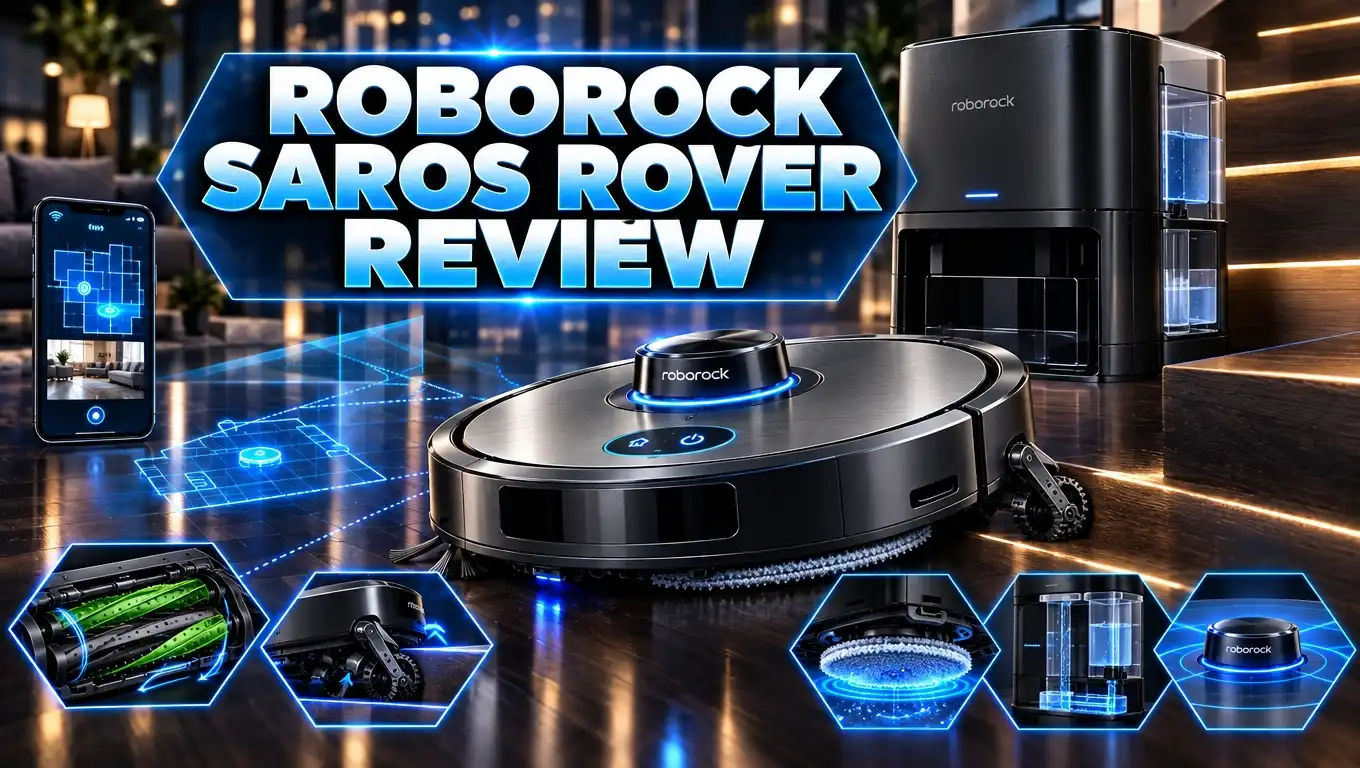
Roborock Saros Rover Review: Stair Climbing Robot Vacuum?
Robot vacuums have one big weakness. They cannot climb stairs. If you live in a two story home, you know the pain. You carry the robot up. You carry it back down. You still vacuum the stairs by hand.
Roborock wants to end that. The Saros Rover has two wheel legs that let it climb stairs and clean each step on the way up. It won a Best of CES 2026 award from CNET. This review covers everything we know: how it works, what it does well, what is still unknown, and whether you should wait for it.
In a Nutshell
- World’s first wheel leg robot vacuum: The Saros Rover uses two legs with wheels. Each leg lifts and lowers on its own. This keeps the body level on stairs, slopes, and uneven floors.
- It cleans stairs, not just climbs them: Rivals like the Eufy Marswalker and Dreame CyberX carry a robot between floors. The Rover cleans every step as it climbs. That is a real first for the category.
- Smart movement: Roborock uses AI, motion sensors, and 3D spatial data. In demos, the Rover made sudden stops, sharp turns, and small jumps. It even dodged tennis balls thrown at it.
- Slow but steady: At CES, it climbed about five large steps in 30 to 40 seconds. It worked on curved and carpeted stairs too.
- No price or release date yet: As of September 2026, Roborock has not shared a price or launch date. Experts expect it to cost at least as much as the Saros Z70, which launched at $2,599.
- Our take: If you have a multilevel home, the Rover is worth watching. If you need a robot today, buy one of the alternatives below.
What Is the Roborock Saros Rover?
The Saros Rover is a robot vacuum with legs. Roborock revealed it at CES 2026 in Las Vegas. It is still in development, but Roborock says it is a real product that will come to market.
Most robot vacuums roll on fixed wheels under a flat body. The Rover works differently. Each wheel sits at the end of a folding leg. Those legs can reach, lift, and push the body up.
The goal is simple. Roborock wants to remove the no go zones in your home. Stairs, tall thresholds, and sunken rooms stop normal robots. The Rover treats them as places it can reach and clean.
This is a big idea. In 2025, Roborock added a robotic arm to the Saros Z70 so it could pick up socks. Arms help a robot deal with clutter. Legs help a robot reach more of your home. Vacuum Wars called legs a possible “category shift” for robot vacuums.
The Rover also stood out at IFA 2026 in Berlin, where it made its European debut. Crowds gathered to watch it climb and hop. Roborock still did not share a price or launch date at that show.
In short, the Saros Rover is Roborock’s boldest robot so far. It aims to fix a problem the industry has ignored for over 20 years.
Roborock Saros Rover
Here is a quick look at the key facts Roborock has shared about the Saros Rover so far.
The Rover uses a two wheel leg design. Each leg moves on its own. This lets the robot keep a level body even when the floor below it changes height.
Roborock says the Rover can handle traditional stairs, curved stairs, and carpeted stairs with bullnose fronts. It can also handle slopes and multilevel room thresholds.
For navigation, the Rover uses AI algorithms, motion sensors, and 3D spatial information. Roborock has not confirmed the exact sensors. We do not know if it uses LiDAR, cameras, or both.
The robot can do things no robot vacuum has done before. It can turn sharply, stop suddenly, change direction fast, and even make small jumps. Roborock says the jumps help when it goes down steps and crosses uneven thresholds.
Some key specs are still missing. Roborock has not shared suction power, battery life, dock features, or mopping details. Those numbers matter a lot. Climbing stairs uses much more power than rolling across a floor.
We also do not know the size or weight of the final model. The CES units were early prototypes. The final product may look or behave a bit differently.
Our advice: treat the current specs as a preview, not a final sheet. We will know more when Roborock sets a launch date.
Design and Wheel Leg Build
The Rover looks strange at first. CNET said its legs look like chicken legs or frog legs. They fold up behind the body when not in use. Then they unfold to push the robot up.
The body stays flat and wide. This looks like a normal Roborock vacuum from above. The magic is under and behind it. The two wheel legs attach directly to the body. The Rover needs no extra shell, treads, or add on module.
This matters a lot. Rivals shown at IFA 2025 used large separate stair climbing units. Those units are bulky. They also carry the robot rather than letting it clean.
Each leg gives the robot reach, lift, and height. Roborock says the motion copies how humans move. When the Rover rises on its legs, it can see and move around obstacles better.
The design also helps on flat floors. The Rover can raise its body to cross tall thresholds. It can lower its body to stay stable. On a slope, it bends one leg and straightens the other to stay level.
Durability is the big question. Folding legs have joints and motors. Those parts must survive hundreds or thousands of stair climbs. Roborock has not shared any durability testing yet.
Still, the build shows real engineering. It is the first robot vacuum design where the legs are part of the robot itself.
Stair Climbing and Stair Cleaning Performance
This is the main event. The Saros Rover climbs stairs and cleans them at the same time.
Here is how it works. The Rover places its two legs on the step below. It pushes its body up until it is level with the next step. It rolls forward onto that step. Then it folds its legs back up. It repeats this for every step.
At CES, CNET watched the Rover climb and clean the same stairs many times without problems. It took about 30 to 40 seconds to climb five large steps. That is slow compared to a person. But it cleans as it goes, so the speed makes sense.
To clean a step, the Rover keeps one leg on the step below for balance. Then it rolls back and forth across the step. This makes sure the whole surface gets cleaned before it moves up.
This is what makes the Rover special. Eufy told reporters its Marswalker cannot clean stairs. Dreame’s CyberX prototype cannot either. They only move a robot between floors.
Roborock says the Rover works on curved stairs and carpeted stairs with rounded bullnose edges. These are hard shapes for any machine.
Safety is still an open question. Falling down stairs could damage the robot or hurt a pet. We need real home testing before we can trust it on every staircase.
Top 3 Alternative for Roborock Saros Rover
The Saros Rover is not for sale yet. If you need a great robot vacuum now, these three Roborock models are strong choices. None of them climb stairs, but they all offer top level cleaning today.
Roborock Saros Z70

- Revolutionary OmniGrip Mechanical Arm – A Robotic Cleaner & Helper: Experience the robotic vacuum with a...
- Ultimate Cleaning Coverage – Intelligent Multi-Pass Cleaning: Forget pre-cleaning! The Saros Z70 detects...
Last update on 2026-07-01 / Affiliate links / Images from Amazon Product Advertising API
The Saros Z70 is Roborock’s robot with a mechanical arm. Its five axis OmniGrip arm picks up small items like socks and tissues. Then it keeps cleaning. It offers 22,000 Pa suction and a slim 3.14 inch body. It launched at $2,599, but sale prices now land near $2,000. Pick this if clutter is your biggest problem.
Roborock Saros 20

Last update on 2026-08-16 / Affiliate links / Images from Amazon Product Advertising API
The Saros 20 is a flagship with 36,000 Pa suction. Its AdaptiLift Chassis 3.0 lifts the robot over tall double layer thresholds. It has dual anti tangle brushes for pet hair. It launched in North America at $1,599.99. This is the best pick for homes with tall room transitions.
Roborock Saros 20 Flow

Last update on 2026-09-25 / Affiliate links / Images from Amazon Product Advertising API
The Saros 20 Flow launched in the US on September 14, 2026, at $1,699.99. It uses a self cleaning roller mop that spins at 240 RPM with 16 water outlets. It also offers 36,000 Pa suction and a 3.54 inch body. Pick this if you care most about mopping hard floors.
AI Navigation and Obstacle Response
Legs mean nothing without a smart brain. The Rover’s software is where the magic happens, according to CNET.
Roborock says the Rover pairs AI algorithms with motion sensors and 3D spatial data. This lets the legs react to the world around them in real time. The robot does not just see an obstacle. It decides how its body should move.
The best demo involved tennis balls. Roborock engineers threw tennis balls at the Rover. The robot spotted them and moved out of the way. Roborock said this shows how the Rover reacts to fast moving objects like pets and kids.
That is a big step forward. Most robot vacuums move slowly and carefully around obstacles. They struggle with moving targets. The Rover seems quick and confident instead.
Obstacle avoidance is still hard for every brand. Even top robots sometimes run into cords or pet waste. Most of these failures come from software, not hardware. If Roborock’s software works this well in real homes, the Rover will lead the market.
Roborock already has strong AI in other models. The Saros 20 Flow, for example, recognizes over 300 types of objects. The Rover will likely build on this system.
We still need proof. A demo booth is clean and controlled. Your living room has cables, toys, and shoes. Real home testing will show how smart the Rover really is.
Balance, Slopes and Small Jumps
The Rover does more than climb stairs. It also shows amazing balance for a robot vacuum.
At CES, the Rover rolled down a steep ramp. It controlled its speed the whole way. It stopped partway down and reversed back up. CNET said it had never seen another robot vacuum do that.
The secret is the independent legs. On a slope, the Rover bends one leg and straightens the other. This keeps its body level. It can even spin around in the middle of a slope and stay balanced.
Then there are the jumps. Yes, this robot vacuum can hop. In one demo, it jumped over laser lines. In another, it danced on stage next to a group of Saros Z70 robots waving their arms.
Why would a vacuum need to jump? Roborock says jumping helps when the Rover goes down steps. It also helps it cross uneven thresholds and stay stable.
Not everyone sees the need for slope skills. CNN pointed out that few homes have steep inclines inside. That is fair. But ramps, sunken living rooms, and uneven old floors are common. Better balance helps in all of these places.
The demos were not perfect. CNET saw the Rover stumble once. It seemed to recover, but a staff member picked it up quickly. For an early prototype, that is a very good result.
Cleaning Power: What We Know So Far
This is the weakest part of our review, and we want to be honest. Roborock has not shared suction or battery specs for the Rover.
We do know Roborock’s current flagships are very strong. The Saros 20 and Saros 20 Flow both claim 36,000 Pa suction. The Saros Z70 offers 22,000 Pa. It is fair to expect the Rover to land somewhere in this range.
But the Rover has a harder job. It must power two motorized legs and a vacuum. Stair climbing uses a lot of battery. Vacuum Wars listed battery life as one of the biggest unknowns.
We also do not know about mopping. Most Roborock flagships vacuum and mop. Mopping stairs would be tricky. Wet stairs could be slippery for the robot and for your family.
The dock is another question. Roborock’s top docks empty the bin, wash mops in hot water, and dry them. We do not know if the Rover will come with a full dock. It also needs a way to return to the dock from another floor.
Here is the key point. The Rover’s value is not raw suction. Its value is reach. A robot that cleans your stairs and every floor has a huge advantage, even with average suction.
We will update this section when Roborock shares real numbers.
How the Saros Rover Compares to Eufy and Dreame
The Rover is not the only stair climbing robot. At IFA 2025, Eufy, Dreame, and MOVA all showed their own ideas. But they work very differently.
The Eufy Marswalker is a separate module. It uses treads to carry a robot vacuum up a full flight of stairs. Then the robot cleans the next floor. It does not clean the stairs.
The Dreame CyberX uses a similar idea. It is a tracked unit with a shell. The robot rides inside it between floors. Again, the stairs stay dirty.
The Dreame X50 Ultra takes a smaller step. It can climb thresholds of about 2 inches. That helps with room transitions, but not with stairs.
The Rover takes a different path. Its legs are part of the robot. It needs no extra module. And it cleans each step while it climbs.
This gives Roborock two big wins. First, you get fewer parts to store. Second, you get clean stairs, which are often the dirtiest part of a home. Hair and dust love to collect on stair edges.
The rivals do have one edge right now. Some may reach shelves sooner. Roborock has not set a date for the Rover.
If stair cleaning matters to you, the Rover is the only design that promises it. That alone makes it the most exciting option.
Price and Release Date
Let’s talk money. Roborock has not announced a price for the Saros Rover. It also has not given a release date.
Roborock told reporters at CES that the Rover will come to market. Some reports said Roborock expects a 2026 launch. But at IFA 2026 in September, the company still had no date to share.
So what might it cost? CNET gave a helpful clue. The Saros Z70 launched at $2,599. CNET expects the Rover to cost at least as much, if not more. Some social media posts guess around $3,000, but Roborock has not confirmed that number.
That price makes sense. The Rover has more motors, more sensors, and more complex software than any robot vacuum before it.
There is some good news. Roborock prices usually drop over time. The Saros Z70 now sells for around $2,000 during sales. The Rover will likely follow the same path.
Our tip: Do not preorder at full price unless you truly need stair cleaning. Wait for early reviews. Then watch for the first big sale, such as Prime Day or Black Friday.
For now, the Rover is a product to watch, not to buy. Bookmark this page and check back once Roborock shares details.
Pros and Cons
Here is a simple breakdown of what we like and what worries us about the Saros Rover so far.
Pros
- Cleans stairs while climbing: It is the first robot vacuum that promises to clean each step, not just carry itself between floors.
- Built in legs: The wheel legs are part of the robot, so you do not need a bulky add on module.
- Handles many stair types: Roborock says it works on straight, curved, and carpeted stairs with bullnose fronts.
- Great balance: Independent legs keep the body level on slopes, ramps, and uneven floors.
- Fast reactions: It dodged thrown tennis balls in demos, which is a good sign for homes with pets and kids.
- Award winner: It earned a Best of CES 2026 award from CNET.
Cons
- No price or release date: You cannot buy it yet, and Roborock has not said when you can.
- Likely very expensive: Experts expect it to cost $2,599 or more at launch.
- Unknown specs: Suction, battery life, mopping, and dock details are still missing.
- Slow on stairs: It took 30 to 40 seconds to climb five steps in demos.
- Durability questions: The leg joints and motors need to prove they last for years.
- Prototype stumbles: It lost its balance once at CES, so safety on stairs still needs testing.
Who Should Wait for the Saros Rover?
The Rover is not for everyone. But for some homes, it could be the perfect robot.
You should wait for the Rover if you live in a two or three story home. Carrying a robot between floors gets old fast. The Rover could clean every level on its own.
You should also wait if you hate vacuuming stairs. Stairs are awkward and tiring to clean by hand. They also collect a lot of pet hair. Pet owners with carpeted stairs may get the most value.
Homes with sunken rooms, tall thresholds, or step down areas are also a good fit. These spots trap normal robots. The Rover can lift itself over them.
Now, who should skip it? If you live in a single floor apartment, the Rover offers little extra value. A Saros 20 or Saros 20 Flow will clean just as well for less money.
Skip it too if you need a robot today. Nobody knows when the Rover will ship. Waiting a year for a vacuum does not make sense if your floors need help now.
Budget shoppers should also look elsewhere. Roborock’s Qrevo line offers strong cleaning at a fraction of the likely Rover price.
Simple rule: multilevel home plus a big budget means wait. Anything else means buy now.
Final Verdict
The Roborock Saros Rover is the most exciting robot vacuum we have seen in years. It solves a problem that no other robot has solved. It climbs stairs and cleans them too.
The demos were impressive. It climbed real stairs many times. It balanced on steep ramps. It hopped, danced, and dodged tennis balls. For an early prototype, it made very few mistakes.
But we have to be fair. A great demo is not a great product yet. We do not know the price, the battery life, the suction, or the release date. We also do not know how the legs will hold up after a year of daily use.
Here is our honest take. If you have stairs and a flexible budget, keep your eye on the Rover. It could change how multilevel homes get cleaned.
If you need a robot now, do not wait. The Saros 20 Flow, Saros 20, and Saros Z70 are all excellent today. They cannot climb stairs, but they clean floors very well.
We think the Rover shows where robot vacuums are going. Arms came first. Now legs are here. The next few years will be fun to watch.
We will update this review once Roborock shares final specs and we can test the Rover in real homes.
Frequently Asked Questions
Can the Roborock Saros Rover really clean stairs?
Yes, based on the demos. It rolls across each step to clean it before climbing to the next one. Rivals like the Eufy Marswalker cannot do this.
When will the Roborock Saros Rover be released?
Roborock has not set a date. It says the Rover is a real product in development. As of IFA 2026 in September, there is still no launch date.
How much will the Saros Rover cost?
There is no official price. Experts expect it to cost at least $2,599, the launch price of the Saros Z70.
Is the Saros Rover available on Amazon?
Not yet. You can buy other Roborock Saros models on Amazon now, like the Saros Z70, Saros 20, and Saros 20 Flow.
What types of stairs can the Rover handle?
Roborock says it works on straight stairs, curved stairs, and carpeted stairs with rounded bullnose fronts.
How fast does the Saros Rover climb stairs?
At CES 2026, it climbed about five large steps in 30 to 40 seconds while cleaning each one.
Does the Saros Rover mop?
Roborock has not confirmed any mopping features for the Rover yet.
Why can the Saros Rover jump?
Roborock says small jumps help it go down steps, cross uneven thresholds, and stay stable.

DK is a technology expert who specializes in AI tools, software, and tech gadgets. He writes for How to Tech Info, providing detailed reviews and practical guides. DK helps readers discover the best AI applications, navigate new software, and choose the right tech gadgets.


