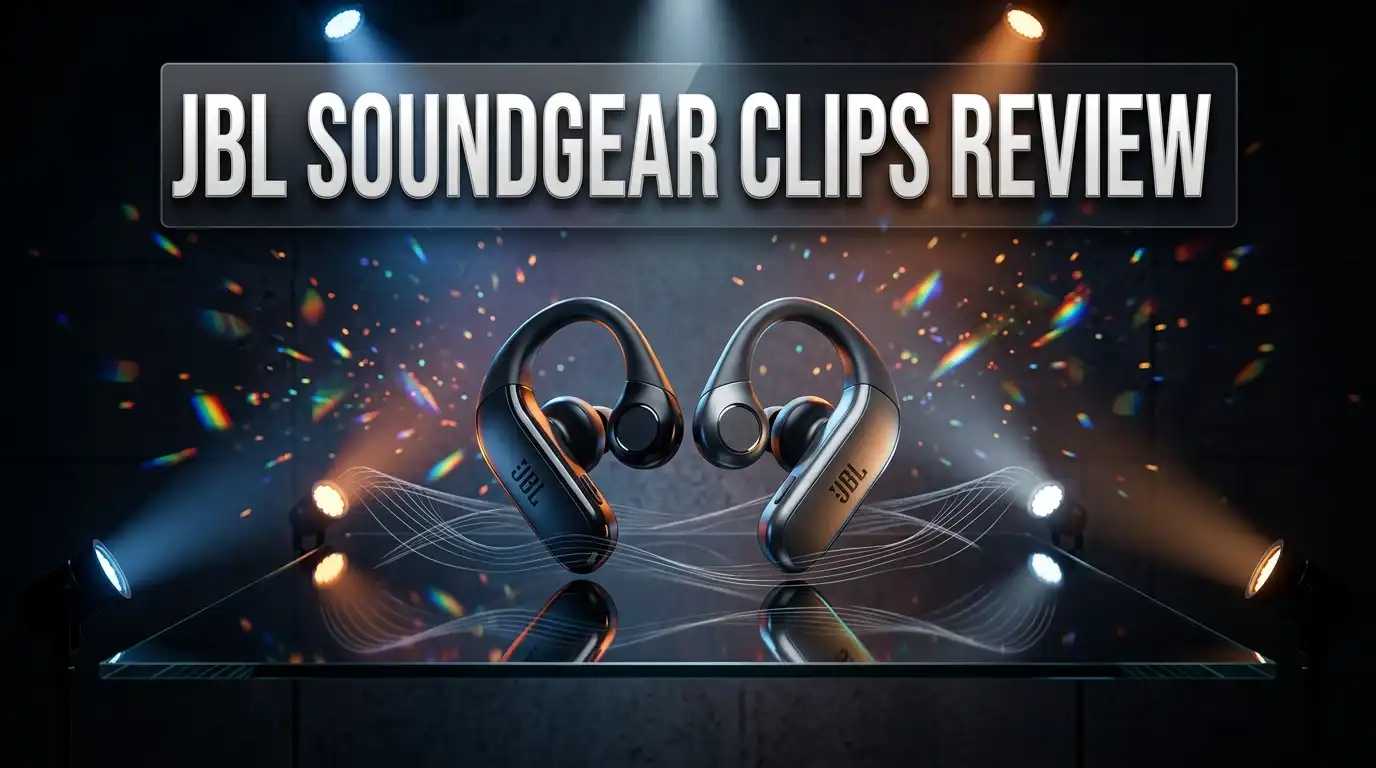
JBL Soundgear Clips Review: Open Ear Sound With Real Style
Open ear earbuds used to look like medical devices. The JBL Soundgear Clips flip that idea completely. They clip onto your ear like a piece of jewelry, they show off a translucent shell, and they still push out the kind of bass JBL fans expect.
I spent weeks with these clips during walks, gym sessions, work calls, and long writing days. I wanted to know one simple thing. Do they actually sound good enough to replace regular earbuds?
This review answers that question in plain language. You get the specs, the sound notes, the battery numbers, the honest flaws, and three strong alternatives. No fluff. Just what you need before you spend $149.95.
In a Nutshell: JBL Soundgear Clips Quick Verdict
Short on time? Here is the fast summary of everything this review covers.
- Price and availability: The JBL Soundgear Clips launched at $149.95 in March 2026. Color choices include copper, blue, purple, and white. Each shell uses a translucent finish that looks retro and modern at the same time.
- Sound signature: An 11mm dynamic driver plus the Adaptive Bass Boost algorithm gives these clips more low end than most clip style rivals. The soundstage feels wide and airy. Mids can smear a little on busy rock or electronic tracks.
- Battery life: You get up to 8 hours per charge and up to 32 hours total with the case. A 10 minute speed charge adds roughly 3 more hours of playback.
- Comfort: A flexible memory wire hook sits under soft silicone. The clamping force stays gentle. Most people forget they are wearing them after 20 minutes.
- Features: You get Bluetooth 5.4, multipoint pairing, Google Fast Pair, four beamforming mics with AI noise reduction, IP54 water and dust resistance, and a 10 band EQ inside the JBL Headphones app.
- Best for: Runners, commuters, office workers, parents, and anyone who needs to hear the room while music plays.
Why the JBL Soundgear Clips Caught My Attention
JBL already sells the Soundgear Sense, a hooked open ear model with a loyal following. The Soundgear Clips take a different route. They skip the ear hook arm and wrap around the outer ear cartilage instead.
That single change makes them far easier to put on. You pinch, you slide, you go. No mirror needed.
The second thing that grabbed me was the look. The translucent housing shows the internal components, which feels like a throwback to the clear gadgets of the early 2000s. The charging case follows the same see through theme.
JBL calls the acoustic platform OpenSound Technology with Air Conduction. Inside that system sits the SonicArc design, a shaped chamber that angles audio into your ear canal while cutting how much sound escapes sideways.
The company aimed this product at a lifestyle buyer, not an audiophile. That intent shows in every design choice. The tuning leans fun. The controls stay simple. The colors pop.
I still approached the review as a sound first test. Style fades fast if music sounds thin.
The good news is that JBL did not treat sound as an afterthought here. The 11mm driver is genuinely large for this category, and it changes the whole listening experience compared to the tiny 10mm units found in cheaper clips.

- OPEN-EAR SOUND: These true wireless earbuds use JBL OpenSound Technology with SonicArc design—music stays...
- ALL-DAY COMFORT: Soft, flexible memory wire hooks grip just right—not too tight, not too loose. These open...

Last update on 2026-09-24 / Affiliate links / Images from Amazon Product Advertising API
What You Get Inside the Box
JBL keeps the unboxing simple and a little bare. Here is the full contents list.
You get the pair of Soundgear Clips earbuds, the translucent charging case, a warranty and warning card, and a quick start safety sheet.
That is it. JBL does not include a USB C charging cable. You need to supply your own. In 2026 that choice makes environmental sense, though it still feels stingy on a $149.95 product.
There are no ear tips to sort through, which is one quiet advantage of the open ear format. Nothing goes inside your ear canal, so nothing needs sizing.
The case weighs 39.7 grams, which is light enough to forget in a jacket pocket. Each earpiece weighs 6.5 grams. That number matters more than it sounds. Heavy clips tug on the ear and create soreness after an hour.
The case lid opens with a satisfying snap. Magnets pull the buds into place with a confident click, so you never fumble to seat them correctly.
One small design note deserves praise. The case shape is flat and wide rather than bulbous. It slides into a front jeans pocket without creating a lump.
The packaging itself uses molded paper pulp instead of plastic trays. It feels like a product built with some care about waste.
Design and Build Quality of the JBL Soundgear Clips
The Soundgear Clips use a C shaped body. One side holds the driver pod that rests in front of your ear. The other side holds the battery pod that sits behind your ear.
A flexible memory wire connects the two halves. Soft, pliable material covers that wire completely.
The clamping force is the star of this design. JBL tuned it so the clip grips without pinching. I never felt a hot spot on my cartilage, even after three straight hours.
Build quality feels solid for the price. The plastics do not creak. The translucent shell resists fingerprints better than glossy black finishes usually do.
Touch panels sit on the outer face of each driver pod. They register taps quickly and give a soft tone as confirmation.
Accidental triggers were almost nonexistent in my testing, which is a real problem on many rival clips. You can adjust your glasses or push hair back without pausing your podcast.
The IP54 rating covers dust and splashing water. That protects the buds during rain and sweaty workouts.
The one weakness is the fit tension over time. The clips sit securely but not tightly, so aggressive head movement can shift them slightly out of the ideal position. I adjusted mine a few times during sprints.
For walking, cycling, lifting, and daily wear, they stayed put without complaint.
Comfort and Fit Across Long Listening Sessions
Comfort is the main reason people buy open ear earbuds, so this section matters most.
The Soundgear Clips passed my long wear test easily. I wore them for a full work day with short breaks and never developed the dull ache that in ear models cause.
Nothing enters your ear canal. That means no pressure, no vacuum feeling, and no wax buildup issues. People with sensitive ears or frequent ear infections will notice the difference immediately.
Glasses wearers get good news too. The clip sits on the outer ear ridge rather than behind the ear, so it rarely fights with temple arms. I wore sunglasses and the clips together during runs with no conflict.
Earring wearers should test carefully. Studs cause no trouble. Larger hoops can collide with the battery pod.
Fit consistency depends on ear shape. Smaller ears may find the clip sits a little low, which pushes the driver away from the canal opening and thins out the bass.
The fix is simple. Rotate the driver pod slightly forward and upward until the sound fills out. Position changes tone more than any EQ setting on this product.
Once you find your spot, muscle memory takes over within a day.
Sleeping on your side with them is not practical. The rigid pod presses into your ear against a pillow.
For everything else, from desk work to trail runs, comfort ranks near the top of the category.
Top 3 Alternative for JBL Soundgear Clips
If the Soundgear Clips do not match your budget or your ears, these three open ear models deserve a look. Each one solves a different problem.
Bose Ultra Open Earbuds deliver the most refined clip style sound available, with immersive spatial audio and up to 48 hours of total playtime. They cost more, though the audio polish is noticeable.

- OPEN YOUR EARS TO THE WORLD: Hear all of what’s around you while enjoying rich, private sound; these...
- BE IN THE MUSIC, ANYWHERE EVERYWHERE: With Bose Immersive Audio spatialized sound, these wireless earbuds...
Last update on 2026-09-24 / Affiliate links / Images from Amazon Product Advertising API
Soundcore AeroClip by Anker offers the best value in this category. You get 12mm drivers, IP55 protection, 32 hours of total playtime, and four mics with AI call cleanup for well under the JBL price.

- Open-Ear Design, Ultra-Comfort: soundcore AeroClip open-ear clip-on earbuds rest gently on your ears without...
- Flexible, Secure Fit: soundcore AeroClip clip-on earbuds boast an adaptive open-ring design that endures...
Last update on 2026-09-24 / Affiliate links / Images from Amazon Product Advertising API
SHOKZ OpenFit 2 uses an ear hook instead of a clip, which locks the fit down for hard training. Dual drivers push stronger bass, and the physical buttons work perfectly with sweaty fingers.

- Groundbreaking Audio Experience - The Shokz DualBoost composite drivers and OpenBass 2.0 algorithm pair...
- Comfortable All-Day Wear - These featherlight, 9.4 g earhooks integrate a Ni-Ti alloy that contours to your...
Last update on 2026-09-24 / Affiliate links / Images from Amazon Product Advertising API
Pick the Bose for sound quality. Pick the Soundcore for price. Pick the Shokz for running and gym stability. Pick the JBL Soundgear Clips if you want the best balance of style, comfort, and bass.
Sound Quality: Bass, Mids and Highs Explained
Open ear earbuds fight physics. Sound escapes into the air instead of sealing inside your canal. Bass suffers first.
JBL fights back with a large driver and smart processing. The result surprised me.
Bass: The low end has real thump for this format. Kick drums land with weight and bass lines stay audible in traffic noise. The texture feels a little loose rather than tight, but presence stays consistent across volumes. Adaptive Bass Boost does most of the heavy lifting here.
Mids: Vocals sit forward and clear. Acoustic guitar, piano, and folk arrangements sound natural and full. Dense rock or electronic tracks push the midrange into a slight smear where instrument separation blurs.
Highs: Treble is the cleanest part of the signature. Cymbals and strings come through with energy and no harsh edge. Nothing pierces, even at high volume.
Soundstage: This is where open ear designs win. The stereo image feels wide and breathable. Instruments occupy space instead of crowding your skull. Podcasts and live recordings sound especially natural.
Codec support covers SBC and AAC only. No LDAC. No aptX. Most listeners will not notice, but hi res streaming fans should know.
Frequency response is rated at 20Hz to 20kHz with 32 ohm impedance and 85dB sensitivity.
Overall, these rank among the better sounding clip style buds you can buy right now.
Call Quality With Four Beamforming Mics
JBL fitted four beamforming microphones across the pair, two per earbud. An AI trained algorithm handles noise reduction.
Call performance impressed me more than expected. Callers described my voice as clear and close, even during a walk on a breezy afternoon.
The wind handling deserves specific praise. Open ear designs usually expose mics to gusts. The AI processing cut that roar down to a soft hiss.
Indoor calls sound excellent. Zoom meetings, phone calls, and voice notes all came through without the tinny quality that plagues cheap earbuds.
Here is a clever touch. The JBL Headphones app lets you choose between using one mic or both mics per earbud. Your ear shape and clip position change which setting sounds best.
I tested both modes. The dual mic setting worked better for me outdoors. The single mic mode sounded slightly warmer in a quiet room.
Experimenting takes two minutes and genuinely improves results.
One real advantage of open ear calls is hearing your own voice naturally. You do not shout. You do not feel plugged up. Long calls cause far less fatigue.
The tradeoff is background leakage on your end. In a loud cafe, some ambient chatter reaches the caller.
For a lifestyle product, call quality here sits comfortably above average.

- OPEN-EAR SOUND: These true wireless earbuds use JBL OpenSound Technology with SonicArc design—music stays...
- ALL-DAY COMFORT: Soft, flexible memory wire hooks grip just right—not too tight, not too loose. These open...
Last update on 2026-09-24 / Affiliate links / Images from Amazon Product Advertising API
Battery Life and Speed Charge Performance
JBL rates the Soundgear Clips at up to 8 hours of playback per charge. The case adds roughly three more full charges for up to 32 hours total.
Those numbers held up in my testing at moderate volume. I averaged close to seven and a half hours before the low battery warning.
Open ear listening usually pushes you toward higher volume in noisy places, which drains cells faster. Expect closer to six hours during city commutes.
Maximum talk time is rated at 4 hours, which is lower than playback because the mic array draws extra power.
Speed charge is the feature you will use most. Ten minutes in the case delivers about three hours of listening. That covers a forgotten charge before a gym session.
A full charge from empty takes about 2 hours.
The case charges over USB C. Remember that JBL does not include the cable.
There is no wireless charging on this model. At $149.95 that omission stings a little, since several rivals include it.
Battery readouts appear in the JBL app and on Android quick settings. iPhone users see case and bud levels in the widget after pairing.
For most people, this means charging twice a week. That is genuinely convenient endurance for a clip this small.
Bluetooth 5.4, Multipoint and Fast Pair
The Soundgear Clips run on Bluetooth 5.4, the current mainstream standard. Connection stability was excellent throughout my testing.
I walked around my apartment with my phone in another room and never dropped audio. Crowded streets with heavy wireless interference caused no stutters.
Multipoint connectivity lets you pair two devices at once. I kept a laptop and a phone connected together all week.
The handoff works well. Music plays from the laptop, then a phone call arrives, then audio switches over automatically. When the call ends, playback resumes.
Multipoint on this model is smoother than on many rivals I have tested. Switching takes about two seconds with no awkward silence.
Google Fast Pair appears on Android. Open the case near your phone and a pairing card pops up instantly. One tap finishes the job.
iPhone users pair manually, which takes about fifteen seconds.
Supported profiles include A2DP V1.4, AVRCP V1.6.3, and HFP V1.8. Transmission runs at 2.4 GHz.
Latency is low enough for video. I watched YouTube and Netflix with no visible lip sync drift.
Mobile gaming shows a small delay on fast paced shooters. Casual games feel fine.
There is no dedicated low latency gaming mode in the app, which is the one connectivity feature I missed.
Touch Controls and the JBL Headphones App
Touch panels sit on the outer face of each earbud. They respond fast and rarely misfire.
Default gestures cover playback, track skipping, volume, and voice assistant. A confirmation tone plays after each successful tap.
The best part is customization. The JBL Headphones app lets you reassign nearly every gesture to either earbud.
I set single tap for play and pause on the left, and double tap for track skip on the right. Setting volume controls on a long press changed my daily experience completely.
The app also unlocks the sound tuning tools. You get six EQ presets plus a full 10 band equalizer for manual work.
That 10 band EQ matters more on open ear buds than on sealed models. Clip position changes perceived tone, so a small midrange lift can rescue a low sitting fit.
My favorite custom curve added 2dB around 150Hz and trimmed 1dB near 3kHz. That combination thickened the low end and smoothed vocal edge.
Other app features include firmware updates, battery readouts, a find my buds tone, and the mic selection toggle for calls.
The app interface stays clean and quick. No account login is required for basic features.
Software support is a genuine strength of this product. JBL keeps updating these apps for years after launch.
Sweat, Rain and Workout Durability
The Soundgear Clips carry an IP54 rating. The 5 covers dust ingress protection. The 4 covers splashing water from any direction.
In plain terms, sweat and rain are fine. Submersion is not. Do not swim with these.
I ran with them through a light drizzle twice. Audio never cut out and no moisture entered the housing.
Gym use went well. Sweat pooled on the driver pod during a heavy session and wiped away cleanly afterward.
Stability during exercise depends on your activity. Walking, cycling, lifting, and yoga cause no movement at all.
Running is where the loose fit shows. During fast intervals I felt the clips shift by a millimeter or two, enough to change the bass response.
They never fell off. Not once. The security is real, though the position is not locked.
Serious runners may prefer a hooked design like the Shokz OpenFit 2 for that reason.
One workout advantage stands out. You hear your surroundings completely, which means traffic, gym announcements, and training partners all come through.
That awareness makes outdoor exercise safer than sealed earbuds ever allow.
The clips also avoid the sweaty seal problem. No suction. No squelching. No slipping caused by moisture inside the canal.
For general fitness use, these work very well.
Sound Leakage and Awareness in Public
Every open ear buyer asks the same question. Can other people hear my music?
The honest answer is yes, a little, depending on volume.
JBL built the SonicArc chamber specifically to reduce that leakage. It angles sound waves toward your canal and cancels some of the escaping energy.
The system works better than average. At 50 percent volume in a quiet room, someone sitting two feet away hears a faint whisper of sound.
At 70 percent, a nearby person can identify the song. At maximum volume, everyone in a quiet office knows your playlist.
My practical advice is simple. Keep volume under 60 percent in shared quiet spaces. Outdoors and in traffic, nobody notices anything.
Bass leaks least. High frequencies leak most, so bright pop tracks carry further than warm jazz.
Now for the upside of that openness. Situational awareness is perfect. You hear cars, bikes, announcements, doorbells, and conversations with zero distortion.
I answered questions at a coffee counter without pausing music. I heard my name from across a room.
Parents will appreciate hearing a child in another room. Cyclists will appreciate hearing traffic from behind.
This awareness is the entire point of the product, and JBL delivers it fully while keeping the music enjoyable.
Pros and Cons of the JBL Soundgear Clips
Here is the honest balance sheet after weeks of use.
Pros
- Standout translucent design in four colors that genuinely looks like an accessory rather than a gadget
- Strong bass for an open ear model, thanks to the 11mm driver and Adaptive Bass Boost
- Wide, airy soundstage with good instrument separation and natural imaging
- Excellent comfort with gentle clamping force and 6.5 gram earpieces
- Up to 32 hours total playtime plus a 10 minute speed charge for 3 extra hours
- Bluetooth 5.4 with reliable multipoint and Google Fast Pair
- Four beamforming mics with AI noise reduction that handle wind impressively
- Deep app control including a 10 band equalizer and fully remappable gestures
- IP54 rating for rain and sweat
- Responsive touch controls with almost no accidental triggers
Cons
- Fit sits slightly loose during running and fast movement
- No LDAC or aptX support, only SBC and AAC
- Mids can smear on dense rock and electronic tracks
- No USB C cable included in the box
- No wireless charging at this price point
- Audible leakage above 60 percent volume in quiet rooms
- 4 hour talk time is shorter than playback time
The cons are mostly category limitations rather than JBL mistakes. Only the missing cable and wireless charging feel like true value gaps.
Price, Value and Where They Fit
The JBL Soundgear Clips launched at $149.95 in March 2026 in copper, blue, purple, and white.
That price places them in the middle of the open ear market. Budget clips sit near $70. Premium models like the Bose Ultra Open Earbuds run close to $300.
At full retail, the value equation is fair but not amazing. You pay partly for the design and the JBL name.
At a discount, the picture changes fast. Retailers have already listed these well below $150 during sales events. Around the $100 mark they become an easy recommendation.
Compare the feature list against the Soundcore AeroClip, which undercuts the JBL price while offering IP55 and 12mm drivers. The Anker option wins on raw specs.
The JBL wins on tuning quality, app depth, and build feel. Specs do not tell the whole story with audio products.
Against the JBL Soundgear Sense, the Clips offer easier fitting and a better look. The Sense offers a more locked down hook for sport.
Long term value looks solid. JBL supports its headphones app for years and firmware updates keep arriving.
The one year limited warranty covers manufacturing defects.
My take is simple. Buy at full price if the design speaks to you. Wait for a sale if you only care about sound per dollar.
Who Should Buy the JBL Soundgear Clips
These earbuds fit some people perfectly and frustrate others. Here is the clear breakdown.
Buy them if you work in an open office. You hear colleagues, take calls cleanly, and never feel ear fatigue during an eight hour day.
Buy them if you walk or cycle in traffic. Full awareness of your surroundings makes outdoor movement much safer.
Buy them if in ear tips hurt you. Nothing enters your canal, so pressure and irritation disappear entirely.
Buy them if style matters to you. The translucent finish genuinely turns heads, and the case looks great on a desk.
Buy them if you take lots of calls. The four mic array with AI noise reduction handles wind and background chatter well.
Skip them if you need noise isolation. These block nothing. Airplanes, trains, and loud gyms will swallow your music.
Skip them if you sprint or play contact sport. The fit stays secure but shifts slightly under hard impact.
Skip them if you chase audiophile detail. The lack of LDAC and the midrange softness will bother critical listeners.
Skip them if you want the cheapest option. The Soundcore AeroClip delivers similar function for less money.
For the everyday listener who wants comfort, awareness, and fun sound, the Soundgear Clips land right on target.
Final Verdict on the JBL Soundgear Clips
The JBL Soundgear Clips succeed at the job they set out to do. They make open ear audio feel desirable instead of clinical.
The 11mm driver gives them more low end authority than most clip rivals. The soundstage feels open and relaxed. The treble stays clean.
Comfort is the quiet triumph here. Six and a half grams per bud with gentle clamping force means you forget they exist.
Battery life at 32 hours total covers a full week of normal use. Speed charging rescues you when you forget.
The app support elevates the whole package. A 10 band EQ and remappable gestures give you real control over your experience.
The flaws are honest and predictable. The fit loosens during hard running. The mids blur on complex tracks. There is no premium codec.
None of those flaws break the product. They simply define who it suits.
I rate the JBL Soundgear Clips a strong recommendation for casual listeners, commuters, office workers, and anyone who values awareness over isolation.
Score: 8.5 out of 10.
If you want the best sounding clip on the market, the Bose costs more and delivers more. If you want the best value, the Soundcore saves you money.
If you want the best mix of sound, comfort, and style at a fair price, the JBL Soundgear Clips earn your attention.
Frequently Asked Questions
How much do the JBL Soundgear Clips cost?
They launched at $149.95 in March 2026. Sale prices have already appeared at major retailers, so watch for discounts during shopping events.
How long does the battery last on the JBL Soundgear Clips?
You get up to 8 hours of playback from the earbuds and up to 32 hours total with the charging case. A 10 minute speed charge adds about 3 hours.
Are the JBL Soundgear Clips good for running?
They work well for steady runs and stay on your ears reliably. During sprints the clips can shift slightly, so serious runners may prefer a hooked design.
Do the JBL Soundgear Clips leak sound?
They leak a small amount above 60 percent volume in quiet rooms. The SonicArc chamber reduces leakage compared to most open ear rivals, and outdoors nobody notices.
Are the JBL Soundgear Clips waterproof?
They carry an IP54 rating, which covers dust and splashing water. Sweat and rain are fine. Do not submerge them or swim with them.
Do the JBL Soundgear Clips support multipoint pairing?
Yes. They connect to two devices at once over Bluetooth 5.4 and switch between them automatically when a call arrives.
What colors do the JBL Soundgear Clips come in?
Copper, blue, purple, and white. Every version uses a translucent finish on both the buds and the case.
Does the box include a charging cable?
No. JBL does not include a USB C cable, so you need to use one you already own.
Do the JBL Soundgear Clips work with iPhone?
Yes. They pair normally with iOS and support AAC. The JBL Headphones app is available on both iOS and Android.
Can you use one earbud alone?
Yes. Each clip works independently for calls and audio, which is useful during meetings or driving.

DK is a technology expert who specializes in AI tools, software, and tech gadgets. He writes for How to Tech Info, providing detailed reviews and practical guides. DK helps readers discover the best AI applications, navigate new software, and choose the right tech gadgets.