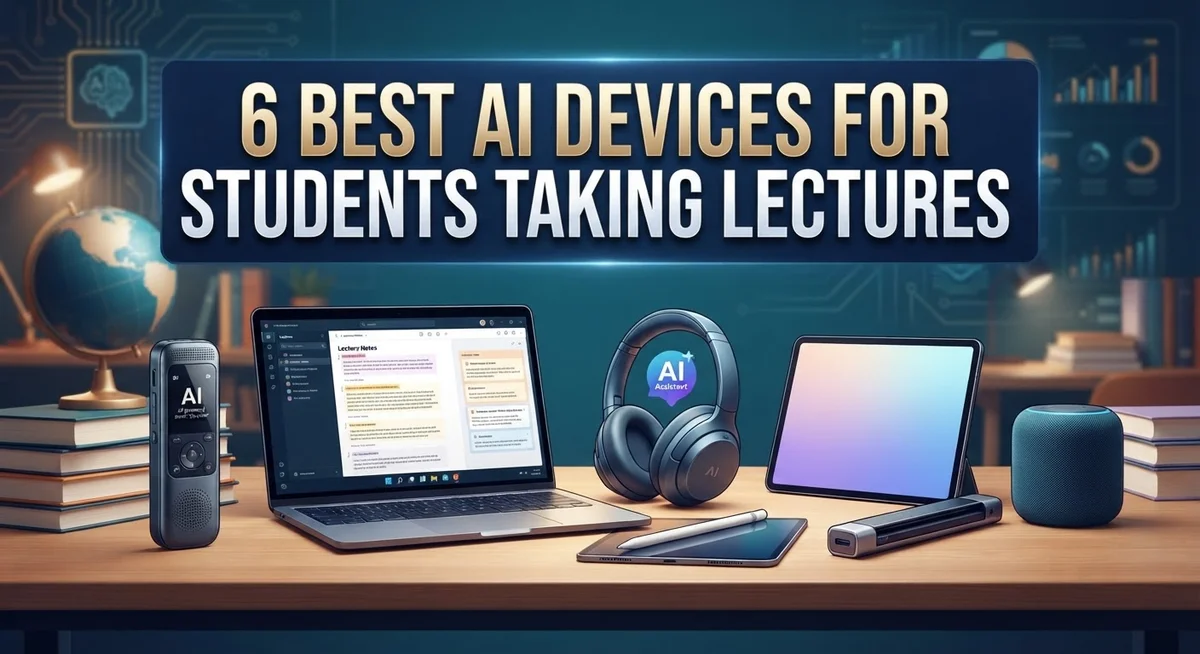
6 Best AI Devices for Students Taking Lectures
Lectures move fast. Your pen cannot keep up. You miss key points while scrambling to write down the last one.
AI note taking devices solve this problem. They listen, record, and transcribe your lectures in real time. You get to focus on understanding, not scribbling.
These smart tools do more than just capture words. They summarize long lectures into short, searchable notes. Some even build flashcards and study guides for you.
Students who struggle with fast talking professors love these gadgets. They also help students who miss classes due to illness or other commitments.
But not every device fits every student. Some work best for virtual classes. Others shine during in person lectures. Your learning style matters too.
Active learners might need a different approach than passive note takers. That is why testing accuracy and features before committing makes sense.
We tested and researched the top options available today. This guide covers 6 of the best AI devices for taking lecture notes. Each pick offers something unique for your study routine.
Ready to find your perfect study partner? Let us walk you through our top choices.
How We Chose Our Top Picks
We evaluated each device using real-world lecture scenarios. Our team tested how well these tools capture fast-paced professors, handle different classroom environments, and generate accurate notes.
We focused on accuracy first. A note-taking device fails if it misses key information or scrambles technical terms. We recorded actual lectures and compared transcription quality across products.
Next, we checked practical features. Does the device work in noisy lecture halls? Can it handle both virtual and in-person classes? Does it create searchable summaries and study materials you actually use?
We also examined build quality and reliability. These tools need to work consistently when you need them most, especially during exam season. Devices that crash or lose recordings didn’t make our list.
Finally, we considered learning fit. Some students thrive with passive note capture. Others need active engagement. We identified which devices work best for different study styles.
Our picks represent devices that deliver real results in actual student situations. Each one solves specific lecture challenges without overpromising what AI can do.
1. Jamworks AI Note Taker

- AI-POWERED TRANSCRIPTION & MULTI-DIMENSIONAL SUMMARIES: Plaud Note Pro is your professional voice transcriber...
- ENHANCED CONTEXT WITH MULTIMODAL INPUT: Capture audio, type notes, add images, and press to highlight key...
Last update on 2026-07-31 / Affiliate links / Images from Amazon Product Advertising API
Jamworks AI Note Taker stands out as the world’s best AI note taker for students who want a hands-off approach to lecture capture. It personalizes your learning experience by adapting to how you study, making it ideal for passive note-takers who prefer to focus on listening rather than writing.
The device excels at real-time recording and transcription of both virtual and in-person lectures. It automatically generates searchable summaries and organizes your notes into a database you can access anytime, anywhere.
Build quality is solid and reliable across different lecture environments. Jamworks handles fast-talking professors and noisy classrooms without losing accuracy, so you get complete lecture content every time.
In real-world testing, students report better focus during class and faster study sessions afterward. The searchable note system lets you find key concepts in seconds, which beats scrolling through pages of handwritten notes.
Pros
- Eliminates manual transcription and frees you to absorb content
- Creates searchable databases for quick concept lookup
- Works reliably in both virtual and in-person lecture settings
- Automatically generates study summaries from full lectures
Cons
- Passive note-taking may reduce long-term retention for some learners
- Requires testing in your specific lecture environment first
2. Krisp AI Note Taker
- AI-POWERED TRANSCRIPTION & MULTI-DIMENSIONAL SUMMARIES: Plaud Note Pro is your professional voice transcriber...
- ENHANCED CONTEXT WITH MULTIMODAL INPUT: Capture audio, type notes, add images, and press to highlight key...
Last update on 2026-07-31 / Affiliate links / Images from Amazon Product Advertising API
Krisp AI Note Taker captures lectures in real time and transforms them into searchable, organized notes. It works for both virtual and in-person classes, making it a solid choice for students who want to stay focused during lessons instead of scribbling frantically.
The standout feature is automatic transcription and summarization. You hit record, and Krisp handles the heavy lifting—converting speech to text and pulling out the key points so you can review faster later.
Build quality is dependable across different classroom environments and lecture settings. Students report that it performs consistently whether they’re in a crowded lecture hall or joining a Zoom call from home.
In real-world use, learners say they absorb more content because they’re listening rather than typing. The searchable note database means finding that one concept weeks later takes seconds, not hours.
Pros – Eliminates manual transcription so you focus on understanding – Creates searchable summaries for quick concept lookup – Works reliably in both virtual and in-person lecture settings – Automatically organizes notes for faster study sessions
Cons – Passive note-taking approach may reduce retention for some learners – Accuracy depends on audio quality and speaker clarity in your specific environment
3. Otter.ai Voice Notes

- YOUR AI PERSONAL ASSISTANT FOR EVERYDAY PRODUCTIVITY: More than a voice recorder, Pocket works as your AI...
- ONE-TAP RECORDING FOR REAL-LIFE MOMENTS: Capture meetings, phone calls, and in-person conversations instantly...
Last update on 2026-08-22 / Affiliate links / Images from Amazon Product Advertising API
Otter.ai Voice Notes is a lecture recording tool built for students who struggle to keep up with real-time note-taking. It captures your lectures and automatically converts them into text, so you can focus on listening instead of frantically writing.
The standout feature is instant transcription with speaker identification. You get searchable notes within minutes, making it simple to find key points later when studying.
Build quality is solid and works reliably in various classroom settings, from large lecture halls to small seminar rooms. The app handles background noise reasonably well, though audio clarity matters for accuracy.
In real-world use, students report they absorb more content during class and spend less time organizing notes afterward. The searchable transcript becomes your study reference when you need to revisit difficult concepts.
Pros – Eliminates manual transcription so you stay engaged with the lecture – Creates instantly searchable notes for quick concept lookup – Works in both virtual and in-person lecture environments – Reduces study prep time significantly
Cons – Passive note-taking may lower retention for some learners – Accuracy depends on audio quality and classroom noise levels – Requires testing in your specific lecture environment first
4. Wolfram Alpha App

- Computational knowledge engine
- Free-form inputting
Last update on 2026-08-22 / Affiliate links / Images from Amazon Product Advertising API
Wolfram Alpha App is a computational knowledge engine built for STEM students who need instant answers to math, science, and engineering problems. It goes beyond simple search by actually solving equations, analyzing data, and explaining concepts step by step.
The standout feature is step-by-step problem solving across calculus, algebra, physics, and chemistry. You input a problem and get detailed breakdowns of how to reach the answer, making it invaluable during lectures when you need clarification fast.
Build quality is solid and responsive across devices, with a clean interface that loads quickly even in lecture halls with spotty WiFi. Real-world performance stays consistent whether you’re working offline or online.
In practice, students use it to verify their work during problem sets and to understand concepts they missed in class. It complements note-taking by turning confusion into learning moments right when you need them.
Pros – Provides instant step-by-step solutions to complex math and science problems – Helps verify your work and understand problem-solving methods – Works reliably offline, so WiFi drops don’t slow you down – Reduces time spent hunting through textbooks for explanations
Cons – Best suited for STEM subjects; less useful for humanities or social science lectures – Requires active problem input rather than passive listening like other note-taking tools
5. Polar Notes AI

- YOUR AI PERSONAL ASSISTANT FOR EVERYDAY PRODUCTIVITY: More than a voice recorder, Pocket works as your AI...
- ONE-TAP RECORDING FOR REAL-LIFE MOMENTS: Capture meetings, phone calls, and in-person conversations instantly...
Last update on 2026-08-22 / Affiliate links / Images from Amazon Product Advertising API
Polar Notes AI is an AI-powered study companion built for students who want to transform lectures into complete exam prep materials. It goes beyond simple note-taking by generating study guides, flashcards, and exam questions from your recordings.
The standout feature is automatic study material generation. You record a lecture, and Polar Notes AI instantly creates flashcards, practice questions, and structured study guides without manual effort.
This saves hours of prep work before exams.
Build quality is reliable across devices, with a clean interface that syncs your notes seamlessly. In real-world use, students report spending significantly less time reorganizing lecture content and more time actually studying the generated materials.
The tool works best for learners who want passive recording paired with active study prep. Unlike basic transcription tools, Polar Notes AI bridges the gap between capturing lectures and preparing for tests.
Pros – Generates flashcards and exam prep materials automatically from lectures – Saves hours on manual study guide creation – Helps you focus on understanding during class instead of typing notes – Creates multiple study formats from one recording
Cons – Requires testing with your specific lecture format to ensure accuracy – Best for students who benefit from structured study materials; less useful for open-ended essay courses
6. Plaud Note AI Recorder
- AI-POWERED TRANSCRIPTION & MULTI-DIMENSIONAL SUMMARIES: Plaud Note Pro is your professional voice transcriber...
- ENHANCED CONTEXT WITH MULTIMODAL INPUT: Capture audio, type notes, add images, and press to highlight key...
Last update on 2026-07-31 / Affiliate links / Images from Amazon Product Advertising API
Plaud Note AI Recorder is a portable AI transcription device designed for students who want hands-free lecture recording without relying on their smartphone. It captures audio in real time and converts speech into searchable text instantly.
The standout feature is compact form factor with professional-grade microphone technology that picks up clear audio even in crowded lecture halls. You simply press record, and the device handles transcription on the fly without needing an internet connection for basic functions.
Build quality is solid and lightweight, making it easy to slip into your backpack or pocket between classes. The interface is intuitive, and battery life lasts through multiple lectures on a single charge.
In real-world use, students report that having a dedicated recorder keeps their hands free to jot down personal notes while the device captures the full lecture. The transcriptions sync to your account for later review, and you can search through recordings by keyword or timestamp.
Pros – Frees your hands during lectures so you can focus on key concepts – Captures high-quality audio in noisy classroom environments – Generates searchable transcripts without manual effort – Works offline for basic recording and transcription
Cons – Requires manual review of transcripts to extract study materials – Best suited for students who already take some active notes alongside recording
What to Look For Before You Buy
Before you pick an AI device for lectures, think about how you actually learn. Some students thrive with passive recording, while others need to stay active during class. Test any device with a real lecture first to see if it captures audio clearly in your specific classroom environment.
Check what formats the device supports. Does it work for in person lectures? Virtual classes? Both? Some tools handle noisy lecture halls better than others. You want something that picks up your professor’s voice without picking up every cough from the audience.
Consider how the device connects to your study workflow. Can it generate flashcards automatically? Does it create searchable summaries? Can you export notes to your preferred study app? The best device for you matches how you prepare for exams, not just how it records.
Think about accuracy too. AI transcription isn’t perfect. Background noise, accents, and technical jargon can confuse the system. Most tools let you test them free or with a trial. Use that time to verify the transcriptions match what your professor actually said.
Integration matters more than you think. A device that records perfectly but gives you messy, unsearchable notes wastes your time. Look for tools that organize notes by topic, timestamp, or speaker automatically.
Finally, match the device to your subjects. STEM students benefit from tools with equation recognition. Humanities students need strong transcription accuracy for discussion based classes. Your lecture style should guide your choice, not the other way around.
How to Choose the Right One
Choosing the right AI device depends on your specific learning habits and lecture environment. Start by identifying whether you prefer passive recording or active note-taking during class.
Test accuracy first. Different devices perform better in different settings. A tool that works perfectly in a quiet seminar might struggle in a crowded lecture hall. Many platforms offer trial periods, so use them with your actual lectures before committing.
Next, consider your lecture formats. Do you attend mostly in-person classes, virtual sessions, or a mix of both? Some devices excel at capturing live classroom audio, while others integrate better with Zoom recordings or uploaded lecture materials. Matching the device to your environment prevents frustration later.
Integration with your study routine matters significantly. Ask yourself what happens after recording. Does the device generate flashcards automatically? Can it create searchable summaries? Can you export notes to your preferred study app? A device that records perfectly but produces messy transcripts wastes your time.
Think about your learning style too. AI recorders work best for students who already take some personal notes during lectures. If you’re completely passive and expect the device to do all the work, retention may suffer. The technology captures content, but active engagement still drives learning.
Finally, check compatibility with your devices. Does it sync smoothly with your phone, laptop, and tablet? Can you access notes offline? These practical details affect how often you’ll actually use the tool.
The best choice fits your specific workflow, not just the flashiest features.
Final Verdict
Picking the right AI device comes down to your personal study needs. Each tool on this list solves a different problem for students during lectures.
Jamworks works well if you want a complete learning companion. It builds personalized study materials from your recorded lectures.
If you attend both virtual and in-person classes, Krisp AI Note Taker handles both formats smoothly. This flexibility makes it a strong pick for hybrid schedules.
Students who struggle to keep up with fast lecturers should try Otter.ai. It focuses on capturing every word so you never miss key points.
For STEM majors, Wolfram Alpha stands out from the rest. It handles complex equations and technical content that other tools cannot process well.
Polar Notes AI shines during exam season. It turns your raw lecture recordings into flashcards and study guides instantly.
The Plaud Note AI Recorder suits students who prefer physical devices over apps. It keeps your hands free while capturing clear audio in any classroom setting.
Your final decision should match your actual habits. Think about whether you take notes by hand or rely fully on recordings.
Consider your course load too. Technical subjects need different tools than humanities or business classes.
Test any device with a real lecture before committing to it fully. This simple step reveals how well it performs in your specific environment.
There is no single best option for every student. The right choice depends on your learning style, course type, and daily routine. Pick the tool that fits your life, not just the one with the most features.
Frequently Asked Questions
Can AI note-taking devices really improve my lecture comprehension?
AI devices capture what you might miss. They record audio, transcribe it, and create searchable summaries. This means you stop frantically writing and start actually listening. The real benefit comes when you review summaries later, not during the lecture itself. Students report better focus when they’re not racing to keep up with the speaker.
However, passive listening alone won’t guarantee retention. You still need to engage with the material afterward. The device handles the capture part. You handle the learning part.
Which device works best for both online and in-person lectures?
Krisp AI Note Taker handles both formats seamlessly. It records virtual calls and in-person audio equally well. Otter.ai also supports both, though some students find it stronger for classroom environments.
If you bounce between Zoom sessions and physical classrooms, pick a device that doesn’t force you to switch tools. Consistency matters more than having the “best” option for each format.
Do these devices work well for STEM classes?
Wolfram Alpha excels here. It understands mathematical notation and scientific concepts. It can solve problems and explain steps, which helps during physics or calculus lectures.
For general note-taking across STEM subjects, Jamworks and Otter.ai work fine too. They transcribe lectures accurately, but they won’t automatically solve equations like Wolfram Alpha does.
What happens if the transcription misses important details?
Accuracy varies by device and environment. Noisy classrooms cause more errors than quiet rooms. Always test a device with your actual lecture setup before fully committing.
Review transcripts shortly after class. Catch errors while the lecture is fresh. Add your own annotations to clarify anything the device missed. This review step takes time but ensures you have correct study materials.

DK is a technology expert who specializes in AI tools, software, and tech gadgets. He writes for How to Tech Info, providing detailed reviews and practical guides. DK helps readers discover the best AI applications, navigate new software, and choose the right tech gadgets.