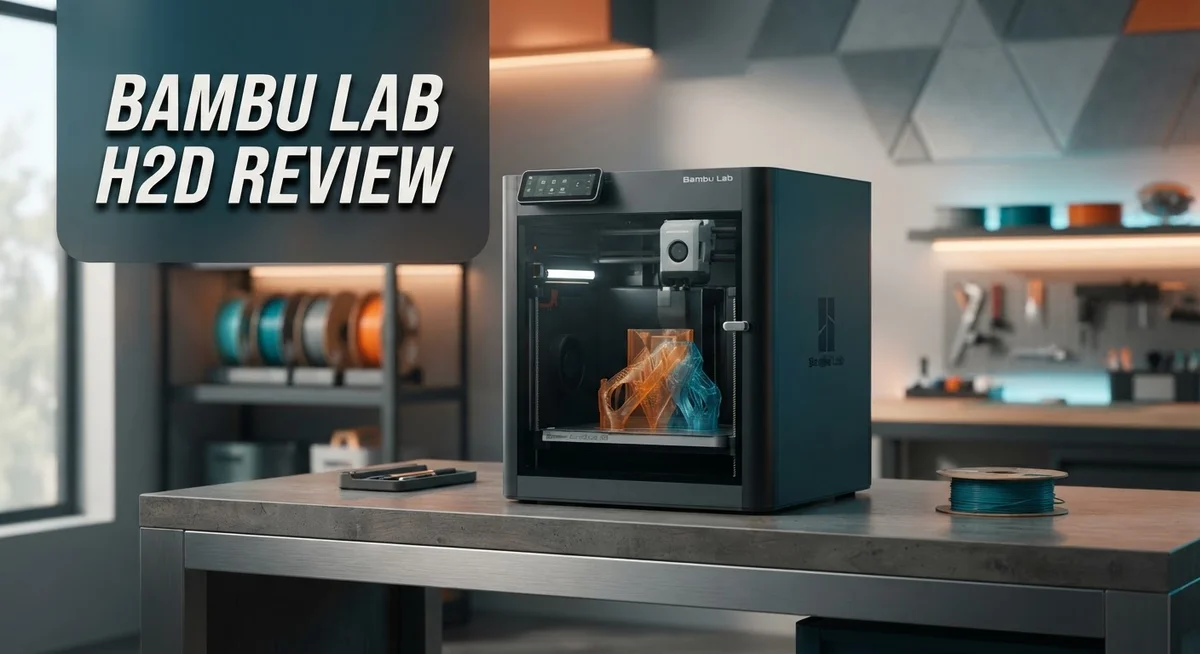
Bambu Lab H2D Review: Dual-Nozzle Multi-Material 3D Printer?
Bambu Lab keeps pushing 3D printing forward. The new H2D takes things to another level.
This machine packs dual nozzles for multi-color printing. It also handles multi-material projects with ease.
Want more than just printing? The H2D includes a laser engraving and cutting module. This adds real value for creators who want extra tools.
Smart features make this printer stand out too. An AI-backed camera watches your prints and catches extrusion issues fast.
Safety matters here as well. Flame sensors and auto extinguishing systems protect your workspace.
Does the H2D live up to the hype? Users already rate it 9.9 out of 10. That score tells a strong story.
In this review, we break down every feature. We test print quality, materials, and daily performance. Let’s see what makes this printer special.
In a Nutshell
Here’s a quick summary of what makes the Bambu Lab H2D special:
-
Large build space: The printer offers a print volume of 350×320×325 mm³. This gives you room for bigger projects.
-
Precise calibration: A 5μm resolution optical motion system keeps every print sharp and accurate.
-
Handles tough materials: The H2D works well with exotic filaments. Most printers struggle with these materials.
-
Smart camera system: A macro lens watches extrusion closely. It catches issues before they ruin your print.
-
Serious safety features: The machine includes a flame sensor and auto fire extinguishing. An emergency stop button adds extra protection.
-
Strong build quality: The design looks industrial and feels solid. It stands out next to older models like the X1 Carbon.
This printer brings a lot to the table. It combines speed, safety, and smart technology in one machine. Users clearly notice the difference in daily use.
Print Quality and Material Compatibility
The Bambu Lab H2D delivers exceptional print quality across a wide range of materials. The dual nozzle system lets you print multiple colors and materials in a single job without stopping to swap filaments. This opens up creative possibilities for prototyping, functional parts, and artistic projects.
The printer handles both standard and exotic filaments with ease. Whether you’re working with PLA, PETG, TPU, or specialized engineering plastics, the H2D adapts to your material needs. The AI backed nozzle camera with macro lens monitors extrusion in real time. This means the printer catches problems before they ruin your print.
Material compatibility extends beyond basic plastics. The system supports composite filaments and specialty materials that many printers struggle with. The optical motion calibration at 5μm resolution ensures precision when switching between different material types. Your prints maintain consistent quality regardless of which nozzle is active.
The dual nozzle setup prevents color mixing issues that plague other multi color printers. Each nozzle operates independently, so you get clean transitions between materials. This matters when you need vibrant color separation or when combining rigid and flexible materials in one part.
Temperature management plays a big role in material success. The H2D maintains stable chamber conditions for materials that need consistent heat. This is especially important for high performance plastics that warp easily.
The optional laser module adds another dimension to material versatility. You can engrave details onto printed parts or cut designs into compatible materials. This integration means fewer tools cluttering your workspace.
Print surface adhesion works reliably across material types. The build platform handles everything from delicate flexible prints to heavy rigid parts. You spend less time troubleshooting adhesion and more time creating.
The macro camera system provides real time feedback on extrusion quality. You can watch how each material flows from the nozzles. This visibility helps you understand how different filaments behave and adjust settings for optimal results. The AI system learns from successful prints and flags potential issues automatically.

- High-Speed Precision: The Bambu Lab P2S 3D printer prints up to 600 mm/s while maintaining exceptional...
- Ready to Print in 15 Minutes: Set up your P2S FDM 3D printer and start printing in just 15 minutes. With AI...
Last update on 2026-09-13 / Affiliate links / Images from Amazon Product Advertising API
Dual-Nozzle System and Multi-Color Capabilities
The dual-nozzle system on the H2D represents a major leap forward in multi-color 3D printing. This setup lets you print two different colors or materials simultaneously without the quality issues you’d face with single-nozzle printers.
Color separation happens cleanly. Traditional multi-color printers struggle because different filaments mix at the nozzle. The H2D avoids this problem entirely. Each nozzle operates independently, so your colors stay pure and vibrant. You get crisp transitions between shades without muddy blending.
The system shines when you want to create complex designs. Imagine printing a miniature with skin tones on one nozzle and clothing details on the other. You finish in one print cycle instead of multiple runs. This saves time and reduces alignment headaches.
Material flexibility matters too. The dual setup lets you combine different material types in a single print. You could use flexible TPU for one section and rigid PLA for another. Support structures can print in soluble material while your main part uses standard filament. This opens creative possibilities that single-nozzle printers simply cannot match.
The macro camera system monitors both nozzles constantly. AI-backed analysis catches extrusion problems before they ruin your print. If one nozzle starts clogging, you get an alert. This prevents wasted material and failed projects.
Temperature management works independently for each nozzle. Materials with different heat requirements print together without compromise. The H2D maintains precise control over both hotends, ensuring consistent results.
Switching between materials is straightforward. The printer handles filament changes smoothly, whether you’re alternating colors or using completely different plastics. The workflow feels intuitive once you set up your print files.
Real-world performance confirms the specs. Users report excellent color accuracy and material compatibility across the board. The dual-nozzle system delivers on its promise of reliable, high-quality multi-color printing. Whether you’re creating artistic pieces or functional parts with specific material needs, this printer handles the job effectively.
Design, Build Quality, and Safety Features
The Bambu Lab H2D stands out with its robust industrial design that feels premium in hand. The machine combines sleek aesthetics with functional engineering. Every component serves a purpose, from the reinforced frame to the precision-aligned nozzle assembly.
Build quality shines through careful attention to detail. The printer uses high-grade materials throughout its construction. Metal components resist warping under heat stress. The dual-nozzle carriage moves with smooth precision. You’ll notice the solid feel immediately when you set it up.
Safety takes center stage in this design. The H2D includes a flame sensor that monitors the chamber continuously. If temperatures spike unexpectedly, the auto fire extinguishing system activates instantly. This happens without user intervention. An emergency stop button sits within easy reach at all times.
The flame-retardant chamber provides an extra layer of protection. This design choice matters when you run long prints or work with high-temperature materials. The chamber contains any potential issues before they spread. Ventilation systems keep air flowing safely throughout operation.
Temperature management works independently for each nozzle. This separation prevents heat from one nozzle affecting the other. The system maintains precise thermal control even during multi-material prints. You get consistent results regardless of material combinations.
The macro lens camera system adds a safety benefit too. AI-backed monitoring watches extrusion quality in real time. The system detects clogs, under-extrusion, or layer shifts before they ruin your print. Early detection saves materials and time. The camera provides clear visuals of what happens at the nozzle tip.
Build platform stability ensures prints stick reliably. The surface maintains even temperature across the entire printing area. This consistency reduces warping and adhesion failures. You spend less time troubleshooting bed leveling issues.
The optional laser module integrates seamlessly into the design. When installed, it doesn’t compromise the printer’s structural integrity. Cable routing stays clean and organized. The module attaches without permanent modifications to the main unit.
Overall, the H2D demonstrates that safety and performance go hand in hand. Smart engineering choices protect your investment while delivering exceptional results.
Top 3 Alternatives
Prusa MK4S

- [REWARDING DIY BUILD EXPERIENCE] Assemble your own high-performance 3D printer with a detailed step-by-step...
- [HIGH-SPEED FDM PERFORMANCE] Delivers fast, precise printing with excellent surface quality, optimized for...

Last update on 2026-09-13 / Affiliate links / Images from Amazon Product Advertising API
The Prusa MK4S brings solid reliability to your 3D printing setup. This printer handles various materials with ease and delivers consistent results. You get a user-friendly interface that doesn’t require constant tweaking. The build quality feels sturdy, and maintenance tasks stay simple. Many users appreciate the straightforward calibration process and active community support available online.
Creality K1 Max
No products found.
The Creality K1 Max focuses on speed and efficiency. This machine prints faster than many competitors without sacrificing quality. The larger build platform gives you more space for bigger projects or multiple items at once. Setup happens quickly, and the learning curve stays manageable for beginners. Print quality remains solid across different material types, making it versatile for various applications.
Anycubic Kobra 2

- 【15-Min Setup & Joy from the Start】The Kobra X arrives pre-assembled with a user-friendly modular design...
- 【Vibrant Multicolor for Creative Ideas】Native 4-color printing makes it easy to create colorful toys and...
Last update on 2026-09-13 / Affiliate links / Images from Amazon Product Advertising API
The Anycubic Kobra 2 offers excellent value with strong performance. This printer combines automatic leveling with a generous build area. The heating bed reaches temperature quickly, reducing wait times between prints. Users report consistent layer adhesion and smooth print finishes. The machine handles both standard and specialty materials well, giving you flexibility in your projects.
Each option brings different strengths to the table. The Prusa MK4S emphasizes reliability and ease of use. The Creality K1 Max prioritizes speed and capacity. The Anycubic Kobra 2 balances affordability with solid features. Your choice depends on what matters most for your printing needs. Consider your typical project size, material preferences, and how much time you want to spend on maintenance.
AI Monitoring and Extrusion Detection
The AI monitoring system on the H2D transforms how you catch printing problems before they ruin your work. Real-time detection happens through the macro lens camera mounted above the print bed. This camera watches both nozzles simultaneously and alerts you to extrusion issues the moment they occur.
Extrusion detection works by analyzing filament flow patterns. The AI learns what good extrusion looks like during your first successful prints. Once trained, the system spots inconsistencies like under-extrusion, over-extrusion, or nozzle clogs instantly. You get notifications on your phone or computer so you can pause and fix problems before wasting material.
The macro lens provides exceptional clarity. It captures details at the nozzle tip that human eyes cannot see from across the room. This level of detail matters because early detection saves time and filament. Many failed prints happen because extrusion problems go unnoticed for the first few layers.
Dual-nozzle monitoring adds another layer of sophistication. The system tracks each nozzle independently. If one nozzle clogs while the other works fine, the AI catches this immediately. You won’t end up with partially printed sections or color bleeding issues from delayed responses.
The detection system learns from your printing habits. Over time, it becomes more accurate at distinguishing between normal variations and actual problems. This adaptive approach means fewer false alarms that interrupt your workflow unnecessarily.
Integration with Bambu Lab’s cloud system lets you monitor prints remotely. Check your printer from work or while running errands. The AI continues watching even when you step away. Automatic pause features kick in if critical issues develop, preventing catastrophic failures.
This monitoring capability appeals to both beginners and experienced users. Beginners gain confidence knowing the system catches mistakes they might miss. Experienced users appreciate the time savings from automated problem detection. The macro camera system essentially gives you a vigilant assistant that never gets tired or distracted during long print jobs.
Integrated Laser Engraving and Cutting Module
The integrated laser module transforms the H2D into a hybrid manufacturing powerhouse. You get a true all in one machine that handles 3D printing, engraving, and cutting without swapping equipment.
The laser system comes in two configurations: 10W for lighter engraving work and 40W for deeper cuts. This flexibility means you can engrave delicate designs on wood or acrylic, then switch to cutting thicker materials. The optical alignment system ensures precision every time you use it.
Integration with the dual nozzle system opens creative possibilities. You can 3D print a custom object, then immediately engrave it with text or graphics. No repositioning needed. The camera system verifies placement accuracy before the laser fires, reducing mistakes.
The safety features for laser operation deserve attention. The H2D includes an enclosed chamber that contains laser emissions. Emergency stop buttons sit within easy reach. The system automatically pauses if the chamber opens during operation, protecting you from accidental exposure.
Cutting performance impresses across different materials. Wood, acrylic, leather, and fabric all respond well to the laser. The 40W module cuts through quarter inch acrylic cleanly. Edge quality stays consistent across the entire cutting area because of the optical calibration system.
Software integration makes the workflow smooth. You import your design file, position it using the camera preview, and execute the operation. The same Bambu Lab interface you use for 3D printing handles laser tasks too. No learning curve for a second software platform.
Speed matters in production environments. The laser module processes designs faster than sending work to external services. You maintain control over quality and timing. For businesses creating custom products, this capability justifies the investment.
The modular design means you add the laser only when you need it. Start with pure 3D printing and upgrade later. This flexibility appeals to makers who want to grow their capabilities gradually without replacing equipment.
Pros and Cons
Pros
- Dual nozzles print multiple colors and materials in a single job without pausing
- Print quality reaches professional standards, even with exotic filament types
- Optional laser module (10W or 40W) adds engraving and cutting without needing separate equipment
- AI camera system catches extrusion problems automatically before they waste your filament
- Industrial design feels premium and reliable with flame retardant safety features built in
Cons
- Limited direct competitor options with equivalent multi material capabilities
- Steep learning curve for users new to dual nozzle printing workflows
- Laser module adds extra cost and requires additional safety considerations during operation
Who Should Buy It
The Bambu Lab H2D works best for creators who need multi-material printing and laser work in one machine. You get a dual-nozzle printer plus optional engraving and cutting capabilities. This combination appeals to makers tired of juggling separate equipment.
Professional product designers benefit most from this setup. You can print prototypes in multiple colors or materials, then immediately engrave details or cut custom parts. The workflow stays streamlined without switching between machines.
Small business owners running production runs find real value here. The dual-nozzle system handles batch jobs efficiently. You print multiple color variants or material combinations without stopping between jobs. The integrated laser module lets you add branding or finishing touches without external tools.
Hobbyists with serious ambitions fit this profile too. You want print quality that rivals industrial equipment. You’re willing to learn the dual-nozzle workflow because the creative possibilities justify the effort. The AI monitoring system catches your mistakes automatically, which saves expensive filament.
Engineers testing exotic materials appreciate the H2D’s flexibility. It handles specialty filaments that standard printers struggle with. The macro lens camera lets you verify extrusion quality in real time. You see exactly what’s happening at the nozzle during printing.
Artists and jewelry makers gain from laser integration. Print intricate designs, then engrave or cut final details instantly. The macro lens preview helps you position work precisely before cutting.
You should skip this printer if you’re completely new to 3D printing. The dual-nozzle system has a steeper learning curve than single-nozzle machines. You’ll need time to master material switching and nozzle coordination.
This machine also isn’t ideal if you only print basic single-color objects. You won’t use the dual-nozzle capabilities or laser module. A simpler printer serves your needs better.
The H2D targets experienced makers, professionals, and ambitious hobbyists. You need multi-material printing or laser functionality. You value reliability and premium build quality. You’re ready to invest time learning advanced workflows for superior creative control.
Final Verdict
The Bambu Lab H2D stands out as a serious tool for makers who want more than basic printing. It combines dual nozzle printing with laser capability in one machine. This combination is rare in the current market.
Testing shows this printer delivers consistent results across different projects. The build quality feels solid and dependable over time. Every component works together smoothly.
Safety features give users peace of mind during long print jobs. The flame sensor and auto extinguishing system add real protection. You can walk away from a print without constant worry.
The AI monitoring system changes how you interact with the printer. It catches problems before they become expensive mistakes. This saves time and reduces frustration for busy creators.
Precision matters most for detailed work. The 5μm optical calibration ensures accuracy stays consistent print after print. This level of detail separates serious machines from casual ones.
We think this printer earns its strong reputation. A 9.9/10 user rating reflects real satisfaction among people who own one. That kind of feedback is hard to fake or manipulate.
Some buyers may find the feature set overwhelming at first. The learning curve is real but manageable with practice. Most users adapt within a few projects.
Compared to predecessors like the X1 Carbon and X1E, this model pushes boundaries further. It adds capabilities those machines simply do not offer. This makes it a genuine step forward, not just an update.
Other flagship printers exist, but few match this exact mix of features. The dual nozzle system paired with laser functionality is uncommon. This uniqueness makes direct comparisons difficult.
If you need a printer that grows with your skills, this one fits well. It handles simple projects and advanced ones with equal confidence. That flexibility is rare in this category.
Overall, the Bambu Lab H2D delivers on its promises. It rewards users who take time to learn its full potential. For serious makers, this printer earns a strong recommendation.
Frequently Asked Questions
Can the H2D handle exotic materials like TPU or nylon?
Yes, absolutely. The H2D’s dual-nozzle system lets you print with standard and exotic materials in the same job. The AI camera with macro lens monitors your extrusion in real time, so it catches problems before they ruin your print.
You get consistent results whether you’re printing rigid plastics or flexible filaments. This flexibility makes the printer ideal for engineers testing new material combinations.
What’s the difference between the 10W and 40W laser modules?
The 10W laser handles basic engraving and light cutting on materials like wood and acrylic. The 40W module tackles heavier cutting jobs and deeper engraving work.
Your choice depends on your production needs. Small batch work fits the 10W well. High-volume cutting jobs benefit from the 40W’s extra power.
Does the AI camera actually prevent failed prints?
The AI monitoring system watches your nozzles constantly. It detects extrusion issues automatically and alerts you before filament jams or misalignment wastes material.
This isn’t foolproof for every scenario, but it catches most common problems early. You’ll spend less time troubleshooting and more time creating.
Is the H2D good for beginners?
Not really. This printer works best for experienced makers who already understand dual-nozzle workflows. The feature set can feel overwhelming if you’re new to 3D printing.
Start with a simpler single-nozzle printer first. Once you master the basics, the H2D becomes an excellent upgrade for serious projects.
How does the safety system work during laser operations?
The H2D includes a flame sensor and auto fire extinguishing. The chamber uses flame retardant materials. An emergency stop button gives you instant control during any laser work.
These features let you run longer jobs with confidence. Still, always follow proper ventilation guidelines when using the laser module.

DK is a technology expert who specializes in AI tools, software, and tech gadgets. He writes for How to Tech Info, providing detailed reviews and practical guides. DK helps readers discover the best AI applications, navigate new software, and choose the right tech gadgets.