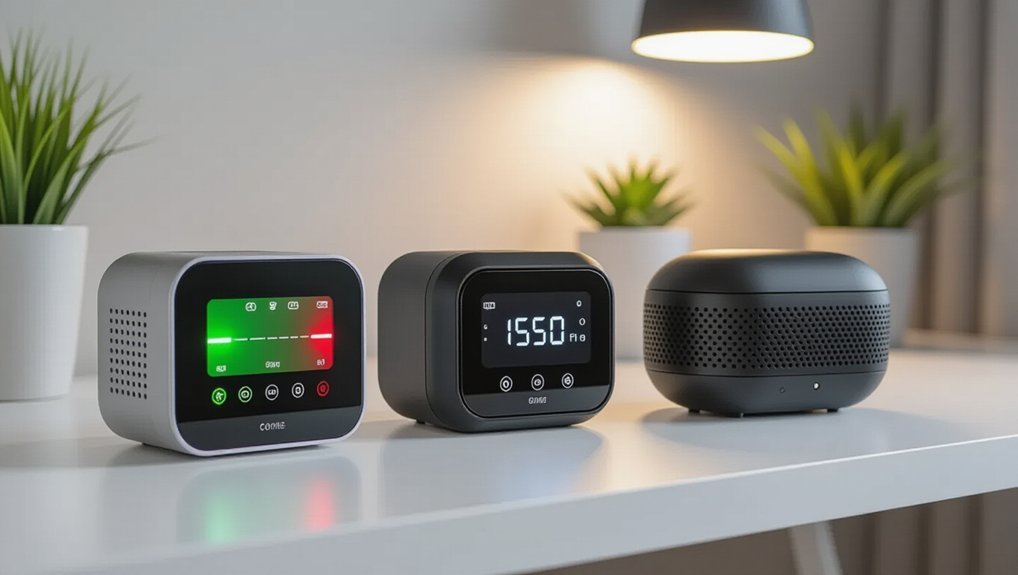
3 Best Air Quality Monitors for Asthma Patients in 2026
If you or someone close to you battles asthma, choosing the right air quality monitor isn’t just about accuracy but also about real-time alerts and ease of use. Experts recommend devices with multi-pollutant detection, capable of tracking PM2.5, CO2, and VOCs—those sneaky irritants that can trigger asthma attacks—and features like large, adjustable displays and customizable alert thresholds. Think of it as having a vigilant companion that constantly guarantees your indoor air stays safe, but the best options are often packed with nuanced sensors and calibration standards that keep you confident. Curious which models hit these marks with lab-grade precision and user-friendly interfaces? Let’s explore them.
Bonoch 16-in-1 Indoor Air Quality Monitor with 7 Display and AQI Alerts

- 【16-in-1 Air Quality Monitor Indoor】 Ensure healthier indoor air with bonoch’s AirSentry 16-in-1 Air...
- 【External High-Precision Sensors (0.001 Accuracy)】 Precision meets performance with external high-accuracy...
Last update on 2026-06-09 / Affiliate links / Images from Amazon Product Advertising API
If you have asthma or are worried about indoor air, the Bonoch 16-in-1 Indoor Air Quality Monitor is a great tool. It keeps track of nine key air parts like CO2, PM2.5, formaldehyde, and TVOC. This gives you a clear view of your home’s air quality at all times.
The device has a big 7-inch LED screen that shows the data in a simple way. You can change the brightness to make it easy to read, whether it’s day or night. It also has seven alert settings that you can customize. If the air quality gets worse, the monitor will send alerts or make a sound to warn you right away. The sensors inside are high-quality. They take samples of the air directly to give you lab-like accuracy. This helps you stay aware and react quickly if something is off.
Good For: People with breathing problems who want to keep their indoor air safe and healthy.
Pros:
- Checks nine air parts, like CO2, PM2.5, formaldehyde, and TVOC.
- Large 7-inch screen with adjustable brightness makes it easy to see the data.
- Custom alerts and sounds startle you when the air becomes unsafe.
Cons:
- The high-quality sensors need careful handling to stay accurate.
- The size and features may feel complicated for those who want simple air checks.
- Some may find setting up alerts and options a little tricky at first.
This device is handy for anyone who wants to improve their air quality and breathe easier. It helps you stay informed and safe in your home.
Smart 128s Indoor Air Quality Monitor (CO2, PM2.5, TVOC, Formaldehyde, Dust Particles)

- FINE PARTICLE DUST LEVEL -- Laser air quality sensor can measure indoor dust level in real time. 6-channel...
- CO2 SENSOR & HCHO SENSOR -- NDIR Non-Spectral Infrared CO2 Carbon Dioxide Sensor with self-calibration...
Last update on 2026-06-09 / Affiliate links / Images from Amazon Product Advertising API
The Smart 128s Indoor Air Quality Monitor is a great choice for families with asthma or allergy sufferers. It gives real-time data on many indoor pollutants that can trigger breathing problems. The device uses laser sensors to measure dust particles in six sizes, from tiny PM0.3 to bigger PM10. This way, it makes sure you catch any irritants that could bother your lungs. It also has an NDIR infrared sensor that gives accurate CO2 readings, so you know how good your air is. The formaldehyde sensor uses a special electrochemical system, and it measures TVOCs—fumes that can cause headaches or irritation. The monitor saves all this data so you can see trends over time, and it is built tough for easy indoor use. Its rechargeable battery and silent fan make it simple to use anywhere in your home.
Best For: homes with people who have asthma or allergies, who want to see their air quality in real time and keep their indoor air clean.
Pros:
- Checks dust, CO2, formaldehyde, and TVOCs all in one device
- Stores a lot of data so you can track changes
- Portable and quiet, with a rechargeable battery for easy use
Cons:
- Needs regular calibration to stay accurate
- A bit bigger than simpler monitors
- Costs more than basic models that check only one thing
This monitor helps you breathe easier by showing you what’s in your indoor air. It’s easy to understand and gives you the info you need to keep your home safe and healthy.
16-in-1 Air Quality Monitor with Display and Alerts

- 【16-in-1 Air Quality Monitor Indoor】Experience the ultimate indoor air quality monitoring with our 16-in...
- 【Crystal Clear 7-inch Large Display】Enjoy a 7-inch LED display for sharp, clear air quality readings...
Last update on 2026-06-09 / Affiliate links / Images from Amazon Product Advertising API
The 16-in-1 Air Quality Monitor with Display and Alerts is a good choice for anyone who wants to keep their indoor air safe. It tests nine important things, like CO2, PM2.5, formaldehyde, TVOC, temperature, humidity, and AQI. This gives you a clear picture of your indoor air. The monitor has a big 7-inch LED screen that shows real-time data, so you always know what’s happening. It also has seven buzzers that go off if the air gets dangerous, so you get alerted immediately. You can adjust the brightness, alert sounds, and set the time easily, making it simple to use. This device helps you stay in control of your air quality and keep your home healthy.
Best For: people who care about their indoor air, allergy sufferers, and families that want quick alerts about air quality issues.
Pros:
- Checks 9 important air quality factors for a full view
- Large 7-inch screen that is easy to see
- Multiple buzzers that alert you fast if air levels are unsafe
Cons:
- The sensors need careful handling; avoid perfumes or strong smells near them
- The device is big, so it might not fit well in small or cluttered spaces
- Setting up and changing settings might be tricky for beginners
Factors to Consider When Choosing Air Quality Monitors for Asthma Patients
When choosing an air quality monitor for asthma, you’ll want to focus on its ability to accurately detect pollutants like PM2.5, VOCs, and humidity levels, since false readings won’t help you breathe easier. Real-time monitoring and customizable alerts can be game-changers, letting you know immediately if pollutant levels spike—no more sleeping through sneezes or surprise asthma attacks. Don’t forget to think about how easy it is to use and maintain the device; after all, you want something straightforward, not another household puzzle, and sensors that stay accurate without requiring constant tinkering.
Accurate Pollutant Detection
Making sure your air quality monitor detects pollutants correctly is really important. It’s not just about getting numbers; you need accurate data that helps you manage asthma better. Sensors that are precise matter a lot. They can measure stuff like CO2 and dust within tiny units, so you know the readings are trustworthy. Good monitors also check temperature and humidity carefully—within a few degrees and a few percent—so you can spot changes that might cause symptoms. Multiple sensors work together to catch small changes early. Better airflow design helps the monitor detect problems sooner. External sensors, placed outside or near the air, can find pollutants like formaldehyde, VOCs, and dust, which are important to know about. Reliable calibration and features that stop false alarms—like from perfumes or sprays—keep your readings accurate when you need them most.
Real-Time Monitoring Ability
Choosing a monitor with real-time monitoring is important if you want to stay safe from sudden changes in air quality. These monitors give you immediate data about pollutants like PM2.5, VOCs, or CO2. When these levels go up, the device will send an alert right away. This quick warning lets you open a window or leave the room before you start to feel sick. Real-time data makes sure you catch even small spikes in pollution. These can happen quickly, so fast detection is key. With updates happening all the time, you can control your indoor air and avoid flare-ups. It’s like having a watchful eye that always warns you of danger before things get worse.
Alert Customization Options
Do you know how much you can change your air quality alerts? Many air monitors let you set your own alert levels, so you only get notified when pollution is at a level that really matters to you. You can choose to get alerts for specific pollutants, which is useful if you have allergies or asthma. Some devices let you pick how you are notified, like feeling a small vibration, hearing a gentle sound, or seeing a color change on the screen. You might also be able to turn alerts off when you don’t want to be disturbed or change the alert sounds. Setting these options helps you receive alerts that suit your needs. This way, you stay informed without getting too many notifications.
Sensor Maintenance Needs
Since sensors can lose accuracy over time, regular maintenance is important when choosing an air quality monitor for asthma. Calibrating the sensors often is key. If you don’t calibrate, the readings might be wrong, and you could chase false pollution signals. Many monitors have self-check features that tell you when to adjust or replace sensors. Cleaning the sensor surfaces and making sure air can flow freely around the device also help. Dust or blocked vents can block detection and cause false readings. Sensors that measure gases like formaldehyde or TVOCs may need calibration or replacement after a few months, as their ability to detect drops over time. Things like perfumes or fumes from chemicals can interfere too. Calibration is not a one-time task. It needs to be part of regular upkeep. Doing so helps keep your monitor accurate and trustworthy.
Ease of Use
When choosing an air quality monitor for asthma, ease of use is just as important as accuracy. Look for a device that is simple to operate. Clear buttons and labels help you find what you need quickly. A big, bright screen makes it easy to see the air quality levels at a glance. You shouldn’t have to strain your eyes or get close to the device to read the numbers.
Opt for a monitor that is easy to set up and doesn’t need a lot of calibration. This saves you time and frustration. Features like alerts that sound or light up can warn you about bad air without causing worry. Being able to change units from Fahrenheit to Celsius easily or manage alarms simply makes daily checks easier.
A device with these simple features helps you stay on top of your asthma management without feeling overwhelmed. It keeps you focused on your health, not on figuring out how to use the monitor.
Data Storage Capacity
Having enough storage is important when choosing an air quality monitor for asthma. If you want to track air conditions over several weeks or months, the device needs enough space to save all the data. Devices with bigger storage can record things like PM2.5, VOCs, and humidity for a long time. This helps you see long-term pollution patterns that can affect asthma.
If the storage is small, you will need to delete old data or move files often. This can cause gaps in your records. Look for monitors that have expandable storage or can store data for a long time without needing to be emptied. Larger storage makes it easier to keep recording without interruptions. It also helps when you want to look back and analyze your air quality history, which can help you manage asthma better.
Battery and Power Source
Pick a power source for your air quality monitor that you can count on. Look for monitors with rechargeable batteries or good power adapters. This ensures you don’t lose data during a power outage. Batteries that last a long time—hours or days—are helpful. Choose models that don’t use a lot of power. These batteries last longer and need less charging. Many monitors show a battery level. This helps you know when to recharge or change batteries. Make sure the power source fits your needs. It can be USB chargers, wall adapters, or portable batteries. Pick the option that works best in your space and daily life. That way, your monitor stays ready to give accurate data whenever you need it.
FAQs
How Accurate Are Household Air Quality Monitors Compared to Professional-Grade Devices?
Household air quality monitors provide useful real-time data, but their accuracy varies and they generally don’t match professional-grade devices. You can rely on them for continuous tracking but should consider professional tests for precise assessments.
Can Air Quality Monitors Detect Specific Allergens Causing Asthma Symptoms?
Air quality monitors can often detect common allergens like dust, pollen, and mold spores, helping you identify triggers. While they might not specify every allergen, they give valuable data to manage your asthma effectively.
What Is the Ideal Placement for an Air Quality Monitor in a Home?
You should place your air quality monitor in a central location, away from windows and vents, to get accurate readings. Keep it at breathing level and avoid directly exposing it to airflow or sources of pollution for best results.
Do Air Quality Monitors Require Calibration for Consistent Accuracy?
You need to calibrate your air quality monitor regularly to guarantee it stays accurate. Follow the manufacturer’s instructions, as calibration helps maintain reliable readings and effective monitoring, especially when keeping track of asthma triggers in your home.
How Often Should Air Quality Monitors Be Maintained or Replaced?
You should typically maintain your air quality monitor monthly by checking sensors and cleaning if needed. Replace sensors or the device itself every 1 to 2 years, depending on usage and manufacturer recommendations, to guarantee accurate readings.

DK is a technology expert who specializes in AI tools, software, and tech gadgets. He writes for How to Tech Info, providing detailed reviews and practical guides. DK helps readers discover the best AI applications, navigate new software, and choose the right tech gadgets.