
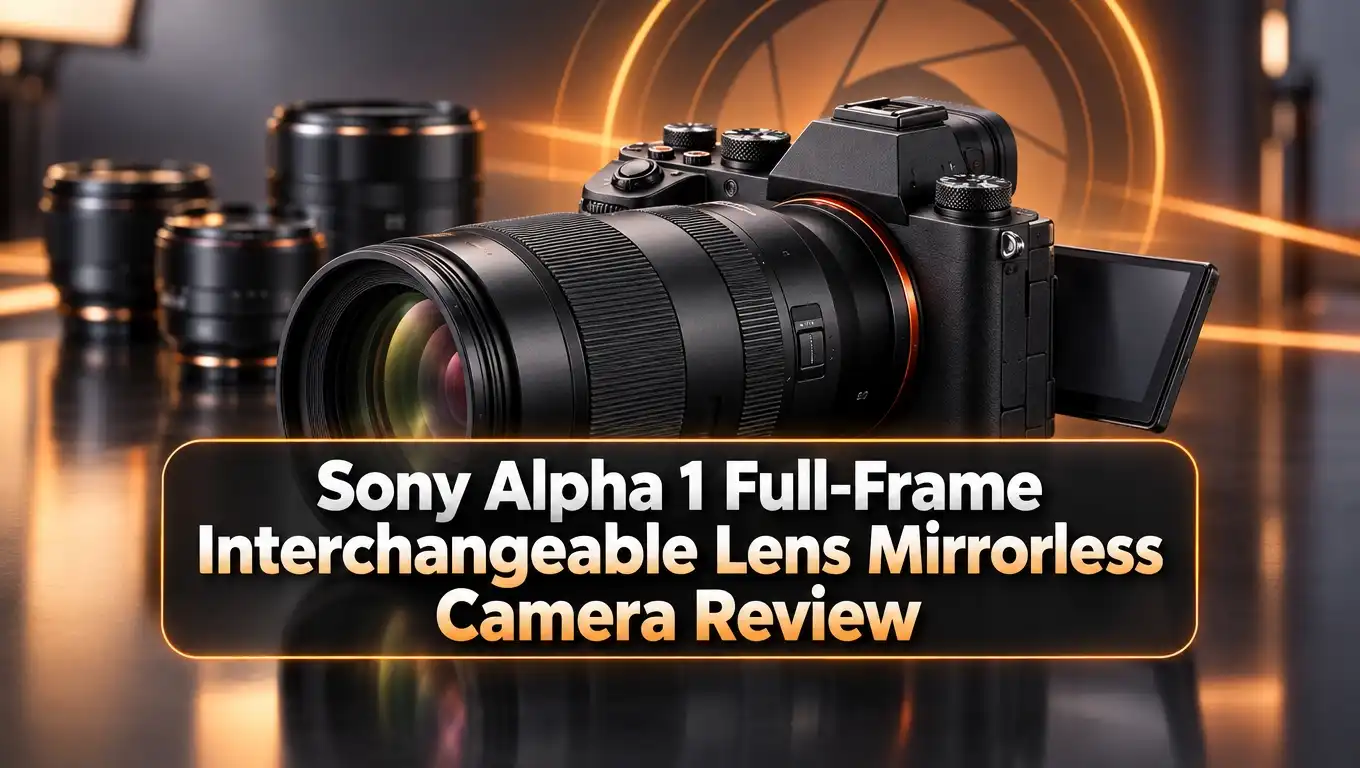
Sony Alpha 1 Review 2026: 50MP Speed Monster Still Worth It?
Picture a camera that shoots 50 megapixel photos at 30 frames per second. Now add 8K video and some of the best autofocus ever made. That camera is the Sony Alpha 1, and it changed what photographers expect from one body.
Sony launched it in early 2021 at $6,498. Its successor, the Alpha 1 II, now exists too. So here is the big question. Does the original Alpha 1 still make sense for you today?
In this review, I cover the sensor, autofocus, video, battery, and more. I also share honest pros, cons, and strong alternatives. Stay with me, because the answer might save you a lot of money.
In a Nutshell
- Resolution and speed together: The Alpha 1 has a 50.1MP stacked Exmor RS sensor that shoots up to 30 fps with full AF and AE tracking. Before this camera, you had to choose between resolution and speed. The Alpha 1 gives you both in one body.
- Top tier autofocus: It makes 120 AF/AE calculations per second and has Real time Eye AF for humans, animals, and birds. It locks onto subjects fast and stays locked, even when they move in unpredictable ways.
- Serious video power: The camera records 8K 30p and 4K 120p video in 10 bit. It also offers S Log3 and RAW output over HDMI, so filmmakers get plenty of room for color grading.
- Class leading viewfinder: The 9.44 million dot OLED EVF runs at up to 240 fps with 0.9x magnification. It is bright, sharp, and very smooth, and you get no blackout during bursts.
- Better value in 2026: The launch price was $6,498. Now renewed units have been listed on Amazon for around $3,374, which makes this flagship much easier to afford.
- Main downsides: The rear screen only tilts, and the menus take time to learn. Battery life is average for heavy video use.
Sony Alpha 1 Full Frame Interchangeable Lens Mirrorless Camera

- 50.1MP full-frame stacked Exmor RS CMOS sensor w/ integral memory
- 8x more powerful, next generation BIONZ XR image processing engine

Last update on 2026-09-29 / Affiliate links / Images from Amazon Product Advertising API
The Sony Alpha 1 is Sony’s flagship full frame mirrorless camera. Sony built it for professionals who shoot everything, including sports, wildlife, weddings, landscapes, and films. It mixes the speed of the A9 series with the resolution of the A7R series.
At its heart sits a 50.1MP full frame stacked sensor with integral memory. That memory lets the sensor read data very quickly. The fast readout drives the 30 fps bursts and the 8K video.
Sony paired this sensor with the BIONZ XR processor. Sony says it is up to eight times more powerful than the older engine. You notice that speed in quick startup, fast menus, and smooth buffer clearing.
The camera uses the Sony E mount, which has a huge lens lineup. You can pick from Sony G Master lenses and third party options from Sigma, Tamron, and others. That choice gives you great flexibility at every budget.
The Alpha 1 also keeps a familiar body style. If you have used an A7 or A9 camera, you will feel at home fast. That familiarity is a real advantage for pros who work under pressure.
In short, this camera tries to do everything well. Most reviewers agree it succeeds. DPReview called it “the most refined Alpha series interchangeable lens camera yet” at the time of its release. The rest of this review looks at each part of the camera in detail.
Design and Build Quality
The Alpha 1 feels solid in your hands. It weighs about 737 grams with battery and card, so it is light for a flagship. Heavy DSLR flagships often weigh twice as much.
The body uses a magnesium alloy frame. Sony also added dust and moisture resistance. I would not shoot in a storm without cover, but light rain and dust are fine.
The grip is deep and comfortable. People with large hands may find it a bit small with big telephoto lenses. A vertical grip fixes this and doubles your battery capacity too.
Controls are placed well. You get a drive mode dial and a focus mode dial on the top left, plus an exposure compensation dial on the right. These physical dials let you change settings without opening menus.
The rear has a joystick for fast AF point selection. Custom buttons are everywhere, and you can program most of them. Custom buttons save time during fast events like weddings or sports.
Sony also improved the port layout. You get a full size HDMI port, which is great for video work. There is also a LAN port for fast file transfers on news and sports jobs.
The main design weak spot is the rear screen. It tilts up and down but does not flip out to the side. Vloggers and video shooters would prefer a fully articulating screen. The Alpha 1 II later fixed this with a four axis screen.
Sensor and Image Quality
The 50.1MP stacked sensor is the star of this camera. It captures huge files with fine detail. You can crop hard and still get sharp prints.
Dynamic range is excellent at base ISO. Sony rates it at around 15 stops for stills. You can pull detail from dark shadows without much noise.
The native ISO range runs from 100 to 32,000. You can extend it from 50 to 102,400. Clean results come up to around ISO 6400, and usable ones go even higher.
Color output looks natural. Sony has improved its skin tones a lot over the years. Portraits from the Alpha 1 look warm and pleasing right out of the camera.
The camera also offers a Pixel Shift Multi Shooting mode. It combines up to 16 images into a single file of about 199 megapixels. This mode works best for still subjects like architecture and art reproduction. You need a tripod and Sony’s Imaging Edge software to merge the files.
One more detail matters here. The stacked sensor reads out very fast, which reduces rolling shutter distortion. That means fast subjects, like golf swings, look straight and natural with the electronic shutter.
You can shoot uncompressed RAW, lossless compressed RAW, or compressed RAW. Just note that 30 fps bursts require compressed RAW or JPEG. For most uses, the quality difference is very small. For landscapes and studio work, lossless RAW gives you the best files.
Top 3 Alternative for Sony Alpha 1
The Alpha 1 is amazing, but it may not be right for everyone. Here are three strong alternatives worth checking.

- Sony’s extensive high-performance G Master line work with the 50.1 megapixel*1 Exmor RS image sensor and...
- The massive volume of data from the 50.1 megapixel*1 full-frame Exmor RS image sensor is processed in real...
Last update on 2026-09-29 / Affiliate links / Images from Amazon Product Advertising API
The Sony Alpha 1 II is the direct successor. It keeps the 50.1MP sensor and 30 fps speed. It adds an AI processing unit for smarter subject recognition. Stabilization also improves, up to 8.5 stops at the center.
It also has a fully articulating four axis screen and a deeper grip. If you want the newest Sony tech, this is the pick. It costs more than a used or renewed original, though.

- High Image Quality: Canon EOS R5 8K digital camera features a stacked, back-side illuminated 45-megapixel...
- Powerful Image Processor: DIGIC X image processor with an ISO range of 100-51200; expandable to 102400x...
Last update on 2026-09-29 / Affiliate links / Images from Amazon Product Advertising API
The Canon EOS R5 is a great choice for Canon fans. It has a 45MP sensor and 8K RAW video. Its Dual Pixel CMOS AF II is very reliable.
The R5 also has a flip out screen and strong in body stabilization. It usually costs much less than the Alpha 1. The trade off is overheating in long 8K clips and a slower burst rate of 20 fps.

- 45.7MP Stacked CMOS sensor and EXPEED 7 image processing. Fast powerful AF that can keep up with the fastest...
- Subject detection uses deep learning to automatically detect and track people, cats, dogs, birds, cars...
Last update on 2026-09-29 / Affiliate links / Images from Amazon Product Advertising API
The Nikon Z9 is Nikon’s flagship powerhouse. It has a 45.7MP stacked sensor and no mechanical shutter at all. It shoots 8K video and 20 fps RAW bursts, or faster in JPEG.
The Z9 has a built in vertical grip and a huge battery. It is heavier than the Alpha 1, but it is extremely durable. Nikon has also added many features through firmware updates.
Autofocus Performance
The Alpha 1 autofocus is one of its biggest strengths. It uses 759 phase detection points that cover about 92 percent of the frame. That wide coverage lets you track subjects near the edges.
The system makes 120 AF and AE calculations per second. This is twice the rate of earlier Sony models. The result is sharper tracking of fast subjects.
Real time Eye AF works for humans, animals, and birds. Bird shooters love this camera for that reason. It finds a small bird eye even against busy backgrounds.
Real time Tracking is also excellent. You tap a subject, and the camera follows it across the frame. It uses color, pattern, and distance data to stay locked.
In real use, the hit rate is very high. Sports shooters report very few missed frames in long bursts. Wildlife photographers praise how it handles birds in flight.
Low light AF works down to EV negative 4 with an f/2 lens. That means indoor events and dim churches are fine. Focus stays quick even in poor light.
There is one small note here. The Alpha 1 lacks the AI based subject detection of the Alpha 1 II. It cannot detect cars, trains, or insects. For most people, the human, animal, and bird modes cover what they need. For motorsport shooters, the newer model may be worth the extra cost.
Burst Shooting and Speed
Speed is where the Alpha 1 really shines. It shoots up to 30 frames per second with the electronic shutter. It does this with full autofocus and exposure tracking.
Best of all, you get blackout free shooting. The viewfinder never goes dark during bursts. You see the action live, which makes following subjects much easier.
The mechanical shutter tops out at 10 fps. That is still fast for most jobs. You might use it under flickering lights or with certain flash setups.
The buffer is deep. You can capture more than 155 compressed RAW frames at full speed. With JPEG, you can shoot even longer before the camera slows down.
Fast memory cards matter a lot here. The camera supports CFexpress Type A cards. These cards clear the buffer much faster than SD cards.
The Alpha 1 also has an anti flicker feature for the electronic shutter. It reduces banding under LED and fluorescent lights. This helps a lot in indoor arenas and gyms.
Sports and news photographers will love this speed. You can catch the exact moment a ball hits a bat. Missing the peak moment becomes rare with this camera.
For casual shooters, 30 fps can feel like too much. You end up with thousands of files to sort. Luckily, you can set lower burst rates for daily use.
Video Capabilities
The Alpha 1 is a true hybrid camera. It records 8K video at 30p in 10 bit 4:2:0. The 8K footage comes from an 8.6K oversampled readout, so it looks very sharp.
For 4K, you get up to 120 fps for smooth slow motion. The 4K footage is also oversampled in some modes. That gives clean, detailed video.
Serious filmmakers get S Log3 and S Cinetone profiles. S Log3 gives wide dynamic range for grading. S Cinetone gives a pleasing film look straight from the camera.
You can also send 16 bit RAW video out over HDMI to an external recorder. This gives the most editing room. Pros on larger sets will value this option.
Heat management is good. Sony used a heat dissipating structure in the body. You can record 8K for about 30 minutes in normal conditions, which is long for this class.
The camera supports XAVC HS, XAVC S, and XAVC S I codecs. XAVC HS uses the efficient H.265 format. That saves storage space without losing much quality.
Autofocus in video is excellent too. Eye AF tracks faces smoothly during movement. Focus transitions look natural and cinematic.
There are a few weak points. The tilting screen limits front facing shots. Also, 4K 120p comes with a slight crop. Still, the Alpha 1 remains a strong video tool in 2026.
Viewfinder and Screen
The Alpha 1 viewfinder is stunning. It has 9.44 million dots and 0.9x magnification. When it launched, it was the highest resolution EVF on the market.
It also runs at up to 240 fps refresh rate. That makes moving subjects look very smooth. You get less lag, which helps with tracking fast action.
The image looks bright and clear. Many people say it feels close to an optical viewfinder. Once you use it, other EVFs feel dull.
The eyepiece is comfortable, even for people who wear glasses. You see the full frame without pressing your eye hard. That matters on long shoots.
The rear screen is a 3.0 inch tilting touchscreen with 1.44 million dots. It works fine for menus and playback. However, its resolution is low for a flagship camera.
The screen tilts up and down only. It does not flip to face you. This limits vlogging and awkward angle video work.
Touch controls work for focus point selection. You can also use touch to scroll through photos. Sony has improved its touch menu support compared to older models.
The menu system uses Sony’s newer layout with color coded tabs. It is easier than old Sony menus. Still, it has many settings, so new users need some time. I suggest setting up the My Menu tab with your favorite settings.
Image Stabilization
The Alpha 1 has 5 axis in body image stabilization. Sony rates it at 5.5 stops of shake reduction. This helps a lot with handheld shots.
With stabilization on, you can shoot sharp images at slow shutter speeds. For example, you might shoot at 1/15 second with a 50mm lens. That is great for low light scenes without a tripod.
The system works with all lenses. It even helps adapted lenses without their own stabilization. You enter the focal length for manual lenses to get the best results.
For video, the camera offers Active Mode. This mode adds digital stabilization on top of the sensor movement. It adds a small crop, but it makes walking shots smoother.
Sony also supports gyro data recording. You can use Sony Catalyst Browse software to stabilize footage later. This gives very smooth results for handheld video.
Keep in mind that 50MP sensors show small shakes more clearly. You may need faster shutter speeds than with lower resolution cameras. A good rule is to double the usual minimum shutter speed.
Compared to rivals, the Alpha 1 stabilization is good but not best in class. Canon and Nikon offer slightly higher ratings. The Alpha 1 II also improved on this a lot. Still, for most shooting, the Alpha 1 system works very well.
Battery Life and Storage
The Alpha 1 uses the NP FZ100 battery. This is the same battery found in the A7 IV and A9 II. Many Sony shooters already own spares.
CIPA rates the battery at about 430 shots with the EVF and around 530 shots with the rear screen. Real world numbers are often much higher. Many users get over 1,000 shots per charge for stills.
Video drains the battery faster. Long 8K sessions will need extra batteries. I suggest carrying at least two spares for a full day of video.
You can charge the camera over USB C. You can also power it directly while shooting. That helps for long timelapses or studio work.
For storage, the camera has two dual format card slots. Each slot takes either CFexpress Type A or SD UHS II cards. This setup gives you great flexibility.
CFexpress Type A cards are fast but expensive. They are needed for the highest video bitrates and the fastest buffer clearing. SD cards work well for regular stills and lighter video.
You can record to both cards at the same time. Dual recording creates an instant backup. Wedding and event photographers will appreciate this safety feature.
One tip: CFexpress Type A cards cost more per gigabyte than Type B. Budget for this before you buy. Card costs can add up quickly with 50MP files and 8K video.
Flash Sync and Pro Features
The Alpha 1 offers some rare pro features. The biggest one is its 1/400 second flash sync with the mechanical shutter. That was the fastest sync in a full frame camera at launch.
A faster sync helps outdoor portrait shooters. You can overpower bright sunlight with flash more easily. You also need less high speed sync, which saves flash power.
Even with the electronic shutter, it syncs at 1/200 second. Few cameras could use flash with an electronic shutter at all. This lets you shoot silently with flash in some situations.
The camera also shoots flash at up to 10 fps with compatible Sony flashes. Event shooters can capture fast moments without waiting for recycle times.
Connectivity is strong. You get built in Wi Fi, Bluetooth, and a wired LAN port. The camera supports FTP transfer for sending images to editors quickly.
News and sports agencies love this. Photographers can send images from the sideline within seconds. That speed matters when publications race to post first.
There is also a 5G ready option through compatible phones. Sony designed this to support fast mobile transfers. The Transfer and Tagging app adds voice memos and captions.
Finally, the camera supports tethered shooting via USB C and software like Capture One. Studio shooters can see images on a large monitor right away. These features show that Sony built the Alpha 1 for working pros.
Who Should Buy the Sony Alpha 1
The Alpha 1 is not for everyone. It fits specific users very well. Let me break it down.
Wildlife and bird photographers are ideal buyers. The bird Eye AF, 30 fps bursts, and 50MP files allow deep crops. You can capture sharp birds in flight and crop in for detail.
Sports photographers will love the speed and blackout free viewfinder. The fast FTP transfer helps with tight deadlines. The anti flicker feature helps in indoor arenas.
Wedding and event shooters also benefit. They get high resolution portraits and silent shooting in quiet moments. Dual card slots add peace of mind.
Hybrid creators who shoot photos and video get great value. The 8K video and S Log3 support cover most client work. One camera can handle both jobs.
Landscape photographers can use it too. The 50MP sensor and pixel shift mode deliver huge detail. However, a cheaper A7R model may serve them better.
Who should skip it? Beginners will not use most of its features. The price is too high for learning. A Sony A7 IV or A6700 makes more sense.
Vloggers may also prefer another camera. The tilting screen makes self filming awkward. The Sony ZV E1 or FX3 might suit them better.
With renewed prices near half the launch cost, the Alpha 1 is more tempting now. If you shoot fast action at high resolution, it remains a smart buy.
Pros and Cons of Sony Alpha 1
Every camera has strengths and weak points. Here is an honest look at both sides of the Sony Alpha 1.
Pros
- The 50.1MP stacked sensor delivers excellent detail and wide dynamic range for all kinds of shooting.
- It shoots 30 fps bursts with full AF and AE tracking and no viewfinder blackout.
- Real time Eye AF for humans, animals, and birds tracks subjects with a very high hit rate.
- It records 8K 30p and 4K 120p video in 10 bit with S Log3 support.
- The 9.44 million dot EVF at 240 fps is one of the best viewfinders ever made.
- The 1/400 second flash sync is very fast and helps outdoor flash work.
- Dual card slots accept CFexpress Type A and SD UHS II cards for flexible storage.
- It is compact and light for a flagship camera, at about 737 grams.
Cons
- The rear screen only tilts and has a low resolution for the price.
- The launch price was very high, although renewed deals have lowered the cost.
- CFexpress Type A cards are expensive and sold in smaller sizes.
- 30 fps bursts need compressed RAW or JPEG files.
- It lacks AI subject detection for cars, trains, and insects, which the Alpha 1 II adds.
- The grip can feel small with large telephoto lenses.
- Battery life drains quickly during long 8K video sessions.
Overall, the pros clearly outweigh the cons for professional shooters. The weak points mostly affect video and vlogging users.
Final Verdict
The Sony Alpha 1 changed the camera industry. It proved that one body could offer high resolution, extreme speed, and pro video. Before 2021, no camera did all three this well.
Five years later, it still performs at a very high level. The sensor, autofocus, and viewfinder hold up well against newer rivals. Many pros still use it every day.
The Alpha 1 II does improve on it. You get AI subject detection, better stabilization, and a better screen. However, the core image quality and speed stay very similar.
That makes the original a great value pick in 2026. Renewed units have shown up for roughly half the launch price. For that money, you get flagship performance that few cameras match.
Should you buy it? If you shoot wildlife, sports, or events, the answer is yes. It will handle almost any job you give it.
If you mainly shoot video for YouTube, look at other options. The screen design and battery life may annoy you. The Sony FX3 or A7S III could fit better.
Also, remember the hidden costs. You will need fast cards, extra batteries, and good lenses. A 50MP sensor rewards sharp glass, so budget for quality lenses.
In the end, the Alpha 1 is still a true flagship. It is fast, sharp, and reliable. For the right shooter, it remains one of the best cameras money can buy.
FAQs
Is the Sony Alpha 1 still worth buying in 2026?
Yes, for many pros it is. Its 50MP sensor, 30 fps speed, and top autofocus still compete with newer cameras. Lower renewed prices make it an even better value.
What is the difference between the Sony Alpha 1 and Alpha 1 II?
The Alpha 1 II adds an AI processing unit for better subject detection. It also has stronger stabilization, a four axis screen, and a deeper grip. The sensor resolution and burst speed stay the same.
Does the Sony Alpha 1 overheat during 8K recording?
It handles heat well for its class. Most users can record 8K for about 30 minutes in normal temperatures. Hot weather may shorten this time.
What memory cards does the Sony Alpha 1 use?
It uses CFexpress Type A and SD UHS II cards. Both card slots accept either format. CFexpress Type A cards give the best speed for bursts and high bitrate video.
How many photos can the Sony Alpha 1 take per battery?
CIPA rates it at about 430 shots with the viewfinder and about 530 with the rear screen. Real world stills shooting often goes well past 1,000 shots per charge.
Is the Sony Alpha 1 good for beginners?
It is not the best choice for beginners. It is expensive, and its many settings can feel overwhelming. A Sony A7 IV or A6700 suits new users better.
Can the Sony Alpha 1 shoot RAW video?
It cannot record RAW video internally. However, it can send 16 bit RAW video over HDMI to a compatible external recorder, such as an Atomos Ninja.
What is the fastest flash sync speed on the Sony Alpha 1?
It syncs flash at up to 1/400 second with the mechanical shutter. With the electronic shutter, it syncs at up to 1/200 second.

DK is a technology expert who specializes in AI tools, software, and tech gadgets. He writes for How to Tech Info, providing detailed reviews and practical guides. DK helps readers discover the best AI applications, navigate new software, and choose the right tech gadgets.


