
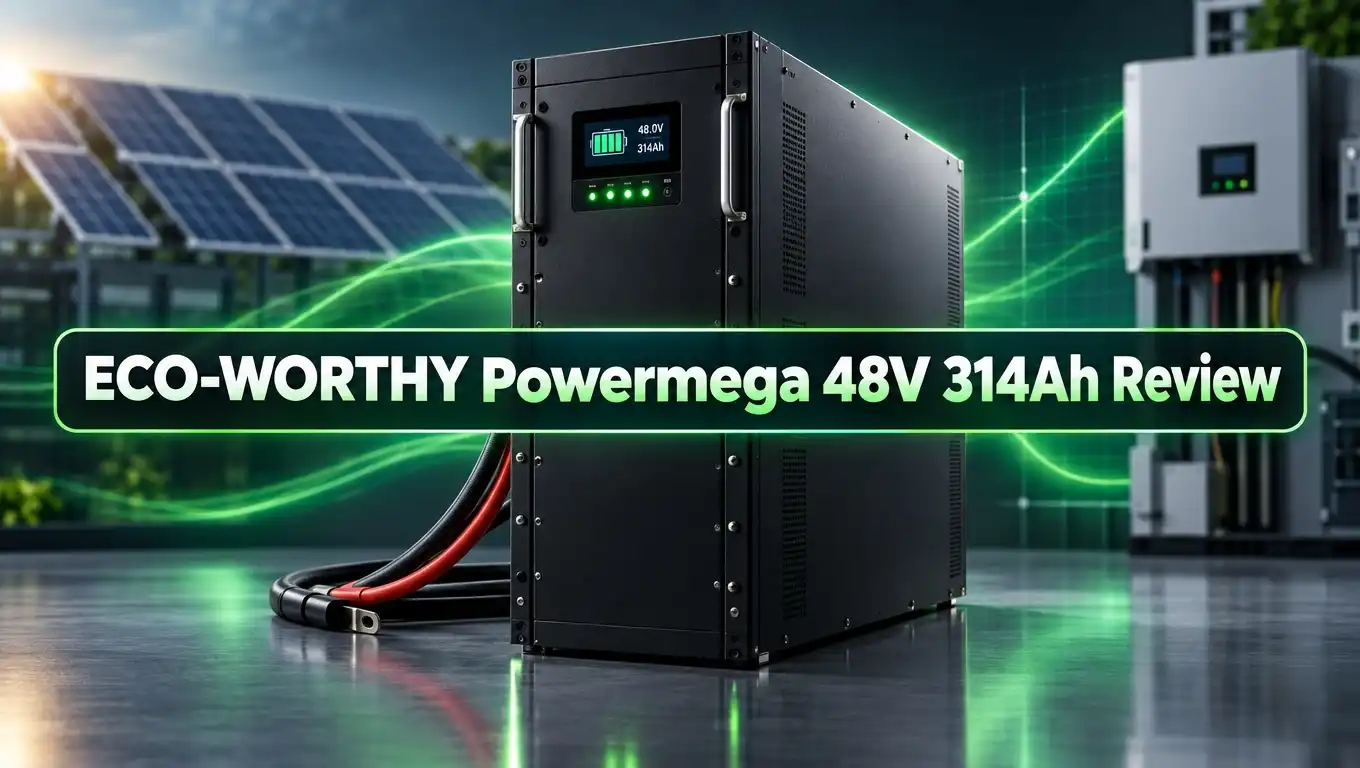
ECO-WORTHY Powermega 48V 314Ah Review: 16kWh Battery Worth It?
Your power goes out. The fridge stops humming. The lights go dark. Now picture a single battery that keeps your whole home running through the night. That is the promise of the ECO-WORTHY Powermega 48V 314Ah. It packs 16.08kWh of energy into one rolling cabinet, for about $2,600.
This review covers everything. You will learn about the cells, the BMS, the safety features, and the real limits. I also share what early owners say. By the end, you will know if this battery fits your home, cabin, or workshop.
In a Nutshell
- Huge capacity in one box: The Powermega stores 16.08kWh using 16 Grade A 314Ah LiFePO4 cells. One unit can run a small home’s essentials through a full night. You can also link up to 15 units for a total of 241kWh.
- Smart 200A BMS with active balancing: A PACE 200A BMS protects the battery. A dual channel 2A active balancer keeps the cells even. This helps the battery hold its full capacity for years.
- Two layers of safety: A 250A two pole breaker with shunt trip backs up the BMS. An aerosol fire suppression module adds extra peace of mind inside the cabinet.
- Easy monitoring: A 7 inch color touchscreen shows live data. Bluetooth and WiFi let you check the battery from your phone. PC software gives deeper data for troubleshooting.
- Strong value: At about $162 per kWh, the price beats many big brand wall batteries. It also carries a 10 year warranty.
- Main weak spot: It has no self heating. It will not charge below 32°F, so cold garages and northern cabins need a warm spot.
ECO-WORTHY Powermega 48V 314Ah LiFePO4 Battery

- UL 1973 Certified for Safety & Reliability: The Powermega 48V 314Ah is UL 1973 certified and backed by a...
- 16.07kWh High Capacity: ECO-WORTHY 48V 314Ah LiFePO4 battery delivers 16.07kWh of powerful energy in a compact...
Last update on 2026-09-29 / Affiliate links / Images from Amazon Product Advertising API
The ECO-WORTHY Powermega 48V 314Ah is the brand’s biggest single battery so far. ECO-WORTHY calls it the “PowerMega 314.” It launched in early 2026 as the first model in a new series. The series targets home backup and off grid solar systems.
Most 48V batteries come in 100Ah server rack modules. You stack three of them to reach about 15kWh. The Powermega takes a different path. It puts all 16kWh into one cabinet. That means fewer cables, fewer connections, and fewer failure points.
The battery sits on the floor on locking caster wheels. It fits in a garage, a utility room, or an off grid shed. You roll it into place and lock the wheels. Then you connect it to your inverter.
The Amazon listing shows a 4.8 star rating from early buyers. Customers say it works as expected and gives good value for money. One buyer even said it could power a house.
ECO-WORTHY aims this battery at two groups. The first group is DIY solar fans who build their own systems. The second group is electricians who design backup systems for clients. Both groups want big storage at a fair price.
In this review, I break down each feature one by one. I also point out the trade offs. No battery is perfect, and this one has a few quirks you should know about before you buy.
Key Specifications at a Glance
Specs tell you a lot about a battery. Here are the numbers that matter most for the Powermega 314.
The battery has a nominal voltage of 51.2V and a capacity of 314Ah. That gives you 16.08kWh of stored energy. Some listings round this to 16.07kWh or 16.1kWh. They all describe the same battery.
Inside, you find 16 LiFePO4 cells rated at 3.2V and 314Ah each. ECO-WORTHY says these cells hold more than 80% capacity after 10,000 cycles at a 0.5C rate. If you cycle the battery once per day, that works out to over 24 years of use.
The BMS handles 200A of continuous charge and discharge. At 51.2V, that is roughly 10kW of power. This is enough for most home inverters in the 5kW to 10kW range.
The two pole circuit breaker is rated at 250A total. It uses two 125A poles. The breaker includes a shunt trip, so the BMS can cut power in an emergency.
For communication, you get CAN, RS485, and RS232 ports. You also get Bluetooth and WiFi for app monitoring. The 7 inch touchscreen lets you set the inverter protocol right on the battery.
The battery weighs about 280 to 293 pounds. It discharges from minus 4°F to 131°F. It charges from 32°F to 131°F. The best range is 59°F to 86°F.
The warranty lasts 10 years. You can link up to 15 batteries in parallel for 241kWh.
Build Quality and Design
First impressions matter with a battery this big. The Powermega ships in a wooden crate. Early owners say it arrives well packed and in good shape. One buyer said the battery was “very well boxed” and dropped right in the driveway.
The cabinet feels solid. It has a clean metal case with a large touchscreen on the front. The breaker and power switch sit in easy reach. The terminals and communication ports are clearly labeled.
The best design choice is the wheel system. The battery sits on locking casters. You rotate a red gear clockwise to unlock the wheels. You rotate it counterclockwise to lock them. Owners love this feature once the battery stands upright.
You still need two people for the move. At nearly 300 pounds, this is not a one person job. Getting the battery out of the crate and upright takes some planning. A dolly or a friend with strong arms helps a lot.
Some sellers call it a “wall mount” battery. In practice, it is a floor standing unit. The wheels carry the weight, and the design suits garages and utility rooms.
The box includes the battery, a user manual, battery to battery cables, a USB to RS232 cable, and a communication cable. The power cables are 2/0 AWG. That is thick copper, which suits the 200A rating.
If you buy the two pack, ECO-WORTHY adds a free 400A busbar. This makes parallel wiring much cleaner. One early buyer did report a missing cable kit, but support offered to send the parts.
Top 3 Alternative for ECO-WORTHY Powermega 48V 314Ah
The Powermega is a strong choice, but it is not the only one. Here are three alternatives worth a look. Each one fits a slightly different buyer.

- 🌞【48V 314Ah LiFePo4 Battery】Connecting 16S1P 3.2V 314Ah A-grade batteries in series increases the...
- 🌞【Intelligent BMS】This LiFePO4 battery is equipped with a smart 150A BMS to ensure the best protection...
Last update on 2026-09-29 / Affiliate links / Images from Amazon Product Advertising API
The Dawnice 16kWh 51.2V 314Ah battery is the closest rival. It uses the same 314Ah cell size and stores the same 16kWh. It supports CAN and RS485 for inverter communication. The key difference is the BMS. Dawnice uses a 150A BMS, while ECO-WORTHY uses 200A. The Dawnice is also lighter on paper at about 144kg. It costs a little more, near $2,660.

- Upgraded to V2 with 3A Active Balancing — Starting September 10, the new Cubix100 Pro V2 features 3A active...
- 90% Closed-Loop Inverter Compatibility: Seamlessly communicates with most mainstream inverters, including EG...
Last update on 2026-09-29 / Affiliate links / Images from Amazon Product Advertising API
The ECO-WORTHY Cubix100 Pro 48V 100Ah suits buyers who want smaller steps. Each module holds 5.12kWh. You can start with one and add more later. The big win is its low temperature resistant cells. This makes it a better fit for cooler spaces. The Cubix line also carries UL listings that many inspectors like to see.

- LiTime's 48V(51.2V) 100Ah LiFePO4 Stacked Lithium Battery, with premium EV-grade LiFePO4 cells and latest BMS...
- 【Versatile Applications for Home Backup and More】The LiTime battery energy storage system is designed for...
Last update on 2026-09-29 / Affiliate links / Images from Amazon Product Advertising API
The LiTime 51.2V 100Ah ComFlex server rack battery is another modular pick. It uses a slim 3U chassis that fits a standard rack. Each unit holds 5.12kWh. LiTime supports parallel setups for bigger banks. It is a good choice if you already own a rack cabinet.
Pick the Dawnice if you want the same big box format. Pick a 100Ah module if you want flexible, smaller steps.
Grade A Cells and Real Capacity
Cells are the heart of any battery. The Powermega uses 16 Grade A LiFePO4 cells at 314Ah each. The 314Ah cell is a newer size. It has quickly become popular in home storage because it packs more energy per cell.
LiFePO4 chemistry is the safest common lithium type. It resists thermal runaway far better than the NMC cells in many phones and cars. It also lasts much longer. That is why nearly every serious home battery now uses LiFePO4.
ECO-WORTHY rates the cells for 10,000 cycles at 80% capacity. This rating assumes a 0.5C rate. For this battery, 0.5C means about 157A. Most homes draw far less than that on average, so real use should be gentle on the cells.
What does 16kWh mean in daily life? Here is a simple example. A fridge uses about 1.5kWh per day. LED lights use maybe 0.5kWh. A home office adds another 1kWh. A furnace fan adds 2kWh. That totals around 5kWh. One Powermega could run those loads for about three days without sun.
For a full house with AC, the math changes. Central air can use 3kWh or more per hour. In that case, 16kWh might last a few hours. Many owners solve this by adding a second unit.
New owners should know one thing. The state of charge reading may look off at first. Support explains that the BMS needs a few full cycles to learn the real capacity. After that, the readings settle down.
200A BMS with Active Balancing
The BMS is the brain of the battery. The Powermega uses a PACE 200A BMS. PACE is a well known BMS maker in the energy storage market. Many rack and wall batteries use PACE boards.
The standout feature is dual channel 2A active balancing. Most budget batteries use passive balancing. Passive balancing burns off extra energy from high cells as heat. It is slow and wasteful. Active balancing moves energy from high cells to low cells. It is faster and more efficient.
Why does this matter? Cells drift apart over time. When one cell hits full before the others, the whole pack stops charging. This cuts your usable capacity. Good balancing keeps all 16 cells in step, so you get the full 16kWh.
By default, balancing starts when a cell reaches 3400mV and the voltage gap hits 30mV. You can change these settings in the app or PC software. However, ECO-WORTHY warns that changes may affect your warranty. Talk to their tech team first.
The BMS also guards against common faults. Cell overvoltage protection trips at 3600mV after a 1 second delay. Cell undervoltage protection trips at 2700mV. Discharge overcurrent protection works in two stages, at 210A and 250A.
The BMS also blocks overcharge, short circuits, and extreme heat or cold. It even stops charging below freezing. This protects the cells from lithium plating damage.
Early owners report cell voltages staying close together. One user saw all cells within a tight range while the BMS showed “equalizing” in the app.
Safety Features That Protect Your Home
A 16kWh battery holds a lot of energy. Safety should be a top concern. The Powermega uses several layers of protection, and this is one of its best selling points.
The first layer is the BMS. It watches voltage, current, and temperature all the time. If something goes wrong, it cuts power.
The second layer is the two pole 250A circuit breaker. It has two 125A poles. The breaker includes a shunt trip. This lets the BMS trip the breaker on its own in extreme cases. If the BMS fails or a hard short happens, the breaker still disconnects the battery. This mechanical backup is rare at this price.
The third layer is the S type aerosol fire suppression module. It protects a volume of 0.4 cubic meters inside the cabinet. If the temperature climbs to a dangerous level, the module releases an aerosol that puts out flames. LiFePO4 fires are rare, but this feature adds real peace of mind for a battery that lives in your home.
The battery also includes a pre charge resistor circuit. This limits the inrush current when you connect it to an inverter. Inrush sparks can damage capacitors and terminals over time.
On certification, the current Amazon listing mentions UL1973. Early forum posts said the first batch was not yet certified. If your local inspector requires a specific listing, check the exact paperwork before you buy. Some areas also want UL9540 for full systems.
Some DIY experts suggest adding a Class T fuse or a quality DC breaker between the battery and inverter. This is good practice for any large battery bank.
Smart Monitoring Options
Knowing what your battery is doing makes life easier. The Powermega gives you three ways to monitor it. Each one serves a different need.
The first is the 7 inch HD color touchscreen. It sits right on the front of the battery. It shows module voltage, each cell voltage, current, temperature, and state of charge. It also shows alarms and protection events. You can change settings and pick your inverter protocol right on the screen. This is much easier than flipping tiny DIP switches.
The second is the ECO-WORTHY app. It connects over Bluetooth for nearby checks. It connects over WiFi for remote checks. You can see your battery status from work or on vacation. Owners confirm the iPhone app works and shows detailed cell data.
The third is the PC software. You connect with the included USB to RS232 cable. This tool gives the deepest view of the data. It is great for commissioning a new system. It also helps when you need to troubleshoot with support.
One tip for new owners: the screen may show a “Protection” status after a full charge. Do not panic. Tap into the details to see the type. If it says full charge protection, that is normal. The status clears once the battery starts to discharge.
This level of monitoring used to cost extra. Many batteries still need a separate shunt or monitor. Here, it all comes built right in.
Inverter Compatibility and Parallel Expansion
A battery is only useful if it talks to your inverter. The Powermega supports CAN and RS485 closed loop communication. This lets the battery share its state of charge and limits with the inverter. The inverter then charges and discharges more safely.
ECO-WORTHY says the battery works with most popular inverter brands, including Victron. It also pairs with ECO-WORTHY’s own 5kW off grid inverter in bundle deals. You pick the right protocol on the touchscreen. Owners on forums also connect it to EG4 inverters.
For bigger systems, you can link up to 15 batteries in parallel. That gives you a maximum of 241kWh. The batteries talk to each other through RS485 IN and RS485 OUT ports in a daisy chain. A DIP switch sets each battery’s address. The main battery collects data from all units and sends it to the inverter.
There is one important limit. The Powermega cannot talk to other ECO-WORTHY batteries like the V3 rack or Cubix100. Those use a JBD BMS, while the Powermega uses PACE. You can still wire them in parallel on the DC side to add capacity. However, they will not share data.
Your inverter also cannot read two different battery groups at once through CAN and RS485. So if you mix battery types, only one group will run in closed loop.
My advice is simple. If you plan to expand, stick with more Powermega units. This keeps communication clean and your system easy to manage.
Installation and Setup Tips
Installing the Powermega is not hard, but it takes care. Here are the steps and tips that early owners and ECO-WORTHY share.
First, plan the move. The battery weighs close to 300 pounds. Get a helper. Open the crate near the final spot if you can. Once the battery stands up, the wheels make the rest easy. Lock the wheels once it sits in place.
Second, pick a good location. Choose a dry spot with stable temperatures. The ideal range is 59°F to 86°F. Avoid direct sun and damp floors.
Third, check your cables. The included cables are thick 2/0 AWG. Some smaller inverters have terminals that only fit about 2 AWG. In that case, use a proper adapter or a busbar. Size your wire to handle your inverter’s full current.
Fourth, follow the right power on order. ECO-WORTHY recommends this sequence. Turn on the battery circuit breaker first. Then turn on the low voltage switch. Then turn on the inverter. This order lets the pre charge circuit do its job.
Fifth, set the protocol. Use the touchscreen to pick your inverter brand. Then connect the CAN or RS485 cable.
Finally, run a few full cycles. The BMS needs time to learn the true capacity. One owner saw two batteries showing 100% at different voltages. Support said several full charge and discharge cycles fix this.
If you are not comfortable with DC wiring, hire a licensed electrician. A 16kWh battery can deliver dangerous current.
Cold Weather Limits
Every battery has a weak spot. For the Powermega, it is cold weather charging. This battery has no self heating system.
LiFePO4 cells can be damaged if you charge them below freezing. To prevent this, the BMS blocks charging below 32°F. The battery can still discharge down to minus 4°F. So it will power your loads in the cold, but it will not refill from solar until it warms up.
This matters a lot in some settings. Picture an off grid cabin in Maine during January. The battery sits in an unheated shed. The sun shines, but the battery refuses to charge. By evening, you run low on power.
Forum users have raised this exact point. One user asked ECO-WORTHY to make a heated 48V battery for cabins in the north. As of now, the Powermega does not offer that.
There are workarounds. You can place the battery inside a heated space. You can build an insulated box around it. Some owners add a small heating pad with a thermostat. Others simply keep the battery in a basement where temperatures stay stable.
If you live in a warm or mild climate, this is not a concern. Most garages in the South and West stay above freezing. Indoor utility rooms work well everywhere.
If cold charging is a must, look at options with self heating. The EG4 WallMount Indoor battery is one heated option, but it costs more. The Cubix100 Pro also uses low temperature resistant cells.
Price and Value for Money
Price is where the Powermega shines. On Amazon, a single unit costs about $2,599.99 with free delivery. That works out to roughly $162 per kWh.
How does that compare? Big brand home batteries often cost much more per kWh once you add installation. Even popular DIY brands usually charge $180 to $300 per kWh for rack batteries. A stack of three 100Ah server rack modules often costs more than one Powermega. It also needs extra cables and a rack.
Here is what you get for the money. You get 16kWh of storage, a 200A BMS, active balancing, a mechanical breaker, fire suppression, a touchscreen, and app monitoring. You also get a 10 year warranty. Many budget batteries only offer five years.
Some rivals do cost less. Other 314Ah cabinets from lesser known brands sell for $2,100 to $2,400. However, those brands often have less support and fewer reviews. ECO-WORTHY has a large US presence and an active support team on DIY forums.
The two pack is also worth a look. It includes a free 400A busbar. This saves you money and makes wiring cleaner.
Think about value over the battery’s life. If it truly delivers 10,000 cycles, the cost per stored kWh becomes very low. Even at half that cycle count, it beats lead acid and many older lithium options by a wide margin.
For most buyers, this is one of the best dollar per kWh deals in home storage right now.
Pros and Cons
Every product has strengths and weak points. Here is a clear breakdown of both for the Powermega 314.
Pros
- Huge 16.08kWh capacity in one cabinet means fewer cables and a cleaner setup than stacking rack modules.
- Active balancing BMS from PACE keeps cells even and helps you use the full capacity for years.
- Two pole 250A breaker with shunt trip adds a real mechanical backup to the BMS.
- Aerosol fire suppression gives extra safety for a battery that lives in your home.
- 7 inch touchscreen, Bluetooth, and WiFi make monitoring and setup simple.
- Wide inverter support through CAN and RS485, including Victron and many popular brands.
- Scales up to 15 units for a massive 241kWh bank.
- Strong value at about $162 per kWh with a 10 year warranty.
Cons
- No self heating, so it will not charge below 32°F.
- Very heavy at close to 300 pounds, so you need two people to move it.
- No communication with V3 or Cubix batteries because they use a different BMS.
- Some early units needed a few cycles before the state of charge readings settled.
- Certification paperwork should be checked if your inspector needs specific UL listings.
Overall, the pros clearly outweigh the cons for most buyers. The cold weather limit is the only major issue. You can solve it with smart placement. The other cons are small trade offs for a battery this big and this affordable.
Who Should Buy the Powermega 314
This battery is not for everyone. But it fits certain buyers very well. Here is who will love it most.
Homeowners who want whole home backup are the top match. If outages hit your area often, one Powermega can keep essentials running for a day or more. Pair it with solar, and you can ride out long outages.
DIY solar builders will enjoy the value. You get a big, smart battery without buying a rack and many modules. The touchscreen and app make setup friendly for first timers.
Off grid cabin and shed owners in mild climates will find it a great fit. One unit covers lights, fridges, pumps, and small tools. A UK club member on a forum planned to power fridges, freezers, lights, and a microwave with one unit and six 500W panels. Experienced users said it would be more than enough.
Workshop owners can use it to run big power tools. The 200A BMS handles high surge loads with ease.
Electricians and installers will like the clean design. One cabinet is faster to install than a rack of modules.
Now, who should skip it? If you need to charge in freezing temperatures, look for a heated model. If you already own ECO-WORTHY V3 or Cubix batteries and want full communication, the Powermega will not link with them. If you cannot handle a 300 pound unit, a modular 100Ah system is easier to move.
Final Verdict
The ECO-WORTHY Powermega 48V 314Ah delivers a lot of battery for the money. It stores 16kWh in one rolling cabinet. It includes features that often cost extra elsewhere. And it does all this for around $2,600.
The safety package stands out most. You get a smart BMS, a mechanical breaker with shunt trip, and fire suppression. Few batteries at this price offer all three. The active balancing is another big plus. It helps you keep the full capacity year after year.
Monitoring is simple and complete. The touchscreen, app, and PC software give you every number you need. Inverter support is wide, and parallel expansion goes up to 241kWh.
The main drawback is no self heating. If your battery lives in a cold space, plan for it. Place it indoors or add insulation. The weight is also real, so bring a helper for installation day.
Early owners seem happy. The 4.8 star rating and positive forum reports back that up. ECO-WORTHY also has an active support team that answers questions in public threads. That matters for a product this new.
My take is clear. If you want big, safe, and affordable home storage, the Powermega 314 is one of the smartest buys in 2026. Just make sure your climate and setup fit its limits.
Frequently Asked Questions
How long will the ECO-WORTHY Powermega 48V 314Ah power my home?
It depends on your usage. A home using 5kWh per day on essentials could run about three days. A home running central AC may only get a few hours. Check your daily kWh use on your utility bill to estimate.
Is the Powermega 314 UL certified?
The current Amazon listing mentions UL1973. Early batches were not certified at launch. Ask the seller for the certificate if your inspector needs proof.
Can I connect the Powermega with ECO-WORTHY V3 or Cubix batteries?
You can wire them in parallel on the DC side. However, they will not communicate. The Powermega uses a PACE BMS, while V3 and Cubix models use a JBD BMS.
Does the battery work in cold weather?
It discharges down to minus 4°F. It will not charge below 32°F because it has no self heating. Keep it in a space that stays above freezing.
Which inverters work with the Powermega?
It supports CAN and RS485 closed loop communication with most major brands, including Victron. You select the protocol on the touchscreen.
How many Powermega batteries can I connect together?
You can connect up to 15 units in parallel. That gives a maximum capacity of about 241kWh.
What warranty does ECO-WORTHY offer?
ECO-WORTHY backs the Powermega 314 with a 10 year warranty. Keep your order details and follow the setup guide to protect your coverage.

DK is a technology expert who specializes in AI tools, software, and tech gadgets. He writes for How to Tech Info, providing detailed reviews and practical guides. DK helps readers discover the best AI applications, navigate new software, and choose the right tech gadgets.


