
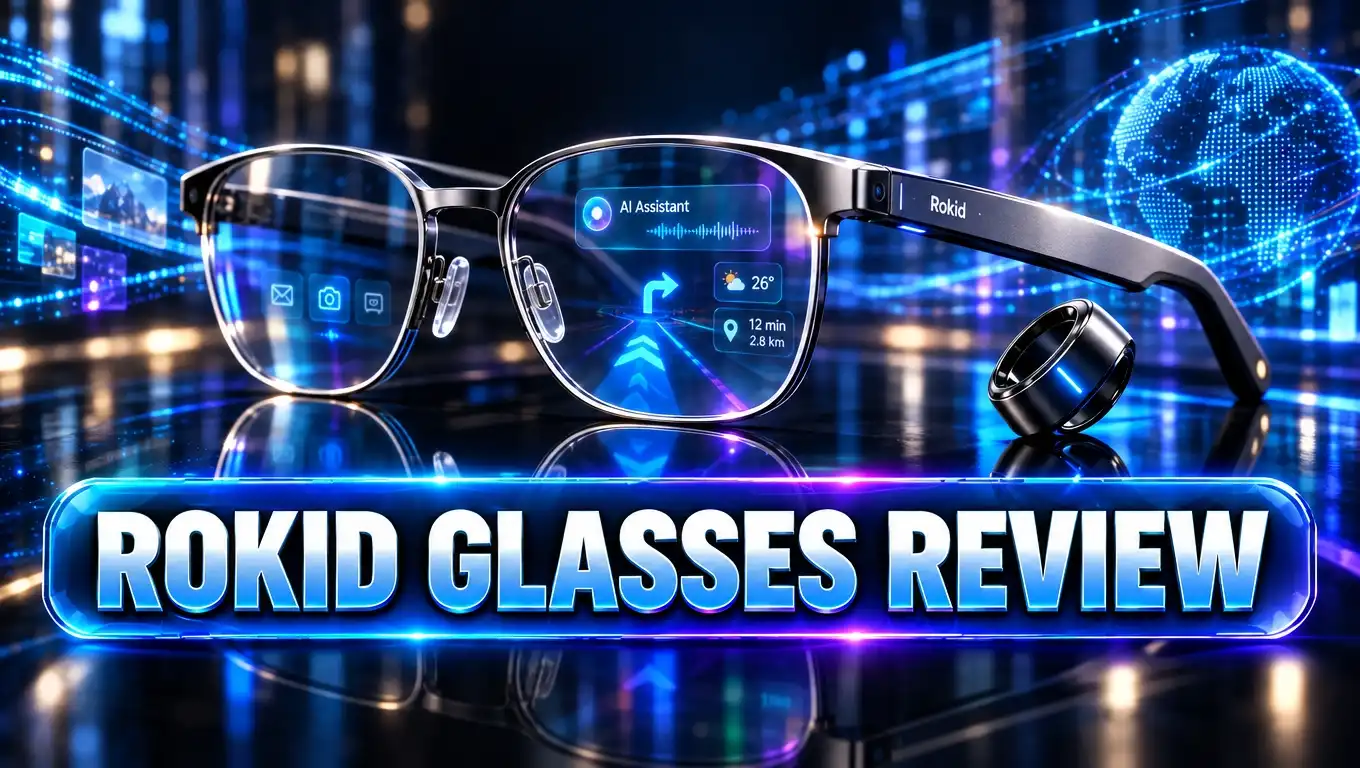
Rokid Glasses Review: Honest Look at the Lightest AI Display Glasses
Most smart glasses have the same problem. You ask a question and hear the answer, but you see nothing. Rokid Glasses fix that with a small green display inside the lenses.
They weigh only 49 grams and have a 12MP camera. You can use ChatGPT or Gemini, and the glasses show live translation right in front of your eyes. It sounds like science fiction, but you can buy them today.
So are they worth your money? This review covers design, display, AI, camera, battery, and price. By the end, you will know if Rokid Glasses fit your life.
In a Nutshell
- Lightweight display glasses: Rokid Glasses weigh just 49 grams. They look like normal Wayfarer frames and pack a dual green Micro LED display, a 12MP camera, speakers, and four microphones.
- Bright and useful screen: The display reaches 1,500 nits, so you can read it in sunlight. It shows translations, captions, directions, teleprompter text, and AI answers.
- Choice of AI models: You can switch between ChatGPT and Gemini. Most rivals lock you into one assistant. Rokid says the AI features stay free.
- Mixed battery and camera results: Casual use can last a full day. Heavy use drains the 210mAh battery in about two to four hours. The camera looks good in daylight but struggles in dim light.
- Price check: The glasses launched at $599. Prescription clip ins cost roughly $120 to $200 more, and the charging case costs about $99 extra.
- Best for: Travelers, speakers, busy professionals, and early adopters who want a heads up display without the bulk.
Rokid Glasses: Quick Overview and Key Specs
No products found.
Rokid is a Chinese company founded in 2014. It has made AR and AI glasses for years. The Rokid Glasses are its first display glasses built for everyday wear.
The product started on Kickstarter and raised over $4 million in under two months. It also won a Best of CES 2025 award. That early hype brought a lot of attention to this small brand.
Here are the main specs you should know:
- Weight: 49 grams
- Display: Dual monochrome green Micro LED waveguide, up to 1,500 nits
- Field of view: About 23 degrees
- Chips: Snapdragon AR1 Gen 1 plus NXP RT600 for light tasks
- Camera: 12MP Sony IMX681 sensor, 109 degree view
- Battery: 210mAh, with an optional 3,000mAh charging case
- Software: YodaOS Sprite with the Rokid app
The dual chip setup matters. The Snapdragon chip handles heavy AI work, and the smaller NXP chip handles simple tasks. This split saves battery and keeps the glasses cool.
The glasses run Rokid’s own system, called YodaOS Sprite. It is based on Linux, and you control it with taps, swipes, and your voice.
Just say “Hi Rokid” to wake the assistant. You can ask questions, take photos, or start a translation. The whole system works without you pulling out your phone.
Design and Comfort: Do They Look Like Normal Glasses?
This is where Rokid Glasses shine. From a few feet away, they look like regular glasses. The Wayfarer shape is classic and safe.
Tom’s Guide wore them for 62 days. The reviewer took them to a pub, and none of his friends noticed anything odd. That is a big win for social comfort.
At 49 grams, they rank among the lightest full feature display glasses you can buy. The Meta Ray Ban Display glasses feel much heavier by comparison, and many testers call them bulky.
The frame uses TR90 polymer, which is light and hard to bend out of shape. The hinges use titanium alloy for extra strength.
The temples curve gently around your ears. Reviewers say they do not dig into your head like some rival frames. You can wear them for hours without pain.
There are a few design flaws, though. PhoneArena found the glossy plastic attracts fingerprints. You will use the cleaning cloth a lot.
The charging connector also sits on the outside of the frame. It is visible up close, and it breaks the “normal glasses” illusion a little. Squint hard, and you can also see the display waveguides. Most people will never notice.
In the box, you get:
- The glasses
- A magnetic charging cable
- A premium magnetic case
- A cleaning cloth
Overall, Rokid nailed the look and feel. They are glasses first and gadgets second.
Display Quality: Small Screen, Big Impact
The display is the main reason to buy Rokid Glasses. It sits in both lenses, so your eyes see one clear image. Dual eye displays cause less eye strain than single eye designs.
The screen is monochrome green. That sounds basic, but it is a smart choice. Green is easy for your eyes to read, and it stays sharp in bright light.
The Micro LED engine is tiny at just 0.15cc. It still hits 1,500 nits with 10 brightness levels. Tom’s Guide could read it clearly on a summer day.
One small catch: green text can blend into green grass or trees. You may lose a few words outdoors in parks.
The user interface is simple and clean. It shows the time, weather, and battery on the home screen. You can also add widgets, like compact or expanded weather.
Here is what the display can show you:
- Live translation subtitles
- Speech captions
- Turn by turn directions
- Teleprompter text
- AI answers
- A camera viewfinder
The camera viewfinder is an underrated feature. Most AI glasses make you guess your photo framing. With Rokid, you see the shot before you take it.
PhoneArena noted one weakness. You can only move the display up or down, and you cannot resize it. For some people, the edges of the screen may feel cut off. Rokid has pushed regular updates, so this may improve.
Top 3 Alternative for Rokid Glasses
Rokid Glasses are not the only choice. Some people want a lower price, a bigger brand, or a big screen for movies. Here are three solid alternatives on Amazon.
Rokid Ai Glasses Style (Non Display)

- World's 1st Dual AI Assistant Gemini 3 and ChatGPT 5.2: Your hands-free knowledge partner for object...
- 12MP First-Person Camera with EIS: Featuring a Sony IMX681 sensor with Electronic Image Stabilization (EIS) to...
Last update on 2026-06-09 / Affiliate links / Images from Amazon Product Advertising API
This is Rokid’s cheaper sibling. It has no display, but it keeps the 12MP camera, ChatGPT and Gemini support, and translation in 89 languages.
It weighs just 38.5 grams, so it is even lighter. Rokid claims up to 12 hours of mixed use. It sold for $249 during Prime Day 2026. Choose this if you want AI help and audio but do not need a screen.
Ray Ban Meta (Gen 2) Smart AI Glasses
No products found.
The Ray Ban Meta Gen 2 is the most popular AI glasses model. It has a 12MP ultra wide camera, 3K video, open ear audio, and Meta AI.
It starts around $379. There is no display, but the brand, style, and camera quality are strong. This is a safe choice for content creators.
Rokid Max AR Glasses

- 360-inch Immersive Visual Experience: Immerse yourself in a breathtaking visual journey with our Rokid Max AR...
- Expanded Field of View, Ultra-Smooth Gameplay: Say goodbye to visual constraints. With a wide 50° field of...
Last update on 2026-09-25 / Affiliate links / Images from Amazon Product Advertising API
The Rokid Max serves a different purpose. It is a virtual big screen for movies, games, and work. It uses Micro OLED displays and connects to phones, laptops, and consoles.
It is not built for all day wear outside. Pick this if you care more about entertainment than AI help.
AI Assistant: ChatGPT and Gemini in Your Glasses
Most AI glasses lock you into one assistant. Meta glasses use Meta AI only. Rokid lets you choose between ChatGPT and Gemini. Available models may vary by region.
This choice is really useful. Tom’s Guide used ChatGPT for quick logic questions and switched to Gemini for image and location tasks. Each model has its own strengths.
The assistant is multimodal. It can see through the camera and hear your voice. Say “Hi Rokid, what am I looking at?” and it tells you.
Here are some things testers did with it:
- Identified buildings on a walking tour
- Suggested recipes from ingredients on a counter
- Guided a car repair while hands were dirty
- Answered general knowledge questions
PhoneArena fixed a car tailgate while asking the glasses for help. Hands free AI makes sense when your hands are busy. You hear the answer and see it on the display too.
The Snapdragon AR1 chip keeps responses fast. Reviewers did not report lag during normal use.
There are a few quirks. The AI sometimes hears “Rokid” as “Rocket,” but it still responds. It also gave outdated instructions about the app at times.
Rokid says the AI features will stay free. That matters, because some rivals may add subscription fees later. Free AI access adds real long term value.
Real Time Translation, Captions, and Teleprompter
Translation is one of the best reasons to buy these glasses. The glasses show live subtitles inside your lenses while someone talks to you.
Two way translation also works. Both sides of a face to face conversation get translated, so you can travel abroad and actually chat with locals.
Rokid claims support for 89 languages. PhoneArena found some languages did not work yet. The list may still be rolling out through updates.
Text translation works too. Point your eyes at a sign or menu, and the glasses translate it. One annoying quirk: the AI sometimes reads the full foreign text aloud before translating.
The intelligent captioning feature helps in meetings. It transcribes speech, identifies speakers, and creates summaries. People with hearing difficulties may also find captions helpful.
The teleprompter is a highlight for speakers. You load your script in the app, and the text scrolls as you talk. It follows your pace and pauses automatically.
This is great for presentations, videos, and speeches. Keep in mind that people close to you may notice faint text on the lenses.
Heavy captioning does use a lot of battery. Tom’s Guide drained the glasses in just under two hours of constant captioning. For long meetings, plan to charge.
Camera Performance: Great in Daylight, Weak at Night
Rokid Glasses use a 12MP Sony IMX681 sensor. Ray Ban Meta glasses use the same sensor. It has a wide 109 degree view and an f/2.25 aperture.
You can take photos in three ways:
- Say “Hi Rokid, take a photo”
- Tap the capture button
- Hold the button to record video
Video clips can run up to 10 minutes. Rokid lists support for 12MP photos and video up to 1680p. You can shoot in 3:4, 9:16, or 4:3 ratios.
In daylight, photos look sharp and colorful. Tom’s Guide noted warm color tones. Most people will be happy with daytime shots.
Low light is the weak spot. Rokid advertises Low Light HDR, but testers still saw dark areas lose detail. Night shots often look muddy.
PhoneArena also found heavy processing. Colors looked boosted, and a gray rainy sky looked sunny in photos. This processing likely helps the AI recognize objects faster.
File transfer needs attention. Photos stay on the glasses until you move them through the app. PhoneArena lost some pictures after a battery drain and a software update. Transfer your files often.
PhoneArena also noticed two photos and a short audio clip it did not mean to capture. This might have been a bug. Still, privacy deserves thought with any camera glasses.
Audio Quality and Battery Life
The audio surprised most reviewers. Rokid uses dual AAC near ear directional speakers. Sound stays clear even at high volume.
You get three sound modes: Rhythm, Clarity, and Podcast. PhoneArena heard the AI assistant clearly on busy streets. That is impressive for such tiny speakers.
Some sound does leak, as with all open ear designs. People sitting close may hear your music. The four microphone array reduces wind noise and picks up your voice well in loud places.
Now let’s talk about battery. The glasses hold a 210mAh battery. That small cell keeps them light, but it limits runtime.
Real world results vary a lot:
- Casual use: A full day, according to Tom’s Guide
- Active use: About 3.5 to 4 hours, according to PhoneArena
- Constant captioning: Under 2 hours
- Bluetooth music: About 6 hours, according to Rokid
Charging is fast. The glasses reach about 80% in roughly 20 minutes, and you can use them while they charge.
The optional 3,000mAh charging case costs around $99. It holds multiple full charges. Many buyers wish Rokid included it in the box.
One more tip: the glasses stay awake at least 10 minutes after you take them off. Put them in the case right away to save power.
App, Navigation, and iPhone Support
The Rokid app is the control center. You need it to pair the glasses, change settings, and transfer photos. The app has five tabs: Assistant, Home, Gallery, Discover, and Me.
Pairing is simple and quick. The app design is clean, but settings are spread across different pages. Check each gear icon if you cannot find an option.
Navigation uses Google Maps. Directions appear as a clear heads up display. Tom’s Guide found it easy to follow on city walks.
PhoneArena had more trouble. You must speak your destination, and you cannot type it or use saved places. In foreign cities, the voice system struggled with local place names.
Android users get the smoothest experience. On iPhone, you must adjust several privacy settings and keep the app open in the background. Always on location can drain an older iPhone battery.
Other features include:
- Calls answered with a head nod
- Music control by swipe
- Phone notifications on the display
- GlassPay, available in select regions
GlassPay lets you pay by scanning QR codes, but it is not widely available outside China yet.
The good news is that updates arrive often. Rokid has already added widgets, better display settings, and new features since launch. The glasses today work better than they did on day one.
Price, Prescription Lenses, and Value
Rokid Glasses launched at $599 on the official store. Prices can shift with sales and regions, so check current listings before you buy.
Here is how that compares to rivals:
- Ray Ban Meta Gen 2: About $379, no display
- Meta Ray Ban Display: $799, includes Neural Band
- Rokid Ai Glasses Style: About $379, no display, often on sale
Rokid sits in the middle. You get a display for $200 less than Meta’s display glasses. You pay about $200 more than Meta’s glasses without a display.
Prescription support is good. Rokid offers clip on lenses that cover 0 to 1600 degrees, and they support astigmatism too.
The downside is cost. Prescription lenses start around $120 and can reach nearly $200 with extras. Add the $99 charging case, and your total can pass $800.
So is it good value? It depends on how you use it. If you travel often, give talks, or need captions, the display earns its price. If you mostly want photos and music, a cheaper option makes more sense.
PhoneArena compared the price to a Meta Quest 3 headset. That is a fair point for casual buyers. Rokid Glasses make the most sense for people with clear daily uses.
Rokid Glasses Pros and Cons
After looking at reviews, specs, and real user feedback, here is a clear breakdown. Every product has tradeoffs, and these glasses are no different.
Pros
- Very lightweight design: At 49 grams, they feel like normal glasses, even after hours of wear.
- Normal appearance: The Wayfarer style blends in, and most people will not notice the tech.
- Bright dual display: The 1,500 nit screen stays readable outdoors in sunlight.
- Choice of AI models: You can switch between ChatGPT and Gemini for different tasks.
- Live translation subtitles: Real time captions help with travel and face to face conversations.
- Useful teleprompter: Text scrolls with your voice for smooth speeches and videos.
- Strong audio and mics: Speakers sound clear, and the four mic array handles noisy places.
- Camera viewfinder: You can see your shot before capturing it.
- Free AI features: Rokid says the AI services stay free.
Cons
- Weak low light camera: Night photos lose detail and look dark.
- Limited battery: Heavy use drains the 210mAh battery in a few hours.
- Charging case sold separately: The battery case costs extra.
- Pricey prescription lenses: Clip ins add $120 to $200.
- iPhone hassles: iOS users must keep the app open and adjust settings.
- Limited navigation: You cannot type destinations or use saved places.
- Some regional features: GlassPay and some languages are not available everywhere.
The pros focus on daily comfort and usefulness. The cons mostly involve battery, camera, and extra costs.
Final Verdict: Should You Buy Rokid Glasses?
Rokid Glasses prove one big thing. Display glasses can look normal and feel light. That was hard to find just a year ago.
Tom’s Guide called them “a real Meta Ray Ban Display rival.” The reviewer made them part of daily life for navigation, meeting notes, and AI help. That is high praise after two months of use.
PhoneArena was more careful. It liked the potential but felt the display was underused at first. Since then, updates have added more features and fixed early issues.
You should buy Rokid Glasses if you:
- Travel often and need live translation
- Give talks and want a hidden teleprompter
- Want AI help while your hands are busy
- Need captions in meetings or loud places
- Use Android for the smoothest setup
You should skip them if you:
- Mostly want photos and videos
- Need all day heavy use without charging
- Want the lowest price possible
- Prefer a big brand with wide store support
For content creators, the Ray Ban Meta Gen 2 is a better fit. For budget AI help, the Rokid Ai Glasses Style offers great value.
Overall, Rokid Glasses are the most balanced display glasses at this price. They have flaws, but the comfort, bright screen, and AI choice make them special. If a heads up display excites you, these glasses deserve a close look.
Frequently Asked Questions
How much do Rokid Glasses cost?
Rokid Glasses launched at $599. Prices can change during sales. Prescription lenses and the charging case cost extra.
Do Rokid Glasses have a display?
Yes. They have a dual monochrome green Micro LED display in both lenses. It shows translations, directions, AI answers, and more.
Which AI assistants work with Rokid Glasses?
You can choose between ChatGPT and Gemini. Available models may vary by region. Rokid says the AI features are free.
How long does the Rokid Glasses battery last?
Casual use can last a full day. Heavy use lasts about 2 to 4 hours. Fast charging reaches about 80% in 20 minutes.
Can I use Rokid Glasses with prescription lenses?
Yes. Rokid offers clip on prescription lenses from 0 to 1600 degrees, including astigmatism support. They cost roughly $120 to $200.
Do Rokid Glasses work with iPhone?
Yes, but setup takes extra steps. You must change privacy settings and keep the Rokid app running in the background. Android works more smoothly.
How many languages can Rokid Glasses translate?
Rokid claims support for 89 languages. Some languages may still be rolling out through updates.
Are Rokid Glasses better than Meta Ray Ban Display?
Rokid Glasses are lighter, cheaper, and let you choose your AI model. Meta’s glasses offer a full color display and the Neural Band controller. Your choice depends on budget and needs.
Can people tell I am wearing smart glasses?
Most people cannot. The frames look like normal Wayfarers, and the display is hard to see from outside unless someone looks very closely.

DK is a technology expert who specializes in AI tools, software, and tech gadgets. He writes for How to Tech Info, providing detailed reviews and practical guides. DK helps readers discover the best AI applications, navigate new software, and choose the right tech gadgets.


