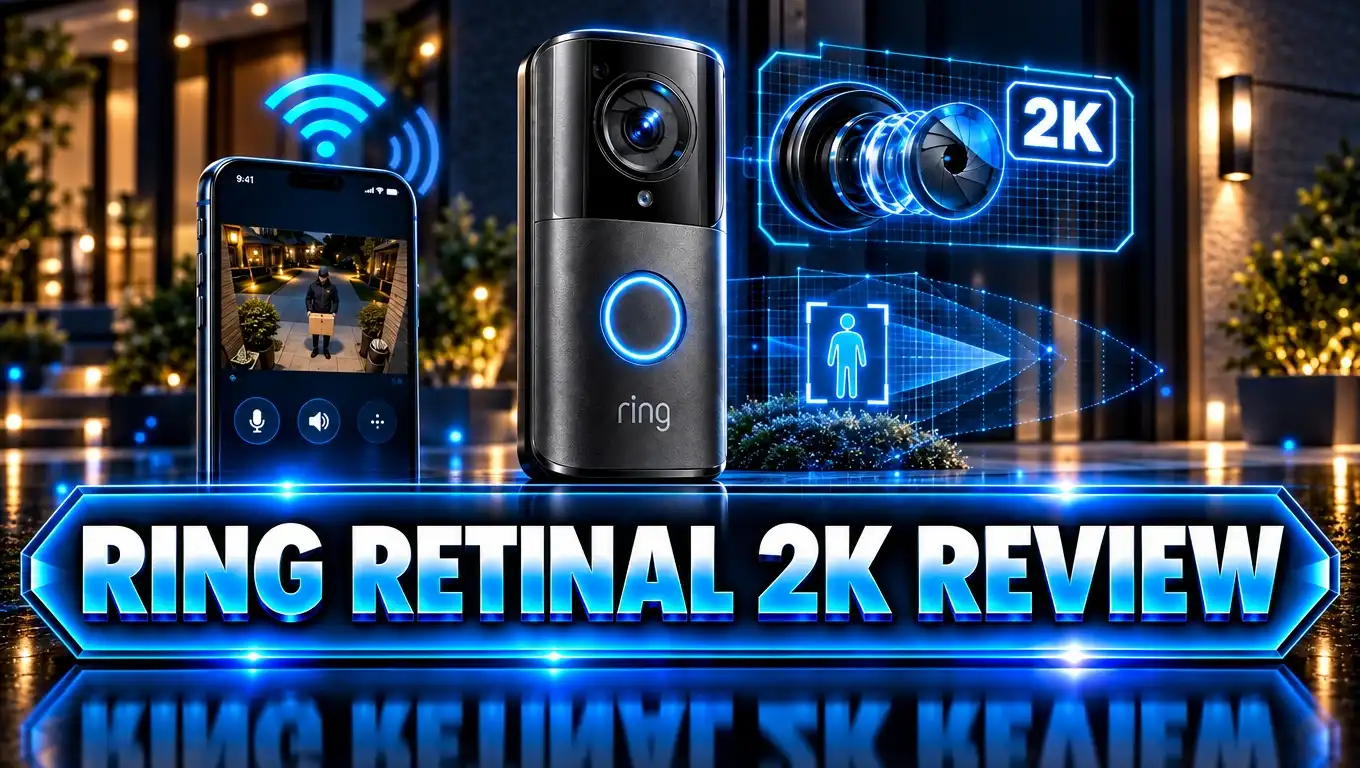
Ring Retinal 2K Review: Wired Doorbell 2K Plus Worth It?
Your front door sees a lot every day: delivery drivers, neighbors, and sometimes a stranger you don’t recognize. A blurry doorbell camera can’t tell you much about any of them. Ring says its new Retinal 2K technology fixes that.
I dug through the specs, owner reports, and expert coverage to test that claim. This review focuses on the Ring Wired Doorbell 2K Plus, the flagship Retinal 2K doorbell. By the end, you will know if it belongs on your front door.
In a Nutshell
- Retinal 2K means sharper video. Ring pairs a 2K sensor (1920 x 1920) with AI tuning. The result is clearer faces and better detail, day and night.
- Low light performance is the star. The doorbell records true color video down to 0.25 lux, so streetlight glow is enough. In total darkness, adaptive infrared night vision takes over.
- Head to toe view is excellent. The 140° by 140° lens with a 1:1 aspect ratio shows visitors from head to feet. It also shows packages left on the ground.
- The price is fair, especially on sale. The list price is $179.99, but Ring has sold it for as low as $89.99. The box includes a Chime Kit Mini and a corner kit.
- Smart features need a subscription. Video history, Familiar Faces, and video descriptions all need a Ring Home plan. Without one, you only get live view and alerts.
- It is best for Ring and Alexa homes. It works well with Echo Show and Fire TV. Google Home users should look at other options.
What Is Ring Retinal 2K?
Retinal 2K is Ring’s name for its newest video imaging system. Amazon announced it at its fall 2025 hardware event along with a higher tier called Retinal 4K. The idea is simple. Resolution alone does not make good video.
Ring describes Retinal Vision as a multistep process. It uses AI powered tuning to clean up the picture, and it focuses on low light scenes. Ring says it tunes each camera for clarity, so the hardware and software work together.
Many devices carry the Retinal 2K label, including the Wired Doorbell 2K, the Battery Doorbell 2K Plus, and the Indoor Cam Plus. The Peephole Cam 2K uses it too.
Owners on Reddit say the jump is noticeable. One user said the 2K upgrade gives a visible improvement in fine details compared with older 1080p Ring cameras. Faces, clothing, and license plates look sharper.
Retinal 2K also supports up to 6x Enhanced Zoom. That lets you zoom into a clip without the image falling apart as fast as it used to. Retinal 4K devices go up to 10x zoom.
In short, Retinal 2K is the middle tier of Ring’s lineup. It costs less than 4K and looks much better than old HD models. For most homes, it is the sweet spot.
Ring Wired Doorbell 2K Plus
No products found.
The Ring Wired Doorbell 2K Plus is the main Retinal 2K doorbell. Ring first called it the Wired Doorbell Plus (2nd Gen). Ring later renamed it, but the features stayed the same.
It launched in 2025 at $179.99. Ring’s own store has recently sold it for $89.99, which is a big discount. Prices change often, so check before you buy.
The key specs look strong for the price:
- Video: 2K resolution at 1920 x 1920 with a 1:1 aspect ratio.
- Field of view: 140° horizontal by 140° vertical.
- Night vision: Low Light Sight with Adaptive Night Vision, true color down to 0.25 lux.
- Connectivity: WiFi 6 with dual band 2.4GHz and 5GHz.
- Power: Hardwired (16 or 24VAC, 10 to 40VA, or 24VDC 12W).
- Operating range: Minus 4°F to 120°F, weather resistant.
The box has everything you need to get started. You get the doorbell, a Chime Kit Mini, a corner kit, a mounting plate, tools, and hardware. Most people can install it in about 15 minutes.
Dual band WiFi 6 is a big deal here. Many budget doorbells only use 2.4GHz. The 5GHz band gives this doorbell a faster and more stable stream when your router is close enough.
Ring rates it at 4.4 out of 5 stars from more than 400 reviews on its site. Target shoppers praise its clear picture, even at night.
Design and Build Quality
Ring gave this doorbell a bold redesign. It has a slimmer body and a clean, modern face. It measures 5.22 inches tall, 2.11 inches wide, and 1.18 inches deep without the mount.
You can pick from four finishes: Nickel Silver, Polished Night Navy, Polished Mocha, and Polished Sandstone. The polished colors look more premium than older Ring doorbells. They blend well with modern front doors.
The faceplate is also interchangeable. You can buy extra faceplates for $14.99 and change the look later. This is handy if you repaint your door or move house.
The button glows when visitors approach, so it is easy to find at night. The build feels solid and weather resistant. It handles cold winters and hot summers within its rated range.
One small warning: Ring says direct sunlight for long periods can raise the device temperature. Heat can affect performance. If your door faces harsh afternoon sun, keep an eye on it.
Ring includes a corner kit in the box, and it also sells a wedge kit for $9.99. The corner kit angles the camera left or right. The wedge kit tilts it up or down for stairs or sloped siding. Both help you aim the lens at your walkway.
Overall, the design is a clear step up. It looks less like a gadget and more like part of your home.
Top 3 Alternative for Ring Wired Doorbell 2K Plus
The Wired Doorbell 2K Plus is a great pick, but it is not for everyone. Here are three strong alternatives to compare.
1. Ring Wired Doorbell 4K Pro

- Capture it all with Retinal 4K video — See your home or business in the ultimate clarity with Retinal 4K.
- Zoom in up to 10x — Catch details at a distance with up to 10x Enhanced Zoom.

Last update on 2026-09-25 / Affiliate links / Images from Amazon Product Advertising API
This is the upgrade pick. It uses Retinal 4K with up to 10x Enhanced Zoom. It adds 3D Motion Detection, HDR video, and Two Way Talk with Audio+. It launched at $249.99. One Ring user said the Pro 4K is simply outstanding next to the 2K Plus.
2. Google Nest Doorbell (Wired, 2nd Gen)

- The wired Nest Doorbell can tell the difference between a person, package, animal, and vehicle; get alerts...
- Get peace of mind knowing you can check your video doorbell 24/7 without having to recharge batteries[1]
Last update on 2026-09-25 / Affiliate links / Images from Amazon Product Advertising API
This is the best choice for Google Home users. It can tell people, packages, animals, and vehicles apart. It works with Google Assistant and Gemini, and it supports 24/7 recording on some plans. The video is HD, not 2K, but it looks clean.
3. eufy Security Video Doorbell E340

Last update on 2026-07-01 / Affiliate links / Images from Amazon Product Advertising API
This is the pick for people who hate subscriptions. It has two cameras. One faces forward, and one faces down to guard your packages. It records 2K video with color night vision and stores clips locally. It runs on a battery or on wires.
Pick the Ring 4K Pro for top clarity, Nest for Google homes, and eufy for no monthly fees.
Daytime Video Quality
Daytime video is where Retinal 2K shines first. The 1920 x 1920 resolution gives you almost double the detail of Ring’s older 1080p doorbells. Faces look clear at normal door distance.
Colors look natural and true to life. Ring tunes the image so skin tones, clothing, and plants look the way your eyes see them. You won’t get that washed out look older cameras often had.
The 6x Enhanced Zoom helps you check small details. You can zoom in on a package label or a car on the street. The image stays usable at moderate zoom, though it softens at maximum zoom.
The Wired Doorbell 2K Plus includes HDR video, according to Ring’s comparison chart. HDR helps with bright skies and shaded porches in the same frame. Visitors don’t turn into dark shadows against a bright background.
Keep in mind that your internet matters. Ring recommends at least 10 Mbps upload speed for 2K devices. If your connection is slower, the doorbell lowers the video quality to keep the stream stable.
This is smart, but it means slow internet will hide some of the 2K benefit. Run a speed test near your front door before you buy. A mesh WiFi point can fix weak signals.
For most homes with decent WiFi, daytime video looks crisp and reliable. It is a clear upgrade over any HD Ring doorbell.
Night Vision and Low Light Performance
Night is where most doorbells fail. This is also where Retinal 2K makes its biggest gains. Ring built this doorbell with Low Light Sight and Adaptive Night Vision.
Low Light Sight records true color video down to 0.25 lux. That is very dark. Ring says nearby street lighting is enough for full color. You can see the color of a jacket or a car at dusk.
When the scene goes fully dark, adaptive infrared night vision turns on. It switches to black and white and balances the picture. It also lowers overexposure on close faces, so nearby visitors don’t turn into bright white blobs.
This fixes a common complaint with older Ring models. Before, a person close to the door often looked too bright at night. The adaptive system now handles that much better.
Owners agree. Target reviewers call out its clear picture, even at night. Ring’s own product page says it performs far darker than previous generations.
Late night deliveries are easier to check now. So are visitors at dusk or any strange activity after midnight. You can spot faces and clothing details that older cameras missed.
If you have a porch light, keep it on. Even a small amount of light lets the doorbell stay in color mode, and color video gives you much more useful detail.
Head to Toe View and 1:1 Aspect Ratio
Older doorbells used wide, short video frames. They showed the street well but cut off faces and feet. The Wired Doorbell 2K Plus uses a square 1:1 aspect ratio instead.
The lens covers 140° horizontally and 140° vertically. Ring calls this true head to toe coverage. You see a visitor’s face and shoes in one frame.
Why does this matter? Packages usually sit on the ground right below the doorbell. With a tall view, you can see a box on your doormat. That makes it easier to catch porch pirates on video.
The square frame also helps with children and pets. Short visitors no longer vanish below the frame. You can see a dog at the door or a kid knocking.
The tradeoff is less side view. A square frame shows less of the street than a wide frame. If you want to watch your whole driveway, add a separate outdoor camera.
The included corner kit helps here. You can angle the doorbell toward your walkway or driveway. This gives you a more useful view if your door sits in a corner.
Overall, the head to toe design suits a doorbell very well. It focuses on what matters most: the person at your door and the package at their feet.
Motion Detection and Smart Alerts
The Wired Doorbell 2K Plus uses Advanced Motion Detection. It lets you draw custom Motion Zones in the Ring app. You pick the areas to watch and leave out the busy street.
This matters a lot for reducing false alerts. Cars, swaying trees, and passing walkers can flood your phone. Custom zones keep alerts focused on your porch and path.
Note that this model does not have 3D Motion Detection. That radar based feature measures distance precisely. It comes on the Wired Doorbell 4K Pro and the Battery Doorbell 2K Plus.
Alerts arrive as real time notifications on your phone. With a subscription, you get Doorbell Calls, which look like phone calls when someone presses the button. That makes it hard to miss a visitor.
A subscription also unlocks Package Alerts. The doorbell tells you when a package arrives on your porch. This is great for busy online shoppers.
Ring has also added a Single Event Alert feature in beta. When a lot of motion happens at once, the camera groups similar motion into one alert. Your phone stays calmer during busy moments.
With the right zone setup, most owners get useful alerts without much noise. Take ten minutes to tune your zones after install. It makes a big difference.
Installation and Setup
Ring built this doorbell for DIY installation. Ring estimates about 15 minutes if you are replacing an existing wired doorbell. The Ring app walks you through every step.
The process is simple. You turn off power at the breaker, then remove your old doorbell. Next you install the Chime Kit Mini at your indoor chime box. Last, you connect the two doorbell wires to the new mount.
The Chime Kit Mini sits above your existing chime. It helps your old chime ring reliably with the new doorbell. Ring says it triggers in less than a second when someone presses the button.
Check your transformer first. The doorbell needs 16 or 24VAC power at 10 to 40VA. Ring recommends 30 to 40VA for the best performance. Halogen or garden lighting transformers will not work.
No doorbell wires? You still have options. Ring sells a plug in adapter and a hardwired transformer separately. You can also pick a battery model instead.
If wiring makes you nervous, Ring offers professional installation starting at $129. That adds to the cost but saves you time and stress.
After mounting, you connect the doorbell to WiFi in the app. Setup is smooth for most owners. Then you set Motion Zones, alert types, and privacy settings.
Ring App and AI Features
The free Ring app is one of the brand’s biggest strengths. It is clean, fast, and easy to learn. You can check live view, talk to visitors, and view alerts from one dashboard.
Two Way Talk lets you speak with visitors from anywhere. Quick Replies work like an answering machine for your door. The doorbell plays a preset message and records a reply when you’re busy.
Ring also added new AI tools with this generation:
- Familiar Faces: Tag family and friends so the doorbell tells you who is at the door.
- Video Descriptions: Get short text summaries of what triggered an alert, like “a dog on the rug.”
- Alexa+ Greetings: Alexa can greet visitors, handle deliveries, and ask solicitors why they came.
- Search Party: Nearby Ring cameras can use AI to help find lost dogs.
Most AI features need a Ring Home subscription. Familiar Faces and Alexa+ Greetings started rolling out in December 2025.
The app also offers Safety Alerts from neighbors and local agencies. Some people love this community feature. Others find it too busy and turn it off.
The doorbell works well with Alexa devices. You can view live feeds on an Echo Show, Fire TV, or Fire Tablet by voice. It does not work with Google Home or Apple HomeKit.
Ring Home Subscription Plans
Here is the honest truth. The doorbell works without a subscription, but you lose a lot. Without a plan, you get live view, alerts, and Two Way Talk. You get no saved video history.
Ring renamed its plans from Ring Protect to Ring Home in 2024. The main tiers are Basic, Standard, and Premium. At the time of writing, Basic costs about $4.99 a month and Standard about $9.99 a month. Premium costs about $19.99 a month. Prices can change, so check Ring’s plans page.
A subscription unlocks key features:
- Up to 180 days of video history
- Package Alerts and Doorbell Calls
- Video Descriptions and Familiar Faces
- Download and share clips
Every new Ring doorbell comes with a free 30 day trial. You only pay after the trial ends. This gives you time to decide if you need it.
For most people, the Basic plan is enough. It covers one device and saves your clips. Homes with many Ring cameras get better value from higher tiers.
If you want zero monthly fees, Ring is not the best fit. The eufy E340 stores video locally with no subscription. Think about this long term cost before you buy.
Privacy and Security
Privacy matters a lot with any camera at your front door. Ring has improved here, but you should still know the details.
The Ring app includes a Control Center. It lets you view and manage your security and privacy settings in one place. You can control authorized devices and turn on two step verification.
Ring also offers end to end encryption on many devices as an option, though some features stop working when you turn it on. Check which features you’d lose before you enable it.
Amazon Sidewalk is on by default. Sidewalk shares a small part of your bandwidth with nearby Amazon devices. It helps devices stay connected when WiFi drops. You can turn it off anytime in the Control Center.
Ring promises software security updates for at least four years after the device stops selling as new. That gives you a long period of support.
Some people have concerns about AI face recognition. Familiar Faces is optional, so you choose whether to use it. You can also set privacy zones to block parts of the view, like a neighbor’s window.
Take a few minutes to review these settings during setup. Turn on two step verification and pick your Sidewalk preference. These simple steps keep your account safe.
Pros and Cons
After reviewing specs and owner feedback, here is a clear summary. These points help you weigh the good against the bad.
Pros
- Sharp Retinal 2K video gives clear faces and fine details during the day.
- Excellent low light color works down to 0.25 lux with just streetlight glow.
- Head to toe 1:1 view shows visitors and packages in one frame.
- Dual band WiFi 6 delivers faster and more stable streaming than 2.4GHz models.
- Stylish redesign comes in four finishes with swappable faceplates.
- Easy DIY install takes about 15 minutes with the included Chime Kit Mini.
- Great value on sale, often far below the $179.99 list price.
- Strong Alexa integration works with Echo Show and Fire TV devices.
Cons
- Subscription needed for video history and most smart features.
- No 3D Motion Detection, which is on the Pro and Battery Plus models.
- Wired power only, so homes without doorbell wires need extra parts.
- No local storage for saving clips without the cloud.
- No Google Home or HomeKit support limits smart home choices.
- Needs 10 Mbps upload to show its full 2K quality.
For most buyers, the pros clearly outweigh the cons. The subscription cost is the biggest thing to plan for.
Who Should Buy the Ring Retinal 2K Doorbell?
This doorbell suits many homes, but it fits some people better than others. Here is a simple guide.
Buy it if you already use Ring or Alexa. It fits right into your system. You can see the feed on an Echo Show and control it all in one app.
Buy it if your door gets little light at night. The low light color performance is among the best at this price. Streetlights or a dim porch light are enough.
Buy it if you have existing doorbell wires. Hardwired power means you never charge a battery. The install takes minutes.
Buy it if you get lots of deliveries. The head to toe view and Package Alerts help protect your boxes.
Skip it if you refuse monthly fees. The eufy E340 gives local storage with no subscription. Skip it if you use Google Home, too. The Nest Doorbell fits that system better.
Also skip it if you want the very best detail. The Wired Doorbell 4K Pro offers 4K video, 10x zoom, and 3D Motion Detection. It costs more, but the jump in clarity is real.
Renters without wires should look at the Ring Peephole Cam 2K or a battery model. Those skip the wiring entirely.
For the average homeowner with wires and WiFi, this is a smart, balanced choice.
Final Verdict
The Ring Wired Doorbell 2K Plus delivers on the Retinal 2K promise. Video looks sharp in the day and holds up well at night. The head to toe view is practical and useful.
Its best feature is low light color video. Seeing true colors at dusk gives you far more useful footage. Faces and clothing stay clear when older cameras would show gray shadows.
The redesign looks great, too. Four premium finishes and swappable faceplates make it feel like part of your home, not just a gadget.
The main catch is the subscription. To get the most from this doorbell, you’ll likely pay for Ring Home. Plan for that cost from day one.
At the full $179.99 price, it is a fair deal. At sale prices near $89.99, it is a fantastic value. Watch for deals during big shopping events.
My rating: 4.5 out of 5 stars. It is the right Ring doorbell for most homes with existing wiring. If you want more, step up to the 4K Pro. If you want less cost, the basic Wired Doorbell 2K works fine.
FAQs
What does Retinal 2K mean on Ring devices?
Retinal 2K is Ring’s newest imaging system. It combines 2K resolution with AI powered tuning. The goal is clearer video, especially in low light.
What is the resolution of the Ring Wired Doorbell 2K Plus?
It records at 1920 x 1920 with a 1:1 aspect ratio. This gives a tall head to toe view of your front door.
Is the Wired Doorbell 2K Plus the same as the Wired Doorbell Plus 2nd Gen?
Yes. Ring changed the name only. The features stay exactly the same.
Does the Ring Retinal 2K doorbell need a subscription?
No, it works without one. You get live view, alerts, and Two Way Talk for free. A Ring Home plan adds video history and AI features.
What internet speed do I need for Retinal 2K?
Ring recommends at least 10 Mbps upload speed. The doorbell adjusts quality automatically if your speed drops.
Can I install the Ring Wired Doorbell 2K Plus myself?
Yes. Most people finish in about 15 minutes with existing doorbell wires. Ring also offers professional installation starting at $129.
Does it work with Google Home or Apple HomeKit?
No. It works with Alexa devices like Echo Show and Fire TV. Google users should consider the Nest Doorbell instead.
How good is the night vision?
It is very good. It records true color video down to 0.25 lux. In total darkness, adaptive infrared night vision takes over.
What is the difference between Retinal 2K and Retinal 4K?
Retinal 4K offers higher resolution and up to 10x Enhanced Zoom. Retinal 2K supports up to 6x zoom and costs less.
Does it work with my existing doorbell chime?
Yes. The box includes a Chime Kit Mini. It installs above your current chime and triggers it in under a second.

DK is a technology expert who specializes in AI tools, software, and tech gadgets. He writes for How to Tech Info, providing detailed reviews and practical guides. DK helps readers discover the best AI applications, navigate new software, and choose the right tech gadgets.