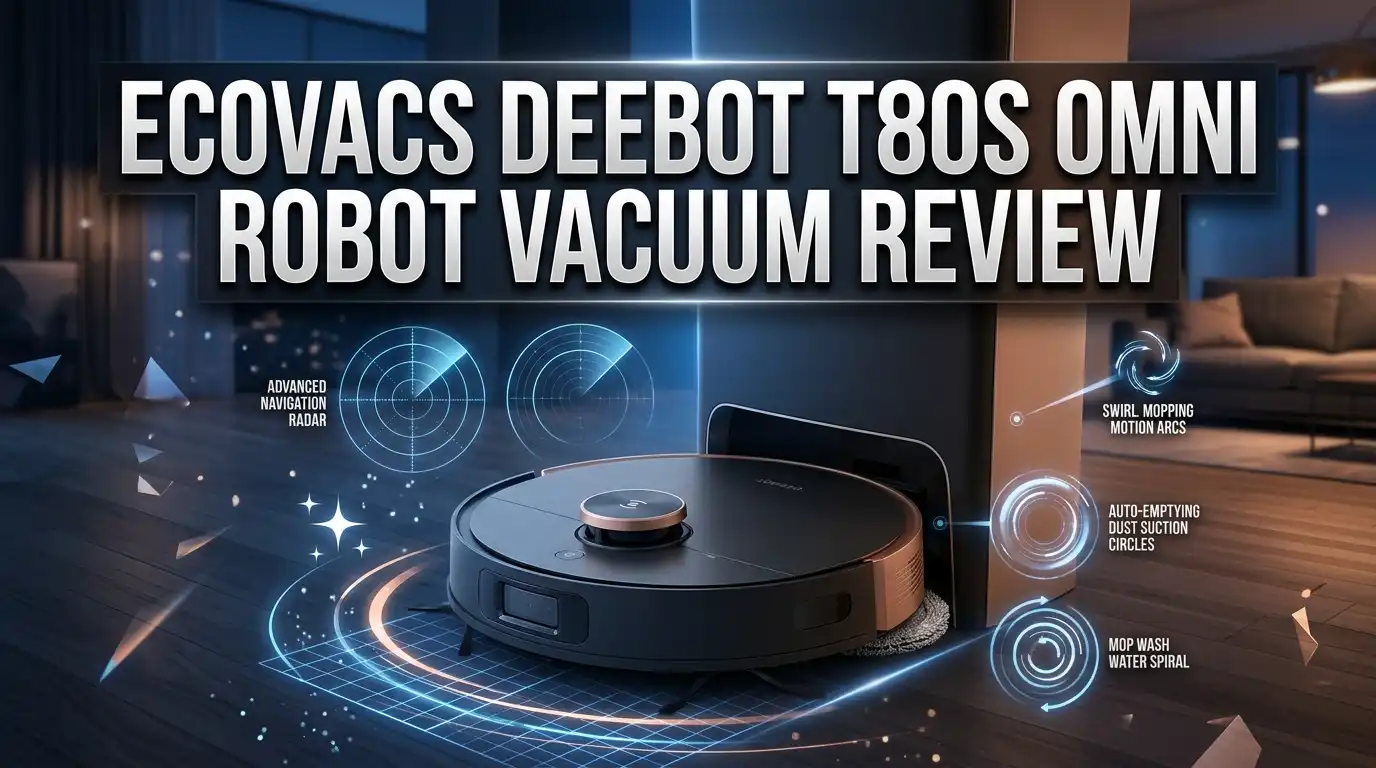
ECOVACS DEEBOT T80S Omni Robot Vacuum Review 2026
Robot vacuums used to be simple floor sweepers. Today they scrub, wash themselves, dodge socks, and empty their own dust. The ECOVACS DEEBOT T80S Omni sits right in the middle of that shift. It borrows the best parts of expensive flagship robots and puts them in a midrange body at a friendlier price.
This review covers everything you need before you buy. You will see how the suction compares to the average robot, how the roller mop handles dried stains, where the navigation slows down, and how the station keeps your hands clean. I also cover three strong alternatives if the T80S Omni does not fit your home.
If you own pets, hate hair tangles, or simply want the floor to look finished without lifting a finger, keep reading. The numbers below tell a clear story.
In a Nutshell
Here is the short version for readers who want the verdict fast.
- Suction is the headline feature. The T80S Omni is rated at 24,800Pa, and in independent bench testing it produced 2.44 kPa of measured suction, roughly two and a half times the category average of 0.99 kPa. That translates into real carpet cleaning power.
- Pet hair results were perfect. The robot removed 100% of flattened pet hair in carpet testing and recorded zero tangles in the seven inch hair test, while the average robot tangles about 26% of those hairs.
- The OZMO Roller 2.0 mop actually mops. It rinses itself continuously, spins at 220 rpm, applies around 3800Pa of pressure, and left only 0.2 g of water behind compared to the 1.07 g average.
- The Omni station does the dirty work. Hot water washing at up to 75C, hot air drying at 63C, automatic dust emptying into a sealed bag, fresh water refills, and dirty water disposal.
- Obstacle avoidance is excellent. It dodged 21 of 24 test objects using an RGB camera, LED light assist, and 3D structured light sensors, well above the average score of 16.
- The one real weakness is navigation speed. Coverage measured 0.62 square meters per minute versus a 0.71 average, so cleaning runs take longer than they should.
ECOVACS DEEBOT T80S Omni Quick Overview

- Deep-Clean 24,800Pa Suction: Powerful 24,800Pa suction lifts dust, pet hair & crumbs from carpets & hard...
- Instant Self-Cleaning OZMO Roller Mop – Scrub, Don’t Just Wipe: Roller mop self-cleans & scrubs in real...

Last update on 2026-08-09 / Affiliate links / Images from Amazon Product Advertising API
The DEEBOT T80S Omni is a 2026 refresh of the DEEBOT T80 Omni. ECOVACS kept the same general shape and station layout, then upgraded the parts that matter most for cleaning.
Suction jumped from 18,000Pa on the T80 Omni to 24,800Pa on the T80S Omni. The brush system moved up to ZeroTangle 3.0. The station now soaks and washes the roller in hot water instead of simply rinsing it.
The robot body stands 3.9 inches tall, which is slim for a machine carrying a water tank and an extending mop. That low profile helps it slide under couches, beds, and kitchen cabinets that block taller robots.
Inside the T series lineup, the T80S Omni sits below the flagship T90 Pro Omni. The T90 Pro Omni climbs taller thresholds and uses the newer OZMO Roller 3.0 mop, but it also costs noticeably more.
Pricing has moved around since launch. The robot listed near $799.99 at release, dropped to promotional pricing around $599, and has appeared under $500 during sales events. That fluctuation makes timing your purchase worth a little patience.
What makes this model interesting is the value equation. You get flagship level suction, a self washing roller mop, hot water station care, and camera based obstacle avoidance for midrange money. Very few robots in this price bracket check all four boxes at once.
Design, Size, and Build Quality
The T80S Omni looks softer than most robots on the shelf. ECOVACS wrapped both the robot and the station in a leather style textured finish instead of the usual glossy plastic.
That choice matters more than it sounds. Glossy tops show dust and fingerprints within a day, while this matte texture hides both and wipes clean easily.
The robot measures 3.9 inches in height, made possible by embedded LiDAR instead of a raised spinning turret. The tradeoff appears later in navigation, but the clearance win is real.
The station is tall and rectangular, holding a clean water tank, a dirty water tank, a sealed dust bag, and the mop washing tray. Both water tanks pull out from the top, so you do not need to move the station to refill it.
Everything you touch weekly sits within easy reach. The dust bag compartment opens with one hand, and the mop tray slides out for the occasional deep rinse.
The dustbin lives under the top lid of the robot, and the filter pops out without tools. The main brush releases with two clips, which helps if you ever need to inspect it.
Build quality feels solid rather than luxurious. Panels line up cleanly, the bumper has good travel, and the wheels have deep tread for grip on rugs.
One practical note: the station needs clear space in front of it. Give it about a foot and a half of open floor so the robot can dock straight every time.
Suction Power and Vacuum Performance
- Deep-Clean 24,800Pa Suction: Powerful 24,800Pa suction lifts dust, pet hair & crumbs from carpets & hard...
- Instant Self-Cleaning OZMO Roller Mop – Scrub, Don’t Just Wipe: Roller mop self-cleans & scrubs in real...
Last update on 2026-08-09 / Affiliate links / Images from Amazon Product Advertising API
Suction is where this robot separates itself from the pack. ECOVACS rates it at 24,800Pa, and unlike some inflated marketing numbers, this one holds up under measurement.
Independent bench testing recorded 2.44 kPa of actual suction at the brush. The category average sits at 0.99 kPa, so the T80S Omni pulls roughly two and a half times harder than a typical robot vacuum.
For context, the pricier T90 Pro Omni measured 1.23 kPa in the same test. The cheaper model out muscles its own flagship sibling.
Airflow measured 19 CFM against a 17 CFM average. Airflow matters for lifting fine dust and light debris from hard floors, and this score is comfortably above the norm.
The carpet deep clean test is the toughest one. Testers press sand deep into medium pile carpet, then measure how much the vacuum extracts.
The T80S Omni pulled out 91% of the embedded sand. The average robot manages 78%, and the T90 Pro Omni scored 81%. That is a standout result at any price.
On hard floors, the combination of strong suction and a bristle brush handles cereal, rice, coffee grounds, and litter scatter in a single pass. Larger debris triggers the side brush lift and a suction boost, which stops the brush from flinging pieces across the room.
Carpet Boost mode kicks in automatically when the robot detects a rug. You can set the boost level in the app if you want quieter runs at night.
ZeroTangle 3.0 Brush System and Pet Hair Pickup
Hair wrap is the single most annoying part of owning a robot vacuum. Anyone with a long haired human or a shedding dog has cut a bristle brush free with scissors at least once.
ZeroTangle 3.0 attacks that problem from two directions. The main brush uses a cyclone directed design that pushes hair along the roller and into the airflow instead of letting it coil.
A comb sits behind the brush and strips away anything that starts to wrap. The side brush uses a spiral V shape that guides hair inward rather than catching it at the base.
The test results speak clearly. In the flattened pet hair test, where testers press two and a half inch hair into carpet, the robot picked up 100% of it. The average score is 82%.
The seven inch hair tangle test is even more telling. Testers scatter long strands, run the robot, then count how many wrapped around the brushes.
The T80S Omni recorded zero tangles. The average robot ends up with 26% of those hairs wound around the roller or side brush.
In plain terms, you should almost never need to pull hair off this brush. That saves a few minutes every week and keeps suction consistent between cleanings.
The side brush also lifts when the robot detects a liquid spill. That keeps the bristles out of the mess instead of painting it across the floor.
For homes with cats, dogs, or long hair, this brush system alone justifies a serious look at this model.
Top 3 Alternative for ECOVACS DEEBOT T80S Omni
No single robot fits every home. If the T80S Omni misses on price, threshold height, or ecosystem preference, these three are the strongest options to compare against it.

- Instant Self-Cleaning OZMO Roller Mop:OZMO Roller Mop washes itself in real time at 220 RPM, removing dirty...
- 18,000Pa Ultra Suction for Deep Cleaning: 18,000Pa suction removes embedded dirt, dust, crumbs, and pet hair...
Last update on 2026-07-01 / Affiliate links / Images from Amazon Product Advertising API

- Zero-Tangling Brushes for Hassle-Free Cleaning: Featuring the DuoDivide Main Brush and FlexiArm Arc Side...
- AdaptiLift Chassis for Smooth Transitions: Glide smoothly across all surfaces with the AdaptiLift Chassis...
Last update on 2026-06-09 / Affiliate links / Images from Amazon Product Advertising API

- Cross Thresholds and Barriers: X50 Ultra utilizes robotic retractable legs to conquer door tracks, thresholds...
- Easily Clean Under Sofas and More: VersaLift Navigation lowers X50 Ultra height to 3.5 in, allowing it to...
Last update on 2026-06-09 / Affiliate links / Images from Amazon Product Advertising API
The ECOVACS DEEBOT T80 Omni is the previous generation model. It drops to 18,000Pa suction and uses a simpler station, but it shares the same OZMO Roller mop concept and the same app. It often sells for well under the T80S Omni, which makes it a smart pick for budget shoppers who still want a roller mop.
The Roborock Qrevo Curv brings 18,500Pa HyperForce suction, a dual anti tangle system, and FlexiArm side reach for corners. Roborock navigation is generally faster and more predictable than embedded LiDAR systems, so this is the one to consider if efficient routing matters more to you than raw suction.
The DREAME X50 Ultra is the climbing specialist. It uses a retractable LiDAR module and a step climbing mechanism that clears far taller obstacles than most robots, plus 20,000Pa suction and full station automation. Pick this one if your home has raised door frames or sunken rooms that stop ordinary robots cold.
Each alternative trades something. The T80 Omni trades power, the Qrevo Curv trades mop pressure, and the X50 Ultra trades price. The T80S Omni sits in the middle of all three.
OZMO Roller 2.0 Mopping System
Most robot mops drag a damp pad or spin two small discs. Both designs share one flaw. They push dirty water around the floor because nothing removes it from the pad during the run.
The OZMO Roller 2.0 works differently. A long cylindrical roller runs the width of the robot, receives fresh water continuously, and passes a scraper that squeegees the used water into an onboard dirty tank.
That means the roller touching your floor is always closer to clean than dirty. Wet spills get lifted rather than smeared, which is the single biggest advantage of this design.
The roller spins at 220 rpm and applies around 3800Pa of downward pressure. ECOVACS says that is roughly sixteen times the pressure of standard dual disc mops.
Testing backs up the claim. In the dried stain test, the T80S Omni scored 126 against a 108 average, meaning it lifted more baked on residue than most competitors.
Water control was even better. The robot left just 0.2 g of water behind, compared with the 1.07 g average. Less standing water means faster drying and fewer streaks.
Combined mopping score came out at 30.5 versus a 20.3 average. The flagship T90 Pro Omni scored 34.5 with its newer OZMO Roller 3.0, so you give up some stain lifting power here but not much.
AI Stain Detection 2.0 adds another layer. When the camera spots a heavy stain, the robot switches to a grid pattern, refreshes the mop, and runs a second pass over that area only.
TruEdge 3.0 Edge Cleaning and Triple Lift
Corners and baseboards are where cheap robots give themselves away. A round robot naturally leaves a strip of dust along every wall.
TruEdge 3.0 solves this by extending the roller mop sideways. The roller pushes out about 1.5 cm past the body whenever the robot follows a wall or cabinet edge.
An air cushion suspension keeps the roller pressed evenly against the floor even as it extends. Soft rubber gliding wheels let the robot hug edges without scuffing paint or catching on trim.
A fixed side brush sweeps loose debris out of the corner and into the suction path. Between the two systems, the gap left along walls shrinks dramatically.
The Triple Lift system handles the other half of the problem. It decides which parts of the robot should touch the floor based on what the sensors detect.
On carpet, the roller mop lifts 15 mm, or about 0.6 inches, so fibers stay dry while vacuuming continues. That single feature lets you clean mixed flooring in one run instead of two.
When the robot finds a liquid spill, both brushes lift and the machine switches to mop only mode. This stops water from entering the dust bin and stops the brush from spreading the mess.
When the robot meets large debris, the side brush lifts and suction increases. Cheerios and kibble get inhaled instead of launched across the kitchen.
These three lift behaviors run automatically. You do not need to set anything in the app for them to work.
AIVI 3D 3.0 Obstacle Avoidance
Obstacle avoidance decides whether you trust a robot to run while you are out. One unlucky encounter with a pet accident ruins the whole value proposition.
The T80S Omni uses a single RGB camera, an LED light for dark rooms, and 3D structured light sensors. ECOVACS calls the package AIVI 3D 3.0, and it now uses a vision language model to identify what it sees.
Test results were excellent. The robot avoided 21 of 24 objects across standard and torture course testing.
The average robot avoids 16. The flagship T90 Pro Omni, which adds a dedicated 3D edge sensor, avoided 23.
Scoring 21 out of 24 at this price is genuinely impressive. Very few midrange robots come close.
In practice, the robot reliably steers around shoes, cables, phone chargers, pet bowls, and toys. The LED assist means it keeps performing after sunset, which trips up camera only systems.
The Omni approach behavior is the other half of this feature. Instead of giving obstacles a wide berth, the robot maps the outline and then cleans tightly along the edge of it.
That matters because over cautious avoidance leaves dirty halos around every chair leg. Here the robot gets close, cleans, and moves on.
One tip worth following: turn on the camera privacy settings in the app if the robot runs in bedrooms. ECOVACS allows you to disable the video feed entirely while keeping avoidance active.
Mapping and Navigation Efficiency
This is the section where the T80S Omni loses points, and honesty matters more than enthusiasm here.
The robot uses embedded LiDAR rather than a top mounted spinning turret. That design keeps the body at 3.9 inches tall, which is great for furniture clearance.
The cost shows up in routing. Embedded LiDAR reads the room from a lower, narrower vantage point, so path planning tends to be less efficient.
Measured navigation efficiency came in at 0.62 square meters per minute, below the 0.71 average. The T90 Pro Omni managed 0.75.
Estimated coverage per charge landed at 1,132 square feet, slightly under the 1,170 average. Strong battery efficiency partly rescued this number, but it did not fully close the gap.
In daily use this means longer cleaning cycles. A run that a faster robot finishes in forty minutes may take this one closer to fifty.
Some early owners have reported occasional mapping quirks and unusual movement patterns. The sample is small so far, so it is worth watching rather than treating as a certainty.
Mapping itself works well once complete. The robot supports multi floor maps, room by room naming, no go zones, no mop zones, and virtual walls.
Do a dedicated mapping run before your first full clean. Give the robot a clear floor, let it build the map, then edit rooms in the app for the best long term results.
The Omni Station and Hands Free Maintenance
The station is the reason this robot carries the Omni name. It handles five jobs so you do not have to.
First, hot water mop washing. A floating tank raises around the spinning roller and soaks it in water heated up to 75C, then lowers to drain the dirty water away.
Soaking beats spraying. Grease and dried food loosen properly instead of getting pushed deeper into the fibers.
Second, hot air drying. The station blows air at 63C from close range while the roller rotates, reaching full dryness in about two hours.
Dry mops do not smell. That single detail solves the mildew complaint that plagued earlier robot mops.
Third, automatic dust emptying. Debris transfers into a sealed disposable bag that holds up to roughly 90 days of household dirt.
Fourth, water management. The station refills the robot fresh water tank and drains the onboard dirty water tank at every dock.
Fifth, self cleaning of the washing tray. ECOVACS rates the tray as maintenance free for about 150 days, so most owners only pull it apart once or twice a year.
A dirty water sensor tells the robot when the mop needs another wash cycle instead of washing on a blind timer. That saves water on light cleaning days.
Your actual chore list shrinks to refilling clean water, emptying dirty water, and swapping the dust bag every few months.
Battery Life and Real Coverage
Battery specifications only matter when paired with efficiency numbers, so here are both.
ECOVACS rates the T80S Omni at 205 minutes of runtime in quiet mode. The category average sits near 165 minutes, so this is a strong figure for a midrange machine.
The T90 Pro Omni claims 350 minutes, which is a real advantage for very large homes. Most apartments and average houses will never need that much.
Efficiency testing measured 1.71 square meters cleaned per one percent of battery. The average is 1.56, and even the flagship T90 Pro Omni measured 1.70.
That means the battery itself is being used well. The robot simply spends some of that advantage on slower routing.
Estimated total coverage per charge landed at 1,132 square feet. For a two bedroom apartment or a typical single floor home, one charge covers everything.
For larger homes, recharge and resume handles the rest. The robot returns to the station, tops up, and continues exactly where it stopped.
Max power mode drains the battery considerably faster, so save it for carpets and heavy traffic days. Standard mode plus Carpet Boost is the sweet spot for daily cleaning.
Charging from empty takes several hours. Schedule cleanings for the morning if you want the robot ready again by evening.
ECOVACS Home App Features
The ECOVACS Home app is consistently one of the better robot vacuum apps on both Android and iOS. Setup takes a few minutes over 2.4 GHz Wi Fi.
Room management is thorough. You can split rooms, merge them, rename them, assign floor types, and set different suction and water levels per room.
Zone controls include no go zones, no mop zones, and virtual walls. Draw them once and the robot respects them on every run.
Scheduling supports multiple routines. You can send the robot to the kitchen after dinner and run the whole floor on weekday mornings.
One clever setting is mop direction control. The robot can mop along the direction of your floorboards, which hides streaks that show up when mopping across the grain.
Cleaning modes cover vacuum only, mop only, vacuum and mop together, and a deep mode with two passes. Water level has multiple steps, so delicate floors get less moisture.
The app also shows cleaning history, maps of each run, filter and brush life counters, and station consumable status. Those reminders help you replace parts before performance drops.
Voice control works with Alexa and Google Assistant for basic commands. ECOVACS also includes its own YIKO voice assistant so you can call the robot without a smart speaker.
Firmware updates arrive regularly, and ECOVACS has a good record of improving navigation and avoidance after launch.
Threshold Climbing, Noise, and Everyday Living
Threshold climbing is a specification most buyers ignore until the robot gets stuck. The T80S Omni is rated for obstacles up to 0.8 inches, or 20 mm.
Testing confirmed clean crossings at 19 mm in both dry and wet conditions. High traction wheels and a dedicated climbing routine handle standard door frames without drama.
That said, 20 mm is a modest limit. The T90 Pro Omni is rated to 40 mm on tiered thresholds and cleared a 32 mm single step in testing.
If your home has tall transitions or a sunken living room, measure before you buy. This is the clearest reason to consider a different model.
Noise levels are reasonable for the power on offer. Quiet and standard modes fade into the background, while max mode is noticeably loud on carpet.
The station makes the most noise during auto empty, which lasts only a few seconds. Hot air drying runs quietly enough to leave on overnight.
For pet households, the robot handles litter scatter, kibble crumbs, and fur without complaint. The camera avoidance also spots pet bowls and toys reliably.
Daily living with it is simple. You fill the clean tank, empty the dirty tank, and let the schedule do the rest.
Consumable costs are modest. Dust bags, side brushes, filters, and the roller sleeve are all standard replacement parts sold in multipacks.
Pros and Cons of the DEEBOT T80S Omni
Here is the balanced summary based on measured performance rather than marketing claims.
Pros
- Exceptional suction. Measured 2.44 kPa, roughly two and a half times the average robot vacuum, and stronger than the pricier T90 Pro Omni.
- Outstanding carpet cleaning. Removed 91% of embedded sand versus a 78% average, which is flagship territory.
- Perfect pet hair scores. 100% pickup of flattened hair and 0% tangles in the long hair test.
- Excellent roller mopping. Continuous self rinsing, 126 stain score, and only 0.2 g of water left behind.
- Great obstacle avoidance. Avoided 21 of 24 objects with camera, LED, and structured light sensors.
- Full station automation. Hot water washing at 75C, hot air drying at 63C, auto emptying, refilling, and draining.
- Slim 3.9 inch body that fits under low furniture despite carrying a water system.
- Mature app with per room settings, mop direction control, and multi floor maps.
Cons
- Below average navigation efficiency at 0.62 square meters per minute, so runs take longer than they should.
- Slightly low coverage per charge at 1,132 square feet against a 1,170 average.
- Embedded LiDAR routes less efficiently than a top mounted spinning turret.
- Modest 20 mm threshold limit, which is a problem in homes with tall transitions.
- Uses OZMO Roller 2.0, not the newer 3.0 system found on the T90 Pro Omni.
- Early reports of occasional mapping quirks from a small number of owners.
DEEBOT T80S Omni vs T90 Pro Omni
These two models sit side by side in the same lineup, so the comparison matters.
The T90 Pro Omni is the flagship. It carries the newer OZMO Roller 3.0 mop, an extra 3D edge sensor, a longer 350 minute battery rating, and much stronger threshold climbing.
The T80S Omni wins on raw cleaning power. Its 2.44 kPa suction beats the T90 Pro Omni at 1.23 kPa, and its 91% carpet deep clean result beats the flagship at 81%.
Mopping goes the other way. The T90 Pro Omni scored 157 on dried stains against 126, and posted a combined mopping score of 34.5 versus 30.5.
Navigation also favors the flagship at 0.75 square meters per minute and 1,372 square feet per charge. Obstacle avoidance was 23 of 24 versus 21 of 24.
So the pattern is clear. The flagship is better at mopping, routing, and climbing, while the T80S Omni is better at vacuuming and costs less.
Choose the T90 Pro Omni if your home has tall thresholds, lots of hard floor, or a large footprint that rewards faster routing.
Choose the T80S Omni if you have carpet, pets, and a normal sized home. You keep the important features and spend meaningfully less money.
Both models landed near each other on independent top twenty rankings, which tells you the gap is smaller than the price difference suggests.
Who Should Buy the ECOVACS DEEBOT T80S Omni
This robot fits a specific type of home very well, and it is worth being direct about who that is.
Buy it if you have pets. The 100% hair pickup and zero tangle results are the strongest scores in this price range.
Buy it if you have carpet. Removing 91% of embedded sand puts it ahead of robots costing considerably more.
Buy it if you want real mopping rather than a damp wipe. The self rinsing roller lifts wet spills instead of spreading them.
Buy it if you want low maintenance. The station handles washing, drying, emptying, refilling, and draining on its own.
Skip it if your home has thresholds taller than 20 mm. No amount of suction helps a robot that cannot reach the next room.
Skip it if you have a very large home and want the fastest possible cleaning cycles. The navigation efficiency will frustrate you.
Skip it if you specifically want the newest mop hardware. The OZMO Roller 3.0 on the flagship lifts dried stains better.
For everyone else, the value here is strong. You get flagship suction, flagship pet hair handling, and near flagship mopping at a midrange price.
Watch the price history before you order. This model has swung between roughly $799 and under $500, so buying during a promotion makes an already good deal considerably better.
Frequently Asked Questions
Is the ECOVACS DEEBOT T80S Omni worth buying?
Yes for most homes. It delivers strong suction, excellent pet hair results, capable roller mopping, and full station automation for less than flagship models. The main tradeoff is slower navigation.
How much suction does the DEEBOT T80S Omni have?
ECOVACS rates it at 24,800Pa. Independent bench testing measured 2.44 kPa of real suction, about two and a half times the average robot vacuum.
Is the T80S Omni good for pet hair?
It is one of the best options available. It removed 100% of flattened pet hair in carpet testing and recorded zero tangles with seven inch hairs.
Does the DEEBOT T80S Omni empty itself?
Yes. The station empties the dust bin into a sealed disposable bag that holds up to about 90 days of debris.
Does the mop wash itself with hot water?
Yes. The station soaks and spins the roller in water heated up to 75C, then dries it with 63C hot air in about two hours.
Can the T80S Omni clean carpet and hard floor in one run?
Yes. The roller mop lifts 15 mm over carpet, so the robot vacuums rugs and mops hard floors during the same cleaning cycle.
How tall a threshold can it climb?
It is rated for obstacles up to 0.8 inches, or 20 mm. Testing confirmed reliable crossings at 19 mm in both wet and dry conditions.
Does it avoid pet waste and cables?
It uses an RGB camera, LED light assist, and 3D structured light sensors, and it avoided 21 of 24 test objects. That is well above the average score of 16.
How long does the battery last?
The official rating is 205 minutes, above the 165 minute average. Estimated coverage is about 1,132 square feet per charge, with recharge and resume for larger homes.
What is the difference between the T80 Omni and the T80S Omni?
The T80S Omni raises suction from 18,000Pa to 24,800Pa, upgrades to ZeroTangle 3.0, and adds hot water soak washing in the station. The older T80 Omni usually costs less.
Does it support multiple floors?
Yes. The app stores multi floor maps with room naming, no go zones, no mop zones, and virtual walls for each level.
How often do I need to maintain it?
Refill clean water and empty dirty water every few days depending on use. The dust bag lasts up to 90 days and the mop washing tray is rated maintenance free for about 150 days.

DK is a technology expert who specializes in AI tools, software, and tech gadgets. He writes for How to Tech Info, providing detailed reviews and practical guides. DK helps readers discover the best AI applications, navigate new software, and choose the right tech gadgets.