Jackery Explorer 5000 Plus and Smart Transfer Switch Review
A blackout can hit at the worst time. The fridge goes quiet, the WiFi drops, and the sump pump stops. You start to wonder how long your food will last.
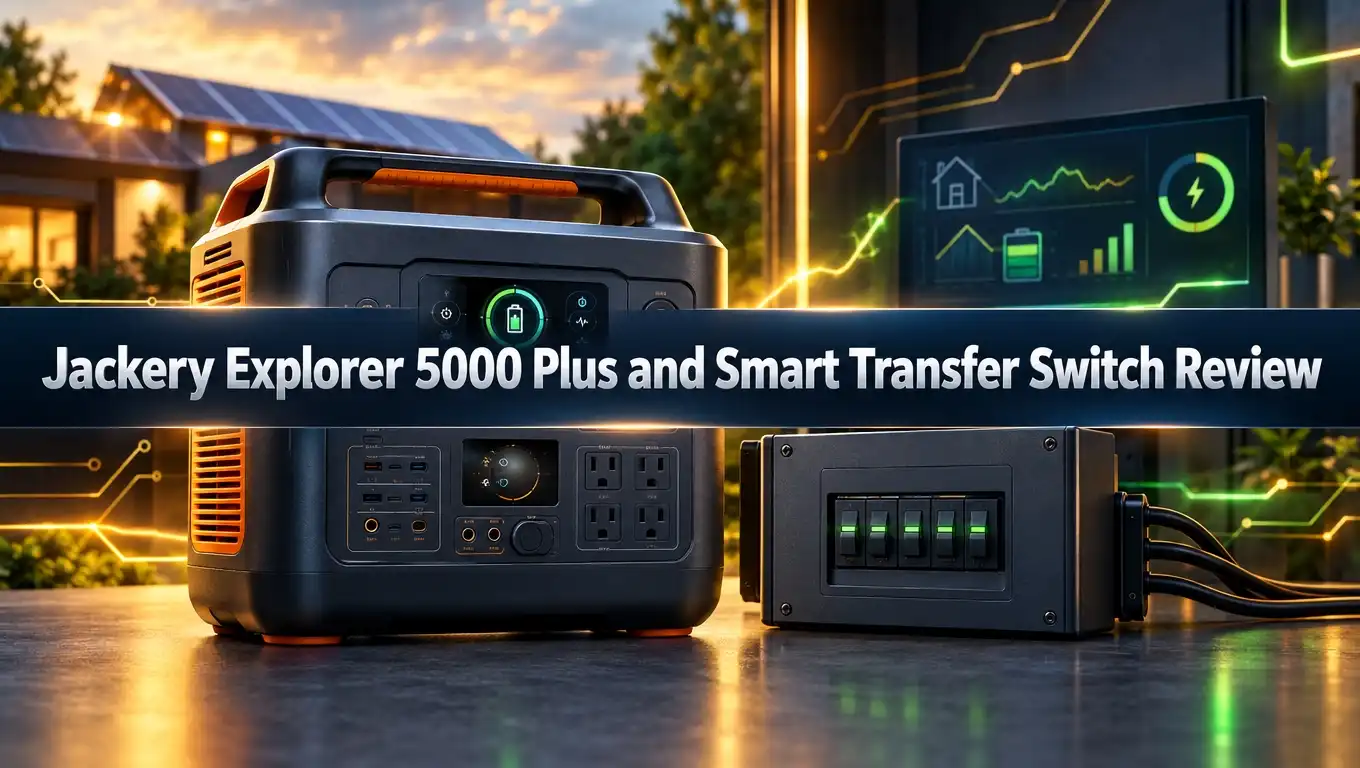
The Jackery Explorer 5000 Plus and Smart Transfer Switch kit aims to fix that problem. It pairs a 5040Wh LiFePO4 power station with a small smart subpanel that connects to your home circuits.
This review covers what this kit does well, where it falls short, and who should buy it. You will also see how it compares with the top rivals from EcoFlow and Anker.
In a Nutshell
- Big battery, big output: The Explorer 5000 Plus stores 5040Wh of energy and delivers 7200W of rated power. It supports both 120V and 240V, so it can run large appliances like a well pump or a central AC unit.
- Smart home connection: The Smart Transfer Switch links the power station to 12 essential home circuits. It switches power fast during an outage, so your key devices keep running with little or no interruption.
- Room to grow: You can add battery packs and a second unit. A full system reaches up to 60kWh of capacity and 14,400W of output when you use two units with the switch.
- Fast solar charging: The unit accepts up to 4000W of solar input. In strong sun, it can refill in about two hours. The AC input tops out at 1800W.
- Long life battery: The LiFePO4 cells are rated for 4000 cycles to 70% capacity. Jackery backs the unit with a 5 year warranty, and you can extend it.
- A few quirks: The unit weighs 134 pounds, lacks a built in light, and the 50A port only supplies 30A of service. Real surge performance also fell short of the claimed figure in independent tests.
Jackery Explorer 5000 Plus and Smart Transfer Switch, 5040Wh

- Handles Even the Big Appliances: Run major home appliances with 7200W of rated power (14,400W surge). Supports...
- Backup That Lasts for 13 Days: A 5040Wh capacity, expandable up to 60kWh — enough to keep your home running...
Last update on 2026-09-30 / Affiliate links / Images from Amazon Product Advertising API
The Jackery Explorer 5000 Plus is the largest power station Jackery has built. It is a clear step up from the camping units that made the brand famous.
This kit combines two products. The first is the power station itself. The second is the Jackery Smart Transfer Switch, which acts as a small subpanel with breakers built in.
Together, they form a home backup system. You do not need to run extension cords around the house during a storm. Your chosen circuits get power straight from the battery.
Jackery claims the battery can keep essentials running for up to 13 days with the right loads. That number depends on what you run, but it shows the scale of this system.
The unit uses LiFePO4 battery chemistry. This chemistry is safer and longer lasting than older lithium ion cells. It also handles daily cycling well, which matters if you plan to use solar every day.
Reviewers at The Solar Lab tested the unit hard. They called it one of the most polished designs Jackery has ever released. They said it can finally compete with big names like EcoFlow and Anker.
This kit targets homeowners who want a quiet, clean alternative to a gas generator. It also suits people who want solar ready backup power without a full rooftop battery install.
Let us break down each part of this system in detail.
Key Specifications at a Glance
Specs tell you a lot about a power station. Here are the most important numbers for the Explorer 5000 Plus.
The battery capacity is 5040Wh. That is enough to run a full size fridge for several days on its own. You can expand it with Jackery Battery Pack 5000 Plus units.
The inverter delivers 7200W rated output. Jackery lists the surge at 14,400W. The unit supports both 120V and 240V output, which is rare in portable power stations.
Charging options are strong. The unit accepts 1800W from a wall outlet and 4000W from solar panels. It has both high voltage and low voltage MC4 solar inputs.
The unit weighs about 134 pounds. It has real wheels and a sturdy pull handle, so one person can roll it on flat ground. Lifting it up stairs takes two people.
The port selection includes four 120V AC outlets, two USB C ports, two USB A ports, and a 12V car socket. It also has an L14 30 twist lock port and a 50A plug.
The Smart Transfer Switch handles 12 home circuits. With two Explorer 5000 Plus units, it supports up to 14,400W of output and 60kWh of total capacity.
The battery is rated for 4000 cycles before it drops to 70% capacity. Jackery offers a 5 year standard warranty on both the power station and the switch. You can add two more years for a fee.
These numbers place the 5000 Plus between the Anker SOLIX F3800 and the EcoFlow DELTA Pro Ultra. It offers more capacity than the Anker and a lower price than the EcoFlow.
Design and Build Quality
The first thing you notice is the build. Jackery kept its signature orange and black look, but the 5000 Plus feels much more solid than older models.
The wheels are large and sturdy. The sliding suitcase handle is one of the strongest handles reviewers have seen on any power station. It does not wobble when you pull the unit across a garage floor.
You also get multiple side handles. These help two people lift the unit into a truck or up a step. At 134 pounds, you will want that help.
The unit looks clean enough to keep in a living room. That matters during an outage, since you may want it near the fridge or medical devices. It also runs very quietly, even under a heavy load.
The display screen shows battery level, input power, and output power. It is easy to read at a glance.
There are a few design quirks. The solar input door opens upward but does not fold back fully. If the unit sits on the floor, you may end up on your knees to plug in MC4 cables.
One lower handle sits on the side. This forces you to tip the unit onto its rounded surface when you lift it this way. It is a small issue, but it feels like an odd choice.
Jackery also dropped the built in LED light. Older Jackery models almost always had one. A light would be very useful during a nighttime blackout.
Overall, the design is practical and well built. The small flaws do not ruin the experience, but they are worth knowing before you buy.
Top 3 Alternative for Jackery Explorer 5000 Plus and Smart Transfer Switch
The Jackery kit is a strong choice, but it is not the only one. Here are three popular alternatives that compete for the same buyers.
EcoFlow DELTA Pro Ultra 6144Wh

- One Powers All. The unit of DELTA Pro Ultra whole house generator includes an inverter and a battery. One...
- Strong Power Security. Scalable from one battery of 6144Wh, two days of essential power, all the way to 15, it...

Last update on 2026-09-30 / Affiliate links / Images from Amazon Product Advertising API
The EcoFlow DELTA Pro Ultra is the premium pick in this class. It offers 6144Wh of capacity and the same 7200W output as the Jackery.
It supports 120V and 240V and can expand to a massive 90kWh. It pairs with the EcoFlow Smart Home Panel 2 for whole home backup.
The downside is price. It often costs about $1,500 more than the Jackery. It also uses a stacked design with a separate inverter and battery module.
Anker SOLIX F3800 Plus 3840Wh

Last update on 2026-09-29 / Affiliate links / Images from Amazon Product Advertising API
The Anker SOLIX F3800 Plus is a close rival. It stores 3840Wh and delivers 6000W of output with dual voltage support.
Anker upgraded the solar input to 3200W on this version. It also added a 30A plug for RV owners. It expands up to about 53kWh with extra batteries.
It has less capacity and output than the Jackery. However, it often sells for a bit less, and Anker offers a strong home panel ecosystem.
Anker SOLIX F3800 3840Wh

- 𝗘𝘅𝘁𝗲𝗻𝗱𝗲𝗱 𝗕𝗮𝗰𝗸𝘂𝗽 𝗣𝗼𝘄𝗲𝗿: Add a Smart Generator 5500 for...
- ...
Last update on 2026-09-04 / Affiliate links / Images from Amazon Product Advertising API
The original Anker SOLIX F3800 remains a popular choice. It offers 3840Wh of capacity, 6000W output, and 2400W solar charging.
It is often on sale, which makes it a good value pick. It does have a higher idle draw of about 80W, compared with around 58W on the Jackery.
Each of these alternatives has strengths. Still, the Jackery offers a great balance of capacity, output, solar input, and price.
Battery Capacity and Expansion Options
The 5040Wh battery is the heart of this system. It uses LiFePO4 cells, which are known for safety and long life.
To put 5040Wh in context, a typical modern fridge uses about 1 to 2kWh per day. That means the Explorer 5000 Plus alone could keep a fridge running for two to four days.
Add a few lights, a WiFi router, and a phone charger, and you still get more than a day of comfort. Jackery says careful use can stretch backup to 13 days.
If you need more, expansion is simple. You can connect Jackery Battery Pack 5000 Plus units to the power station. Each pack adds another large block of storage.
With two Explorer 5000 Plus units and the Smart Transfer Switch, the full system reaches 60kWh. That is enough to power a large home through a long outage.
The battery is rated for 4000 cycles to 70% capacity. If you cycle it once per day, it should last more than ten years. This makes it a good fit for daily solar use.
The charging temperature range runs from 32°F to 113°F. Discharging works from 5°F to 113°F. Keep this in mind if you plan to store the unit in a cold garage.
Idle draw is worth noting too. In testing, the unit used about 58W per hour with the inverter on and no load. That is better than the Anker F3800, but it still drains the battery over time.
Turn off the AC inverter when you do not need it. This simple habit can save a lot of energy during a long blackout.
Power Output and Surge Performance
Power output decides which appliances you can run. The 7200W rated output puts this unit in the top tier of portable power stations.
Most homes can run their key loads on 7200W. This includes a fridge, a freezer, a microwave, a well pump, and lights. You can run several of these at the same time.
The 240V support is a big deal. Many large appliances need 240V, such as central AC units, electric dryers, and deep well pumps. Jackery says the unit can even run a 5 ton AC system.
Jackery lists the surge rating at 14,400W. Surge power matters for motors, which draw a big spike of power when they start.
Independent testing showed mixed results here. The Solar Lab found the unit struggled to start an AC unit with a 10,000W surge. That AC unit only drew 3000W once running.
However, the unit held loads of 8000W and 9500W for 20 to 30 seconds. That is still a very strong result. Most appliances with smaller motors will start without trouble.
If you plan to run a very large AC system, consider a soft start device. This small add on lowers the startup spike and makes it easier for any battery to run the motor.
The unit stays quiet even under heavy loads. That makes it much nicer to live with than a gas generator. You also avoid fumes, fuel storage, and carbon monoxide risks.
For most homes, the power output is more than enough. Just be realistic about very large surge loads.
Smart Transfer Switch Setup and Features
The Jackery Smart Transfer Switch turns the power station into a true home backup system. It is the key part of this kit.
The switch works like a small subpanel. It has breakers built in and connects to your main electrical panel. A licensed electrician should install it.
Once installed, the switch supports 12 essential circuits. You choose which circuits to back up. Common picks include the fridge, sump pump, WiFi, lights, and furnace blower.
During an outage, the switch moves your circuits to battery power. Jackery lists a 20ms switchover time. That is fast enough that most devices will not reset or shut off.
The switch also opens up 240V charging and output. Without the switch, you cannot charge the 5000 Plus at 240V. This is a key difference from EcoFlow and Anker, which offer 240V generator cables.
You can connect two Explorer 5000 Plus units to one switch. This doubles your output to 14,400W and adds redundancy. If one unit has an issue, the other can keep working.
The Jackery app lets you monitor each circuit. You can turn circuits on or off remotely and set power priorities. This helps you stretch battery life during long outages.
Reviewers noted one small issue. The panel has no pre drilled holes, so your electrician may need to drill openings for cables. It is a minor annoyance and not a deal breaker.
The switch is reasonably priced. You can also buy the power station first and add the switch later if your budget is tight.
Charging Speed and Solar Input
Fast charging matters during a long outage. The Explorer 5000 Plus offers several ways to refill its battery.
From a wall outlet, the unit accepts up to 1800W. That refills the 5040Wh battery in roughly three hours. Jackery claims faster times, but reviewers found those claims a bit optimistic.
Solar is where this unit shines. It accepts up to 4000W of solar input. That beats most rivals in this size class, including the original Anker F3800.
With a full 4000W array, you can recharge the battery in under two hours of strong sun. You can also refill an expanded system within a single sunny day.
The unit has both high voltage and low voltage MC4 inputs. This gives you flexibility in how you wire your solar panels. You can use portable folding panels or fixed rooftop panels.
Solar charging also helps you save money. You can use stored solar power at night instead of drawing from the grid. This reduces your utility bill over time.
The unit also supports charging from a gas generator. You can plug a generator into the L14 30 port. This is a great backup plan during cloudy weather.
As noted earlier, 240V charging requires the Smart Transfer Switch. If you buy the kit, you get this feature out of the box.
The high solar input makes this unit a strong pick for people who want to rely on the sun during extended blackouts.
Ports, App Control, and Smart Features
The Explorer 5000 Plus has a practical port layout. All inputs and outputs are easy to reach.
You get four 120V AC outlets on the front. These handle everyday devices like lamps, fans, and small kitchen appliances. You also get two USB C ports and two USB A ports for phones and laptops.
The unit keeps a 12V car socket. Many brands have dropped this port, but it is very useful. A 12V fridge uses less power than a standard AC fridge, which helps during camping or emergencies.
There is also an L14 30 twist lock port and a 50A plug. The 50A plug is a bit misleading, since it only provides 30A of actual service. This limits its use for some large RVs.
The Jackery app connects over WiFi and Bluetooth. You can check battery level, charging status, and power draw from your phone.
The app also supports time of use scheduling. You can charge the battery when grid rates are low and use stored energy when rates are high. This is a simple form of peak shaving.
The unit includes a UPS mode. Jackery lists it as 0ms when devices plug straight into the unit. In testing, UPS mode worked well, and outages went mostly unnoticed.
Jackery also offers a helpful online runtime calculator. Reviewers praised it because it includes idle draw in its estimates. The numbers feel realistic instead of inflated.
These smart features make daily use simple. You do not need to be a tech expert to manage the system.
Price and Value
Price is a big factor for any home backup purchase. The Jackery Explorer 5000 Plus alone has often sold for around $3,000, down from a list price of about $3,500.
At that price, it matches the original Anker F3800 but offers more capacity and output. It also costs about $1,500 less than the EcoFlow DELTA Pro Ultra.
The kit with the Smart Transfer Switch costs more. Prices change often, so check the current deal on Amazon or the Jackery site. Big sale events can bring the price down a lot.
Is it worth the money? For most homeowners, the answer is yes. You get 5040Wh of storage, 7200W of output, and 4000W of solar input in one unit.
Compare that with a standby gas generator. A standby unit often costs $10,000 or more once installed. It also needs fuel, maintenance, and regular testing.
The Jackery kit has lower upfront costs for many buyers. It runs silently, needs little care, and can pair with solar to cut your power bill.
Also consider the long battery life. With 4000 cycles, the battery should last well over a decade. That spreads the cost across many years of use.
The 5 year warranty adds peace of mind. You can extend coverage for two more years if you want extra protection.
Some buyers may find it hard to justify the cost. If you only face short outages once or twice a year, a smaller unit may be enough. For frequent or long outages, this kit delivers strong value.
Pros and Cons
Every product has strengths and weaknesses. Here is a clear breakdown for the Jackery Explorer 5000 Plus and Smart Transfer Switch.
Pros
- Large 5040Wh LiFePO4 battery: It offers enough storage to run essential appliances for days, and the cells last for 4000 cycles.
- Strong 7200W output with 120V and 240V: It can run heavy appliances like well pumps and central AC systems that smaller units cannot handle.
- Excellent 4000W solar input: It recharges in under two hours with a full array, which beats most rivals in this class.
- Smart Transfer Switch with 12 circuits: It connects directly to your home and switches power quickly during an outage.
- Scalable up to 60kWh: You can add battery packs and a second unit as your needs grow.
- Quiet and well built design: The sturdy wheels and handle make it easy to move, and it runs quietly under load.
- Fair price for the capacity: It costs much less than the EcoFlow DELTA Pro Ultra while offering similar output.
Cons
- Heavy at 134 pounds: Lifting it up stairs or into a vehicle requires two people.
- Surge fell short in testing: It struggled with a 10,000W surge load despite the 14,400W claim.
- 50A plug only supplies 30A: This limits its value for large RVs that need a true 50A connection.
- No 240V charging without the switch: You need the Smart Transfer Switch to unlock this feature.
- No built in light: A light would help a lot during nighttime outages.
- Awkward solar door: It does not fold back fully, which makes cable hookup harder at floor level.
Who Should Buy This Kit
This kit is not for everyone. It fits some buyers much better than others.
Homeowners in outage prone areas will get the most value. If storms, wildfires, or grid issues cut your power often, this kit keeps your essentials running without fuel or noise.
People with well pumps or sump pumps should take a close look. The 240V support lets you run these critical loads during a blackout. A flooded basement costs far more than this system.
Solar users will love the 4000W input. You can pair it with panels to build a small off grid setup. This works well for cabins, tiny homes, and rural properties.
Families with medical devices at home will also benefit. The fast switchover and UPS mode help keep CPAP machines and oxygen concentrators running.
Budget minded buyers who want big capacity should consider it too. It offers more storage per dollar than many premium rivals.
This kit is less ideal for some people. If you mainly want a unit for camping trips, 134 pounds is too heavy. A smaller Jackery Explorer model would serve you better.
Renters may also struggle. The Smart Transfer Switch needs installation by an electrician. Many landlords will not allow panel changes.
Large RV owners who need a true 50A connection should look elsewhere. The 30A limit on the 50A plug will fall short for big rigs.
If you fit the ideal buyer profile, this kit is one of the best home backup options in its price range.
Final Verdict
The Jackery Explorer 5000 Plus and Smart Transfer Switch is a big win for Jackery. It proves the brand can compete in the serious home backup market.
The unit offers a 5040Wh battery, 7200W output, and 4000W solar input. These numbers put it right alongside the best from EcoFlow and Anker. The price is often much lower.
The Smart Transfer Switch makes home integration simple. It connects 12 circuits and switches power quickly. You can add a second unit later to double your output and capacity.
The design feels polished. Strong wheels, a sturdy handle, and quiet operation make it pleasant to own. The app adds useful controls like time of use scheduling and circuit management.
There are some flaws. The surge rating did not hold up fully in testing. The unit is heavy, lacks a light, and needs the switch for 240V charging. None of these issues are deal breakers for most buyers.
Our take is simple. If you want reliable, quiet, and solar ready backup power for your home, this kit deserves a spot at the top of your list. It offers excellent value for the capacity and output you get.
Check current pricing before you buy, since Jackery runs frequent sales. A good deal makes this strong system even easier to recommend.
Frequently Asked Questions
How long can the Jackery Explorer 5000 Plus power a home?
It depends on your loads. A fridge, lights, and WiFi can run for several days. Jackery says careful use can stretch backup to about 13 days. Heavy loads like central AC will drain it within hours.
Does the Smart Transfer Switch need professional installation?
Yes. The switch connects to your main electrical panel. A licensed electrician should install it to meet local codes and keep your home safe.
Can the Explorer 5000 Plus run a central air conditioner?
It can run many central AC units thanks to its 240V output. Jackery says it can handle a 5 ton AC. Very large startup surges may be a problem, so a soft start device can help.
How fast does the Explorer 5000 Plus charge with solar?
It accepts up to 4000W of solar input. With a full array in strong sun, it can recharge in under two hours.
Can I connect two Explorer 5000 Plus units together?
Yes. The Smart Transfer Switch supports two units. This setup delivers 14,400W of output and up to 60kWh of capacity with battery packs.
Is the Jackery Explorer 5000 Plus good for RV use?
It works for many RVs, but the 50A plug only supplies 30A of service. Owners of large rigs that need a full 50A connection may want another option.
What warranty does Jackery offer on this kit?
Jackery offers a 5 year standard warranty on the Explorer 5000 Plus and the Smart Transfer Switch. You can buy an extra two years of coverage.
Does the unit work as a UPS for computers and medical devices?
Yes. The unit has a UPS mode that worked well in independent tests. Devices plugged into the unit stay powered when the grid drops.

DK is a technology expert who specializes in AI tools, software, and tech gadgets. He writes for How to Tech Info, providing detailed reviews and practical guides. DK helps readers discover the best AI applications, navigate new software, and choose the right tech gadgets.