Anker SOLIX E10 Review: Power Dock & Extra Battery Worth It?
When the power goes out, the house goes quiet. The fridge stops humming. The AC stops working. Your phone slowly runs out of charge.
The Anker SOLIX E10 with Power Dock and Extra Battery is built to fix that problem. It is a modular whole home battery system that starts at 12kWh and grows to about 90kWh.
In this review, we cover specs, real outage results, installation, price, and the best alternatives. By the end, you will know if this system is right for your home.
In a Nutshell
- Big power output: The E10 gives up to 10kW of output with two battery modules. You can stack three units for up to 30kW. It can even start a 5 ton central AC unit.
- Huge expansion: This kit starts with 12kWh of storage. One E10 holds five B6000 batteries. Three E10 units reach about 90kWh total.
- Whole home coverage: The Power Dock works as an automatic transfer switch with 200A service. It has 12 smart circuits you control from the Anker app. Switchover takes 20ms or less.
- Solar ready: Each E10 accepts 9kW of solar input through two PV inputs. It also works with existing microinverter systems like Enphase.
- Long battery life: The LiFePO4 cells keep 80% capacity after 4,000 cycles. The E10 has a NEMA 4 (IP66) rating for outdoor use.
- Smart savings: Self consumption mode, time of use mode, and Storm Guard help cut bills. Anker claims savings of up to 80% when you pair it with solar.
Anker SOLIX E10, Power Dock and Extra Battery

- Limited-Time Perks: E10 Metal Pad and AC Generator Adapter, Up to 12-Month 0% APR
- Whole-Home Power: 7.6kW Continuous, scales to 22.8kW. 10kW Turbo Output, scales to 30kW Turbo with triple...
Last update on 2026-09-29 / Affiliate links / Images from Amazon Product Advertising API
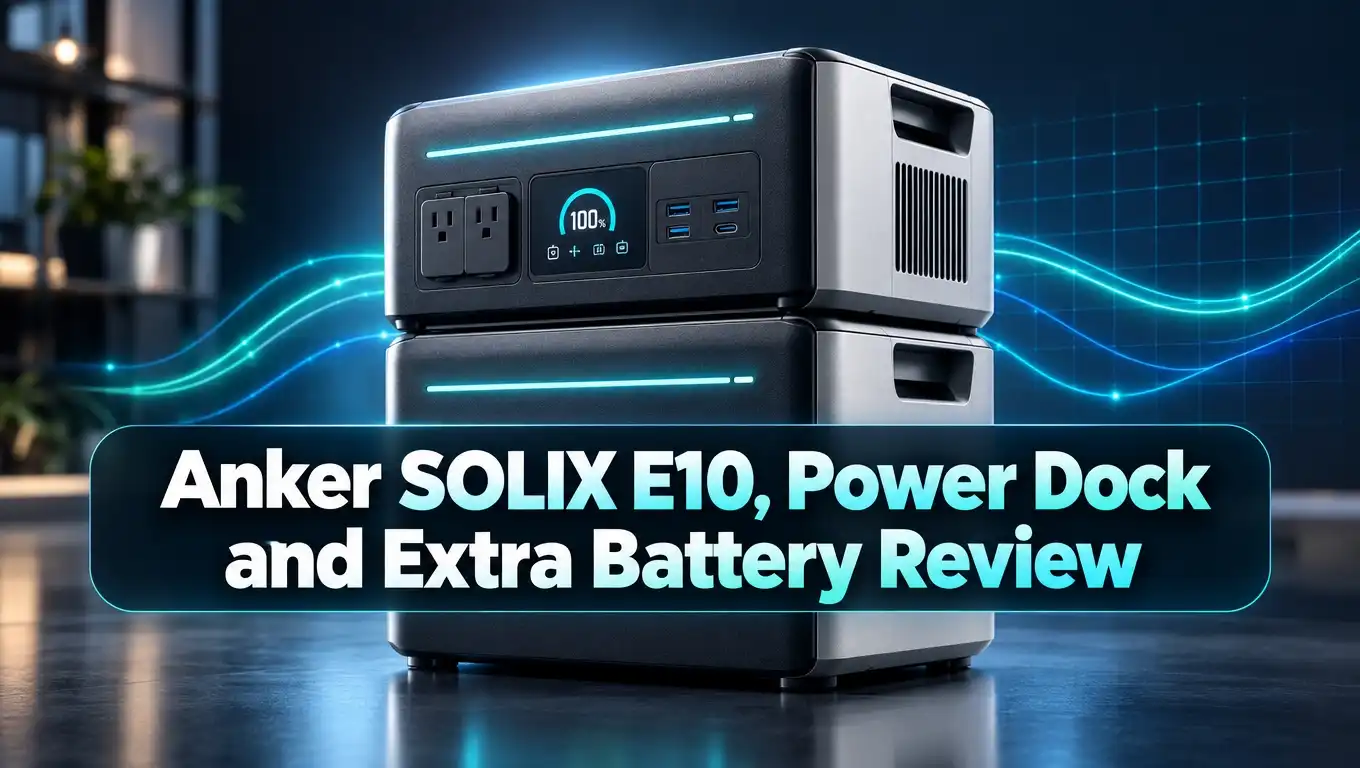
The Anker SOLIX E10 is Anker’s biggest home energy product so far. This bundle includes the E10 power module, the Power Dock, and a B6000 extra battery. With two batteries, you get 12.288kWh of usable storage right away.
The system is a real rival to a standby gas generator. It makes no noise and gives off no fumes. It also earns its keep every day by storing cheap solar power for the evening.
Anker built the E10 around a simple idea. You start small and add more batteries later. Each B6000 module holds 6,144Wh, and you can stack up to five under one E10 unit.
The Power Dock is the brain of the setup. It sits between your utility meter and your main panel. When the grid fails, it switches your home to battery power in 20 milliseconds or less.
Most people will not notice the change. Your lights stay on, and your Wi Fi router keeps running. Your computer does not reboot.
The E10 carries UL 9540 and UL 9540A certification. This is the same safety standard that Tesla Powerwall and FranklinWH meet. That matters for your permit and for peace of mind.
At the time of writing, this bundle costs about $8,209 on Amazon. That price is lower per kWh than many installer only systems. The sections below explain what you get for your money.
What Comes in the Package
This bundle gives you three main parts. Each part has a clear job in the system.
The first part is the E10 power module. This is the inverter, and it weighs 60.6 pounds. It holds no battery inside. All the energy lives in the modules below it.
The second part is the B6000 battery module. Each one stores 6,144Wh at 102.4V nominal. Each module weighs 130 pounds, so two people can carry one into place. You do not need a forklift or a crane.
The third part is the Anker SOLIX Power Dock. It is an automatic transfer switch with 12 smart circuit slots. It also has lugs that feed a subpanel for the rest of your circuits.
The listing name says “Extra Battery,” and it lists 12kWh as the starting point. That means two B6000 modules in total. This detail matters a lot, as we explain later.
The kit also includes wiring guides and a quick start guide. Anker also provides detailed install videos. One reviewer noted these videos are hard to find on YouTube, so ask Anker support for direct links.
You can add the Anker Smart Generator later. It is sold separately. It runs on gasoline, propane, or natural gas and charges the battery directly in DC.
Design and Build Quality
The E10 looks clean and modern. The power module stacks on top of the battery modules like building blocks. The result is a neat tower that fits against a garage wall or outside the house.
Build quality feels solid. The E10 has a NEMA 4 and IP66 rating. It can handle rain, snow, and dust outdoors. The Power Dock carries a NEMA 3R rating, which is also fine for outdoor use.
You can mount the system on the floor or the wall. Anker suggests wall mounting in flood prone areas. Just make sure your wall can hold the weight.
The E10 also handles temperature well. It has a built in battery heater that turns on below 59°F. The heater stops once the battery reaches 68°F.
Hot weather is fine too. The system starts to limit power at 113°F ambient. The maximum operating temperature is 131°F.
The modular design is the real highlight. Most home batteries ship as one heavy block. The E10 splits into pieces that two people can carry by hand.
This makes placement easier. You can fit it into tight spots in a garage or a side yard. The electrician who installed one test unit said the modular batteries made his job much simpler.
Top 3 Alternative for Anker SOLIX E10
The E10 is a great system, but it is not the only choice. Some buyers want something portable. Others want a different brand or a lower starting price.
Here are three strong alternatives worth checking. Each one uses LiFePO4 batteries and supports home backup.
EcoFlow DELTA Pro Ultra with Extra Battery

- One Powers All. The unit of DELTA Pro Ultra whole house generator includes an inverter and a battery. One...
- Strong Power Security. Scalable from one battery of 6144Wh, two days of essential power, all the way to 15, it...
Last update on 2026-09-29 / Affiliate links / Images from Amazon Product Advertising API
The EcoFlow DELTA Pro Ultra is the closest rival. It gives 7,200W of AC output and 12kWh of storage in this bundle. It also expands to 90kWh, just like the E10.
It works with the EcoFlow Smart Home Panel 2 for whole home backup. It is a good pick if you like the EcoFlow app.
Anker SOLIX F3800 Plus

Last update on 2026-09-29 / Affiliate links / Images from Amazon Product Advertising API
The Anker SOLIX F3800 Plus is a portable power station with 3,840Wh of storage. It gives 6,000W of output at 120V and 240V. It expands to about 53kWh.
It rolls on wheels, so you can take it camping or to a job site. It is a smart pick for renters or for smaller homes.
BLUETTI AC500 and B300S Expansion Battery

- [Upgraded and Supercharged] - An AC500 with a 5,000W inverter accepts up to 6 B300S expansion batteries...
- [16 Versatile Ports] - The NEMA 14-50R, TT-30, and L14-30 ports are perfect for heavy-duty appliances. Just...
Last update on 2026-09-29 / Affiliate links / Images from Amazon Product Advertising API
The BLUETTI AC500 gives 5,000W of continuous output with a 10kW surge. With B300S batteries, it expands to 18,432Wh.
It is modular and works with Alexa. It costs much less upfront. It is a good choice for partial home backup on a budget.
Power Output and Performance
Power is where the E10 shines. With two or more batteries, it delivers 10kW of power and can hold that for up to 90 minutes in Turbo mode. That is enough to run most homes during an outage.
Stack three E10 units, and output climbs to 30kW. Very few home batteries reach this level.
The E10 can start a 5 ton central AC. AC compressors pull a big surge when they start. Many batteries fail at this moment. The E10 handles it without trouble.
Here is a key detail. With only one battery module, output drops to 7.6kW. That is why this 12kWh bundle with two batteries is the smart starting point.
One real owner ran his AC and dryer at the same time during an outage. The system did not trip once. His water pump surge was also a non event.
Efficiency is strong too. Anker confirmed about 89% round trip efficiency. That matches the Tesla Powerwall 3 and sits one point behind Enphase and FranklinWH.
Idle draw is about 46W with one power module and one battery. Each extra battery adds about 9W. The heater can pull up to 200W in cold weather, so plan for that in winter.
Battery Capacity and Expansion Options
The E10 grows with your needs. This bundle starts at 12.288kWh. That covers a typical evening peak and leaves power for the next morning.
Each E10 unit holds up to five B6000 battery modules. That gives about 30kWh per unit. A Power Dock supports up to three E10 units.
At full size, you get about 90kWh of storage. That is enough to run a large home for days without the grid.
The best part is that you can add batteries yourself. An electrician must install the Power Dock and grid connection. After that, you can install extra battery modules on your own.
The battery chemistry is LiFePO4. These cells are safer and last longer than older lithium types. Anker rates them at 80% capacity after 4,000 cycles.
If you cycle the battery once a day, that is more than ten years of use. Each module also has its own battery management system. It guards against over discharge and other faults.
One thing to note is the proprietary connectors. The batteries only link with Anker gear. That is normal for this category, but it means you depend on Anker for future modules.
Power Dock and Smart Circuit Control
The Power Dock makes whole home backup possible. It is a smart automatic transfer switch rated for 200A service.
It has 12 smart circuit slots. You assign each circuit a priority in the Anker app. During an outage, the system can shut off low priority loads to save power.
For example, you can keep the fridge, lights, and internet on. You can shed the pool pump or the EV charger. You can change these settings at any time, even during an outage.
The Power Dock also has lugs that feed a subpanel. This lets you cover circuits beyond the 12 smart slots. The cleanest setup places the Power Dock between the meter and the main panel.
You can also run it as a partial home setup. In that case, the Power Dock acts as a subpanel. Only chosen loads get backup.
Circuits 7 and 8 accept third party solar AC input. This lets you keep your existing solar system. Circuits 1 and 2 can take a hardwired generator input.
The Power Dock comes with a 10 year standard warranty. That is double the warranty on the power module and batteries.
Solar Charging and Generator Support
Solar is where the E10 saves you money. Each unit accepts 9kW of DC solar input. It has two PV inputs, each rated for 4,500W at 30V to 450V.
With three units, solar input reaches 27kW. That covers even very large rooftop arrays.
A single B6000 battery can take only 6kW of charge. You need at least two batteries to use the full 9kW solar input. This is one more reason to buy the 12kWh bundle.
Do you already have solar? The E10 supports AC coupling with existing systems. One owner connected 21 Enphase IQ8 microinverters without trouble.
During an outage, the E10 forms a microgrid. Your solar panels keep making power even with the grid down. When the battery fills up, the system tells the microinverters to slow down.
The Anker Smart Generator adds another layer. It gives 4.5kW of DC charging and runs on gasoline, propane, or natural gas. It is quiet at about 65.5 dB in quiet mode.
There is one catch. The Smart Generator is not yet CARB certified for California. California owners can use a third party generator, but it must have less than 10% harmonic distortion.
Anker App and Smart Features
The Anker app gives you full control from your phone. You can see solar production, battery level, and home use in real time. You can also turn the system on or off remotely.
The E10 offers two main modes. Self consumption mode uses your solar first, then charges the battery, then sends extra power to the grid. At night, your home runs on stored energy.
Time of use mode is built for utility plans with peak rates. The battery charges when power is cheap. It then powers your home during expensive peak hours.
Anker says these modes can cut your bill by up to 80% when paired with solar. Actual savings depend on your rates and your use.
Storm Guard is a clever feature. It watches weather alerts in real time. When a storm is on the way, it charges the battery to full ahead of time.
One owner got a high wind alert. The E10 began charging at about 7.6kW right at the forecast start time. The storm later caused a real outage.
The app does not yet offer a local API or Home Assistant support. Smart home fans may miss this. Anker says it has noted the request.
Installation Process
You need a licensed electrician to install the Power Dock. The electrician also handles the main grid connection and permits.
Here is the good news. You do not need a certified installer network. Tesla and FranklinWH often require their own installers. With the E10, you can buy it on Amazon and hire any licensed electrician.
The catch is that the E10 is still new. Many electricians have not installed one yet. You may need to call a few before you find a good fit.
A typical install takes one to two days. One tester’s install took two days because of his combined meter and panel setup. His electrician said the process was smooth and the documents were clear.
The modular batteries make the job easier. Each module weighs 130 pounds. Two people can lift one without special tools.
After the install, you set up the system in the Anker app. This step includes solar setup and smart circuit assignments. Know your solar system details before you start.
Once the Power Dock is in place, adding capacity is simple. You can add battery modules yourself later. No electrician visit is needed for that step.
Real World Outage Performance
Specs are nice, but real outages matter most. One ESS News reviewer lives in a high fire risk zone in Napa Valley. His utility cut power seven times in 2025.
He first ran a simulated outage. He flipped off the main breaker. The Power Dock switched to battery power automatically.
His solar kept producing power without the grid. His AC and dryer ran at the same time with no issues.
Less than a week later, a real storm hit. A strong wind event caused a 4.5 hour outage for hundreds of homes in his area.
Inside his house, nothing changed. The lights stayed on. The only signs of the outage were a utility text message and the sound of neighbors’ gas generators.
The system also behaved as expected when the battery filled up. At about 95% charge, the solar paused for a few hours. It started again once the battery dropped into the low 90s.
This real test shows the E10 works as promised. It turns outages from a crisis into a non event. For families in storm or fire zones, that peace of mind is worth a lot.
Price and Value for Money
This bundle sells for about $8,209 on Amazon. That includes the E10 power module, the Power Dock, and two B6000 batteries for 12kWh.
You also need to budget for installation. Electrician costs vary by region and panel setup. Plan for a few thousand dollars more for labor and permits.
How does it compare? One owner got a quote for a 15kWh FranklinWH aPower 2. His E10 setup came in about 11% lower per kWh.
The E10 also gives daily value. A gas generator sits idle most of the year. The E10 stores solar power every day and cuts your utility bill.
This matters most under plans like NEM 3.0 in California. There, the export credit is tiny compared to the import cost. A battery lets you keep your solar power for yourself.
You may also qualify for tax credits or local rebates. Rules change often, so check current programs in your state.
The warranty is 5 years on the power module and batteries. The Power Dock gets 10 years. Some reviewers call the battery warranty conservative for LiFePO4 cells.
Pros and Cons
After looking at specs, tests, and owner reports, here is a clear summary. These points will help you weigh the E10 against your needs.
Pros
- The modular batteries are easy to carry, and two people can place them without heavy equipment.
- It gives 10kW of output with two batteries and scales to 30kW with three units.
- The Power Dock supports full 200A whole home backup with 12 smart circuits.
- Switchover takes 20ms or less, so most devices never notice an outage.
- It accepts 9kW of solar and works with existing microinverter systems.
- LiFePO4 cells keep 80% capacity after 4,000 cycles.
- The NEMA 4 and IP66 rating allows outdoor installation in rain and snow.
- Storm Guard charges the battery before severe weather hits.
- Any licensed electrician can install it, with no certified installer network needed.
Cons
- A single battery setup limits output to 7.6kW, so you need two modules for full power.
- The Smart Generator is not yet CARB certified for California.
- The 5 year battery warranty is shorter than some rivals.
- Proprietary connectors tie you to Anker for future batteries.
- There is no local API or Home Assistant support yet.
- Many electricians have not installed one yet, so finding one may take time.
Who Should Buy the Anker SOLIX E10
The E10 is not for everyone. It is a big purchase. Here is who gets the most value from it.
Homeowners in outage prone areas are the first group. If you face storms, hurricanes, or wildfire shutoffs, the E10 keeps your home running for days.
Solar owners on low export rates are the second group. If your utility pays little for exported power, a battery lets you store that energy and use it at night.
Families with large loads also benefit. The E10 can start a 5 ton AC, run a well pump, and power a dryer at once. Smaller batteries often fail here.
Anyone tired of gas generators will love the E10. It makes no noise and gives off no exhaust. You do not need to store fuel or wait in line at the gas station.
Who should skip it? Renters should look at the F3800 Plus instead. People with small apartments or low power needs may find it too much.
If your budget is tight, the BLUETTI AC500 offers partial backup for less. You can always upgrade later.
Final Verdict
The Anker SOLIX E10 with Power Dock and Extra Battery is one of the best whole home backup systems you can buy today. It is powerful, quiet, and smart.
The modular design stands out most. You start at 12kWh and grow to about 90kWh. You can add batteries yourself as your needs change.
Real world tests back up the claims. The E10 kept a home running through a real storm outage. The owners did not notice the switch.
There are a few weak spots. The warranty could be longer. California buyers must wait for the Smart Generator. Smart home fans want better integration.
Still, the value is clear. The E10 costs less per kWh than many rivals. It pays you back every day through solar savings.
Our advice is simple. Buy the two battery bundle at minimum. This unlocks the full 10kW output and 9kW solar charging.
If you want to stop worrying about outages, the E10 is a smart long term investment. As one owner put it, silence is the upgrade.
Frequently Asked Questions
How long can the Anker SOLIX E10 power a home?
It depends on your usage. A home using 1kW on average can run about 12 hours on the 12kWh bundle. With solar recharging each day, it can last many days.
Can I install the Anker SOLIX E10 myself?
No, a licensed electrician must install the Power Dock and grid connection. After that, you can add extra battery modules yourself.
Does the E10 work with my existing solar panels?
Yes. The E10 supports AC coupling through circuits 7 and 8 on the Power Dock. Your solar inverter must support the IEEE 1547 2018 grid profile.
How many batteries can the E10 hold?
One E10 unit holds up to five B6000 modules, which is about 30kWh. Three units on one Power Dock reach about 90kWh.
Can the E10 run a central air conditioner?
Yes. With two or more batteries, the E10 can start and run a 5 ton central AC unit.
Is the Anker SOLIX E10 safe to install outdoors?
Yes. The E10 has a NEMA 4 and IP66 rating. The Power Dock is rated NEMA 3R. Both work outdoors.
What is the warranty on the Anker SOLIX E10?
The power module and batteries have a 5 year standard warranty. The Power Dock has a 10 year warranty. The Smart Generator has a 3 year warranty.
Does the E10 work with other generators?
Yes. The E10 works with most third party portable and standby generators. The generator should have less than 10% harmonic distortion for clean power.

DK is a technology expert who specializes in AI tools, software, and tech gadgets. He writes for How to Tech Info, providing detailed reviews and practical guides. DK helps readers discover the best AI applications, navigate new software, and choose the right tech gadgets.