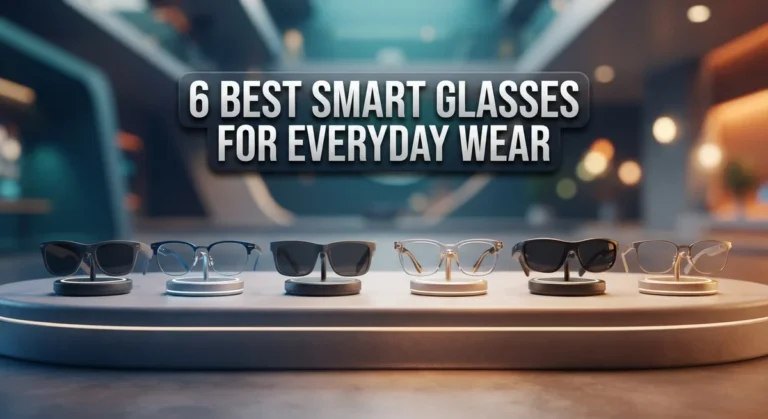
5 Best AI Smart Glasses With Camera 2026 (Top Picks)
Smart glasses stopped being a science fair project. In 2026, they take sharp photos, answer questions out loud, translate menus, and stream music into your ears without earbuds. The best pairs look like normal frames, weigh about 50 grams, and last most of a day on one charge.
You probably found this page because you want a camera on your face without looking strange. Good news: the market finally delivers. Meta owns most of the shelf space, Rokid is pushing hard on translation, and prices now start well under $300 for last year’s models.
I looked at camera resolution, battery life, audio quality, comfort, and real owner feedback. Then I cut the list down to five pairs that are genuinely worth buying today. This guide keeps things simple. You get honest picks, clear pros and cons, and a plain buying guide at the end.
In a Nutshell
Short on time? Here is everything important, compressed into six points.
- Best overall: Ray Ban Meta (Gen 2) Wayfarer Large. It shoots 3K Ultra HD video through a 12MP ultrawide camera, runs Meta AI by voice, and lasts up to eight hours with typical use. The charging case adds roughly 48 more hours. Prices start near $379.
- Best for sports: Oakley Meta HSTN. Same 12MP camera and 3K video, but with Oakley Prizm lens options, a louder speaker system, and a wraparound fit that stays put during runs and rides. Starting price sits around $399.
- Best for translation: Rokid AI Glasses Style. This pair supports ChatGPT and Gemini, handles real time translation across dozens of languages, and includes a 12MP camera with low light HDR. Street prices often drop near $299.
- Best for smaller faces: Ray Ban Meta (Gen 2) Skyler. A cat eye shape with the same Gen 2 internals. Comfort matters more than specs if the frame slides down your nose all day.
- Best budget buy: Ray Ban Meta (Gen 1) Wayfarer. Still a great camera, still runs Meta AI, and now heavily discounted. Video maxes out at 1080p and battery life is shorter, but the value is excellent.
- What to expect overall: none of these pairs replace a phone, and none of them show a floating screen except premium display models. They replace your quick camera moments, your earbuds, and a lot of your voice searches.
Why AI Smart Glasses With Cameras Took Off in 2026
Three things changed at once. Camera sensors got small enough to hide in a temple arm, batteries got denser, and voice assistants finally became useful without a screen.
The result is a device you forget you are wearing. You say a wake phrase, ask a question, and hear an answer two seconds later. No unlocking, no tapping, no staring down at a slab of glass.
Camera quality made the biggest jump. Older camera glasses shot muddy 1080p clips that nobody wanted to post. Current models shoot 3K video with ultrawide framing and image stabilization, which is good enough for social media and family memories.
Prices also settled. A capable pair now costs roughly the same as decent wireless earbuds plus a cheap action camera. That combination is exactly what most buyers were paying for anyway.
Adoption followed. Millions of pairs shipped through 2025 and 2026, and eyewear retailers now stock them next to regular sunglasses. Prescription support pushed things further, because people who need corrective lenses no longer have to choose between seeing clearly and going smart.
There is a catch worth stating early. These glasses record other people, and social rules around that are still forming. Every pair on this list includes a visible capture light, and every pair asks you to be a decent human about it.
How I Picked the Best AI Camera Glasses
I set five simple filters before ranking anything. Each pair had to pass all of them.
Camera first. A pair without at least a 12MP sensor did not make the list. Resolution alone is not everything, but it sets the ceiling for photo detail and video crop room.
Battery second. Anything under four hours of mixed use got dropped. A camera you cannot use after lunch is not a camera you will trust.
Comfort third. I favored frames under 55 grams with balanced weight distribution. Owner reviews consistently show that heavy temples cause headaches within two hours.
Audio fourth. Open ear speakers must be loud enough to hear at 20 miles per hour on a bike. Two picks here clear that bar easily, and the rest are fine for walking and indoor use.
Assistant quality fifth. The AI must answer real questions, identify what the camera sees, and translate speech without long pauses. Meta AI and Rokid’s dual assistant setup both handle this well today.
I also weighted real owner complaints heavily. Reddit threads and long term reviews surfaced problems that launch coverage missed, including lens coating wear on some sports frames and grainy zoomed footage on smaller sensors.
Ray Ban Meta (Gen 2) Wayfarer Large: Best Overall AI Camera Glasses

- Tap into iconic style and advanced technology with Ray-Ban Meta, the #1 selling AI glasses*. Capture photos...
- Chat with Meta AI to get suggestions, answers and reminders. With live translation, you can have a...
Last update on 2026-06-17 / Affiliate links / Images from Amazon Product Advertising API
This is the pair most people should buy. The second generation Ray Ban Meta glasses fix the two biggest complaints about the original: short battery life and soft video.
The camera is the headline. You get a 12MP ultrawide sensor that records up to 3K Ultra HD video, plus slow motion and hyperlapse modes for creative clips. Photos hold detail well in daylight and look clean enough for Instagram without editing.
Battery life doubled. Meta increased capacity by roughly 42 percent, and the glasses now run up to eight hours with typical use. A quick 20 minute charge restores about half the battery, which covers most emergencies.
The charging case matters more than people expect. It carries around 48 extra hours of power and doubles as a hard case in your bag.
Audio is genuinely good. Open ear speakers push clear vocals and surprising bass for their size, and the five microphone array captures clean voice for calls.
Meta AI works by voice with the phrase “Hey Meta.” Ask it to identify a plant, translate a sign, summarize a menu, or start a recording. Live AI keeps the camera aware during a session, so follow up questions make sense without repeating context.
Style options are the quiet advantage. Ray Ban offers more than 150 frame and lens combinations, including Transitions and full prescription support.
Pros
- 12MP ultrawide camera with 3K Ultra HD video and stabilization
- Up to eight hours of typical use, plus roughly 48 hours from the case
- Fast charging reaches about 50 percent in 20 minutes
- Excellent open ear audio with strong microphone pickup
- Huge selection of frames, colors, lenses, and prescription options
- IPX4 water resistance handles sweat and light rain
Cons
- Wayfarer Large suits medium and wide faces only
- Starting price near $379 climbs quickly with Transitions or prescriptions
- No display, so you frame shots blind
- Meta account required, which some privacy minded buyers dislike
Oakley Meta HSTN: Best AI Camera Glasses for Sports and Outdoors

- DESIGNED TO GIVE YOU AN EDGE ON AND OFF THE FIELD — Wearable technology that allows you to capture photos...
- UP TO 8 HOURS OF BATTERY LIFE — A fully charged pair of Oakley Meta HSTN glasses can last up to 8 hours of...
Last update on 2026-07-31 / Affiliate links / Images from Amazon Product Advertising API
Runners, cyclists, and skiers should look here first. The Oakley Meta HSTN takes the same Meta platform and wraps it in a frame built for movement.
The fit is the difference. These grip your head during activity instead of sliding forward, and the temple design tolerates sweat far better than a classic acetate frame.
Camera specs match the Ray Ban Gen 2 closely. You get a 12MP camera with 3K video capture, which produces action camera style point of view clips without strapping anything to your chest.
Reviewers consistently praise the speakers. They play noticeably louder than the Ray Ban models, which helps on windy roads and open trails.
Battery numbers are strong. Expect up to eight hours of typical use, roughly five hours of continuous audio playback, and around 19 hours on standby. The included case tops the glasses back up between sessions.
Lens choices are the Oakley advantage. Prizm lenses sharpen contrast on snow, road, and trail, and Transitions versions adapt between indoor and outdoor light automatically.
One honest warning from long term owners: a few report lens coating wear after heavy use, and the initial fit runs tight before it loosens. Try before you commit if you can.
Pricing starts around $399, with limited edition colorways costing more.
Pros
- Secure sporty fit that stays put during running, cycling, and skiing
- 12MP camera with 3K video for point of view action clips
- Louder open ear speakers than most rivals
- Prizm and Transitions lens options for changing light
- Up to eight hours typical use and around 19 hours standby
- IPX4 rating handles sweat and rain
Cons
- Bold styling looks out of place with office wear
- Some owners report lens coating wear over time
- Initial fit feels tight for larger heads
- Costs more than the standard Ray Ban Gen 2
Rokid AI Glasses Style: Best for Real Time Translation

- World's 1st Dual AI Assistant Gemini 3 and ChatGPT 5.2: Your hands-free knowledge partner for object...
- 12MP First-Person Camera with EIS: Featuring a Sony IMX681 sensor with Electronic Image Stabilization (EIS) to...
Last update on 2026-06-09 / Affiliate links / Images from Amazon Product Advertising API
Travelers should pay attention to this one. Rokid built its reputation on translation, and the Style version strips out the display to cut weight and price.
Dual assistant support is the standout feature. These glasses work with ChatGPT and Gemini, so you are not locked into one company’s model. That flexibility matters as AI quality shifts month to month.
Translation runs in real time across a long list of languages. Speak, listen, and get the meaning back through the speakers within a couple of seconds. For ordering food abroad, it feels close to magic.
The camera is a 12MP unit with low light HDR processing. Rokid markets it as strong in dim restaurants and evening streets, and daylight photos look clean.
Reviewers do flag limits. Zoomed footage can look grainy, and detail falls behind the Meta pairs in tricky lighting.
Pricing is the real hook. List price sits near $379, but street prices frequently land around $299, undercutting both Meta options.
Comfort is decent for long wear. Owners describe the frames as light and easy to forget, though several reviewers criticize the styling as bulky compared to Ray Ban.
Buy these if translation and assistant choice matter more than the last few percent of image quality.
Pros
- Works with both ChatGPT and Gemini, not a single locked assistant
- Fast real time translation across dozens of languages
- 12MP camera with low light HDR for evening shots
- Lower price than comparable Meta models
- Comfortable for long wearing sessions
- No display version keeps weight and cost down
Cons
- Design looks chunkier than Ray Ban or Oakley frames
- Zoomed video shows visible grain
- Smaller accessory and lens ecosystem
- Software polish trails Meta’s app experience
Ray Ban Meta (Gen 2) Skyler: Best for Smaller Faces

Last update on 2026-07-31 / Affiliate links / Images from Amazon Product Advertising API
Fit ruins more smart glasses purchases than any spec sheet ever will. The Skyler shape solves that for people with narrower faces.
It is a cat eye frame with the full Gen 2 hardware inside. You get the same 12MP ultrawide camera, the same 3K Ultra HD video, and the same doubled battery life as the Wayfarer version.
The silhouette reads as fashion eyewear rather than tech. Most people will not notice the camera until the capture light turns on.
Weight sits low and balanced, which reduces pressure on the bridge of your nose during long wear. Reviewers with smaller heads report far fewer slipping problems compared to the Wayfarer Large.
Audio and microphones are unchanged, so calls sound clear and music holds up outdoors.
Meta AI behaves identically. Ask about what you see, start recordings by voice, send messages, or run live translation during a conversation.
Lens options include green sun lenses, Transitions, and full prescription support through Ray Ban and partner opticians.
The main trade off is coverage. A smaller lens area blocks less peripheral light than a large Wayfarer, which matters on very bright days.
Choose Skyler if a standard Wayfarer has ever felt too wide on you. Everything else about the experience matches the flagship pick.
Pros
- Flattering cat eye shape built for narrower faces
- Identical Gen 2 internals with 12MP camera and 3K video
- Up to eight hours of typical use with fast charging support
- Balanced weight reduces nose bridge pressure
- Discreet styling that hides the tech well
- Prescription and Transitions lenses available
Cons
- Smaller lenses give less sun coverage
- Fewer colorway choices than Wayfarer
- Same premium price as the flagship
- Frame shape will not suit every wearer
Ray Ban Meta (Gen 1) Wayfarer: Best Budget AI Camera Glasses

- #1 SELLING AI GLASSES - Move effortlessly through life with Ray-Ban Meta glasses. Capture photos and videos...
- CAPTURE WHAT YOU SEE AND HEAR HANDS-FREE - Capture exactly what you see and hear with an ultra-wide 12 MP...

Last update on 2026-06-09 / Affiliate links / Images from Amazon Product Advertising API
The original model is now the value champion. Meta kept selling it alongside the Gen 2, and prices dropped hard.
You still get a 12MP ultrawide camera and the full Meta AI experience, including voice questions, visual identification, and hands free capture.
Video tops out at 1080p rather than 3K. For social posts viewed on a phone, that gap is smaller than the spec sheet suggests.
Battery life is the bigger compromise. Expect around four hours of mixed use instead of eight, so heavy shooters will visit the case more often.
Audio quality remains solid. Open ear speakers handle podcasts and calls well, though the Gen 2 pushes a little more volume.
Comfort is excellent because the frame weighs roughly the same as ordinary sunglasses. Nobody guesses what you are wearing.
The same 150 plus frame and lens combinations apply, including prescription fitting through Ray Ban partners.
Buy this pair if you want to test the concept without spending flagship money. If you love it, upgrading later is easy and the Gen 1 keeps decent resale value.
Skip it if you plan to shoot long videos daily or want the best possible footage. In that case, the extra money for Gen 2 pays for itself quickly.
Pros
- Lowest price of any quality AI camera glasses on this list
- Same 12MP ultrawide camera hardware
- Full Meta AI voice features and visual recognition
- Classic Wayfarer styling that hides the tech
- Wide prescription and lens support
- Great entry point for first time buyers
Cons
- Video caps at 1080p instead of 3K
- Around four hours of battery life
- Slower charging than Gen 2
- Older processor handles AI requests a little slower
Quick Comparison of All Five Picks
Here is how the five pairs stack up side by side.
Ray Ban Meta Gen 2 Wayfarer leads on balance. Best mix of camera, battery, style, and software, at roughly $379 to start.
Oakley Meta HSTN wins on activity. Better grip, louder speakers, and Prizm lenses, at roughly $399.
Rokid AI Glasses Style wins on price and language flexibility. Dual assistant support and strong translation, often near $299.
Ray Ban Meta Gen 2 Skyler wins on fit for smaller faces, with flagship internals at flagship pricing.
Ray Ban Meta Gen 1 Wayfarer wins on value, trading 3K video and battery life for a much lower price.
Camera quality is nearly identical across the top four. All use 12MP ultrawide sensors, and all shoot 3K except the Gen 1.
Battery separates the group more clearly. The Gen 2 models and the HSTN reach roughly eight hours of typical use, while the Gen 1 sits near four.
Software is where Meta pulls ahead. The companion app handles transfers, editing, and settings smoothly, and updates arrive regularly.
Rokid counters with openness. Choosing between ChatGPT and Gemini is a real advantage if you already pay for one of those services.
Camera Quality Explained in Plain Terms
Megapixels only tell part of the story. A 12MP sensor produces a photo around 4000 pixels wide, which is plenty for phone screens and standard prints.
Sensor size and processing matter more. Smart glasses use tiny sensors, so they lean on software to control noise and boost dynamic range.
Daylight results are strong across every pick here. Colors look natural, and ultrawide framing captures more of a scene than your eye expects.
Low light is where differences appear. Rokid advertises low light HDR, and the Meta pairs handle dim rooms acceptably, but none match a modern phone after sunset.
Video resolution deserves context. 3K means roughly 3000 pixels wide, which gives you room to crop into a shot without losing sharpness.
Stabilization keeps walking footage watchable. It is not gimbal smooth, but it removes the worst jitter.
Framing is the real learning curve. You cannot see what the camera sees, so you point your nose at the subject and trust the ultrawide field.
Clip length limits apply on most models, usually a few minutes per recording. That prevents overheating and protects battery life.
My advice: shoot more than you think you need, and treat these glasses as a memory catcher rather than a professional camera.
Battery Life, Charging Cases, and Real World Endurance
Manufacturer numbers assume light use. Real endurance depends heavily on how much you record.
Video is the battery killer. Continuous 3K recording drains a pair far faster than music playback or occasional photos.
Expect roughly these results with the Gen 2 models and the Oakley HSTN: eight hours of casual use, five hours of steady audio, and far less with heavy filming.
The Gen 1 halves those figures, which is the clearest reason to spend more.
Charging cases change everything. Meta’s Gen 2 case holds around 48 extra hours, so you top up during coffee breaks instead of hunting for outlets.
Fast charging helps too. Twenty minutes in the case restores about half the battery on Gen 2 models.
Standby drain is low on every pair here, so leaving them on your desk overnight is fine.
A practical habit: drop the glasses into the case whenever you sit down. Ten minutes here and there keeps you above 50 percent all day.
Battery health follows normal lithium rules. Avoid draining to zero repeatedly, and keep the glasses out of hot cars.
Replacement is not user friendly on any current model, so treat the battery as a three to four year component.
Meta AI, ChatGPT, and Gemini Compared
The assistant defines the daily experience more than the camera does.
Meta AI powers both Ray Ban and Oakley models. It answers general questions, describes what the camera sees, translates speech, and controls music and messages by voice.
Response speed is quick, usually two to three seconds. Live AI mode keeps context during a session, so you can ask follow up questions naturally.
Weak points exist. Meta AI occasionally refuses harmless requests, and some advanced features roll out by region rather than everywhere at once.
Rokid takes the open route. Its glasses connect to ChatGPT and Gemini, letting you pick the model you trust most.
That flexibility helps power users. If you already subscribe to a premium plan, you get access to the stronger reasoning you are paying for.
Translation is the clearest practical win across all three. Point, listen, and understand a foreign menu or announcement within seconds.
Visual recognition is improving fast. Identifying landmarks, plants, products, and text works reliably in good light.
Do not expect a phone replacement. Complex tasks, long documents, and anything needing a screen still belong on your phone.
Treat the assistant as a quick answer machine for the moments when pulling out a phone would be rude or inconvenient.
Prescription Lenses, Fit, and Comfort Advice
Most buyers underestimate fit. Get this wrong and the glasses live in a drawer.
Measure your current frames first. Check the lens width, bridge width, and temple length printed inside the arm, then match those numbers to the listing.
Wayfarer Large suits medium and wide faces. Skyler suits narrow faces. The Oakley HSTN sits between the two with a sportier curve.
Prescription support is now standard. Ray Ban and partner opticians fit single vision, progressive, and reading lenses into Meta frames.
Expect to pay extra. Prescription lenses typically add $100 to $300 depending on your correction and coating choices.
Transitions lenses cost more but solve the sunglasses problem elegantly. They darken outdoors and clear up indoors automatically.
Weight distribution beats total weight. These frames carry batteries in the temples, so a slightly heavier pair with balanced arms feels better than a lighter unbalanced one.
Nose pads help. Models with adjustable or interchangeable pads let you fine tune the height and stop slipping.
Try before buying if a store nearby stocks them. Fifteen minutes on your face teaches you more than any review.
If you order online, check the return window. Thirty days is common, and that is enough time to judge comfort honestly.
Privacy, Etiquette, and Recording Rules
This section matters as much as the specs. Camera glasses create real social friction.
Every pair here has a capture light. It glows when recording, and covering it violates the terms of use on all major models.
Laws vary by place. Some regions require consent from everyone recorded, especially in private settings.
Never record in bathrooms, locker rooms, medical offices, or schools. That rule needs no legal explanation.
Announce yourself in small groups. A quick “these have a camera, I am not recording” removes almost all tension.
Workplaces often ban them outright. Check your employer policy before wearing a pair into a secure area.
Storage stays local until you sync. Photos and video sit on the glasses until you transfer them through the companion app, which limits accidental cloud uploads.
Voice data is different. Assistant queries travel to company servers for processing, so review privacy settings in the app and delete history if that concerns you.
Turn off the microphone when you do not need it. Every model here includes a physical or software mute.
Common sense wins. Behave like someone holding a visible camera, because functionally that is exactly what you are.
Who Should Buy AI Camera Glasses and Who Should Wait
These are excellent for some people and pointless for others. Be honest about which group you are in.
Buy them if you take a lot of casual photos. Parents, pet owners, hikers, and cyclists get the most value because their best moments happen with full hands.
Travelers benefit enormously. Translation, landmark identification, and quick capture solve real problems abroad.
Creators find them useful for point of view B roll. The ultrawide framing produces footage a phone cannot easily match.
People who already wear glasses daily gain the most convenience. You are wearing frames anyway, so adding a camera costs nothing in comfort.
Wait if you want a display. Screen equipped models exist but cost significantly more and remain rough around the edges.
Skip them if you rarely photograph anything. The novelty fades within a month if you have no real use case.
Also skip them if you work somewhere cameras are banned. You will not be able to wear them where you spend most of your day.
Budget matters too. If $379 hurts, the Gen 1 model at a discount answers the question of whether you actually want this category.
Care, Durability, and Getting Years of Use
Treat these as electronics wearing sunglasses clothing.
Water resistance is IPX4 on the Meta models. That covers sweat and rain, but not swimming, showers, or submersion.
Dry them thoroughly after wet use. Pay attention to the charging contacts, since moisture there causes connection problems.
Clean lenses with a microfiber cloth only. Alcohol wipes strip coatings, and paper towels leave micro scratches.
Never leave them on a car dashboard. Heat damages batteries and can warp frames.
Use the case every time. It protects the hinges, which are the most common failure point on any glasses.
Update firmware regularly. Manufacturers ship camera improvements and AI upgrades through the companion app, and older firmware causes odd bugs.
Expect three to four years of good service. Battery capacity fades gradually, and software support eventually ends.
Warranty coverage typically runs one year for manufacturing defects. Extended plans exist and make sense if you wear them in rough conditions.
Keep the original packaging for a few weeks. Returns go smoother, and resale value improves later.
Final Verdict
The Ray Ban Meta Gen 2 Wayfarer Large is the pair to beat in 2026. It nails the camera, the battery, the audio, and the styling, and Meta’s software keeps improving.
Active buyers should take the Oakley Meta HSTN instead. The grip, the volume, and the Prizm lenses justify the small price bump.
Travelers and language learners should look at the Rokid AI Glasses Style. Dual assistant support plus a lower price makes it the smart contrarian choice.
Smaller faces should choose the Skyler shape, and budget buyers should grab a discounted Gen 1 and see how the category fits their life.
Whichever you pick, the camera changes how you capture things. You stop interrupting moments to photograph them, which turns out to be the whole point.
Frequently Asked Questions
Do AI smart glasses record video without you knowing?
No. Every mainstream model includes a visible capture light that activates during recording, and disabling it breaks the terms of service. The glasses also make a shutter sound for photos on most settings.
How good is the camera compared to a phone?
Daylight photos from a 12MP smart glasses camera look good on a phone screen but fall short of a modern flagship phone in detail and low light. The advantage is speed and framing, not raw quality.
Can I get prescription lenses in AI smart glasses?
Yes. Ray Ban, Oakley, and several partner opticians fit single vision, progressive, and reading prescriptions into most models. Expect to pay roughly $100 to $300 extra depending on your correction.
How long does the battery actually last?
Current Gen 2 Meta models and the Oakley HSTN reach around eight hours with typical mixed use. Heavy video recording cuts that sharply, and the older Gen 1 lasts closer to four hours.
Do they work without a phone nearby?
Partly. You can capture photos and video offline, but AI answers, translation, and messaging need a phone connection for internet access.
Are AI smart glasses worth it in 2026?
They are worth it if you photograph often, travel, or already wear glasses daily. They are not worth it if you rarely take pictures or work somewhere that bans cameras.
Can other people hear my music through the speakers?
At low volume, no. At high volume in a quiet room, people nearby will hear a faint version of your audio, so keep the level down in libraries and offices.
Which pair is best for travel?
The Rokid AI Glasses Style leads for travel because of its fast real time translation and support for both ChatGPT and Gemini. The Ray Ban Meta Gen 2 is a close second thanks to longer battery life and better photo quality.

DK is a technology expert who specializes in AI tools, software, and tech gadgets. He writes for How to Tech Info, providing detailed reviews and practical guides. DK helps readers discover the best AI applications, navigate new software, and choose the right tech gadgets.