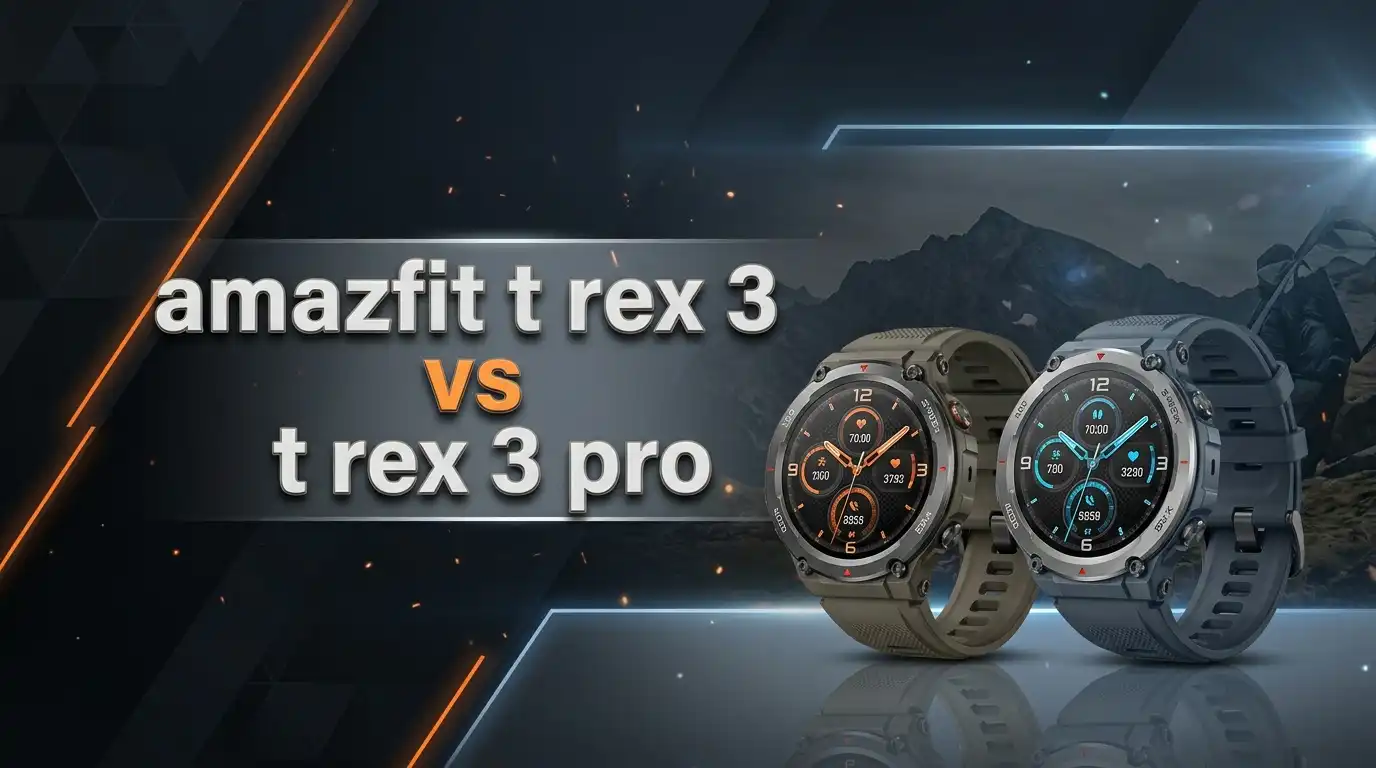
Amazfit T-Rex 3 vs T-Rex 3 Pro: Which Should You Buy?
Choosing a rugged outdoor smartwatch feels hard when two watches share the same name. The Amazfit T-Rex 3 and the T-Rex 3 Pro look like twins on the shelf. They both promise long battery life, strong GPS, and tough bodies. But the Pro model adds premium materials and new tools that change the price a lot.
This guide compares both watches side by side. You will learn what each one does well. You will see the real differences in build, display, battery, and features. By the end, you will know which watch fits your wrist and your budget. Let us break it down in simple terms so you can pick with confidence.
In a Nutshell
Here is the fast summary for busy readers who want the key points right away:
- The Amazfit T-Rex 3 is the budget pick. It costs around $279 and gives you strong GPS, 170+ sport modes, and up to 27 days of battery life in a plastic body with a steel bezel.
- The Amazfit T-Rex 3 Pro is the premium pick. It costs around $329 to $399 and adds a titanium bezel, sapphire glass, a built-in flashlight, a speaker for calls, and better maps.
- The biggest upgrade in the Pro is the scratch-proof sapphire screen and grade 5 titanium bezel. These make the Pro tougher and more scratch resistant for hard trips.
- The Pro adds a two-color LED flashlight and a real speaker. The base T-Rex 3 only has a beeper and vibration alerts, so the Pro wins for night use and Bluetooth calls.
- Both watches share the same 1.5-inch AMOLED display, dual-band GPS, and 10 ATM water resistance. Core tracking feels almost the same on both.
- Pick the base model to save money. Pick the Pro if you want the flashlight, calls, sapphire glass, and routable maps.
Head to Head Comparison Table
| Feature | Amazfit T-Rex 3 | Amazfit T-Rex 3 Pro |
|---|---|---|
| Price | ~$279 | ~$329 to $399 |
| Display | 1.5″ AMOLED (480×480) | 1.5″ AMOLED (also 44mm 1.32″) |
| Screen Glass | Tempered glass | Sapphire glass |
| Bezel Material | Stainless steel | Grade 5 titanium |
| Flashlight | No | Yes, two-color LED with boost |
| Speaker | No, beeper only | Yes, built-in speaker + mic |
| Bluetooth Calling | No | Yes |
| GPS | Dual-band, 6 satellites | Dual-band, 6 satellites |
| Sport Modes | 170+ | 180+ |
| Water Resistance | 10 ATM / 328 ft | 10 ATM / 328 ft |
| Freediving | To 45m | To 45m |
| Battery (typical) | Up to 27 days | Up to 25 days (48mm) |
| Maps | Offline maps, imported routes | Offline maps, routable maps |
| Sizes | 48mm | 44mm and 48mm |
Amazfit T-Rex 3 Overview
No products found.
The Amazfit T-Rex 3 is a rugged GPS smartwatch built for outdoor fans on a budget. It launched at $279 and often drops lower during sales. You get a big 1.5-inch AMOLED screen with a sharp 480×480 resolution. The screen looks bright and clear both indoors and in daylight.
The body uses tough plastic with a stainless steel top bezel. It weighs about 68 grams, which feels light for its size. The watch survives temperatures from -22°F to 158°F. It handles water down to 328 feet, so swimming and snorkeling are safe.
This watch shines with battery life. It lasts up to 27 days with typical use. In accurate GPS mode you get about 42 hours. In long battery GPS mode you can push past 114 hours. That makes it great for multi-day treks and long trips away from a charger.
You get over 170 sport modes, from running and cycling to freediving down to 45 meters. The dual-band GPS locks fast and tracks well, even near tall buildings. It also offers offline maps, voice control, and health tools like heart rate, SpO2, and sleep tracking. The value here is hard to beat for anyone who wants premium features at a mid-range price.
Amazfit T-Rex 3 Pro Overview
No products found.
The Amazfit T-Rex 3 Pro is the upgraded model that fixes weak spots and adds premium parts. It costs $329 to $399 depending on size and finish. The Pro keeps the same rugged spirit but wraps it in tougher, classier materials.
The star upgrade is the scratch-resistant sapphire glass display. Sapphire resists scratches far better than normal glass. Paired with the grade 5 titanium bezel, the Pro feels more premium and survives rough handling. This build quality alone draws in serious adventurers.
The Pro adds a built-in two-color LED flashlight with a boost mode. This helps during night hikes, camping, and early runs. It also packs a real speaker and microphone, so you can take Bluetooth calls right from your wrist. The base model only beeps and vibrates, so this is a big jump.
Battery life stays strong at up to 25 days on the 48mm model. The 44mm version reaches about 17 days. You still get dual-band GPS, 10 ATM water resistance, and freediving to 45 meters. The Pro also improves maps with routable navigation, which the base model lacks. With 180+ sport modes and HYROX training, the Pro targets athletes who want a bit more polish.
Top 3 Alternatives for the Amazfit T-Rex 3 and T-Rex 3 Pro
If neither watch fits your needs, these three options give strong value in the same class.

- Go longer than ever with solar charging that gives you unlimited battery life in smartwatch mode
- Rugged GPS smartwatch is water-rated to 100 meters and thermal - and shock resistant with fiber-reinforced...
Last update on 2026-07-16 / Affiliate links / Images from Amazon Product Advertising API

- Comfort, Lightweight, Durable: Designed as the ultimate running watch, the COROS PACE 3 GPS sports watch...
- Always-On 1.2" Transflective Touchscreen: COROS PACE 3 GPS sports watch features a touchscreen experience...
Last update on 2026-07-16 / Affiliate links / Images from Amazon Product Advertising API

- STYLISH DESIGN, BRIGHT DISPLAY: The sleek stainless steel build blends classic style with workout durability...
- PRECISE HEART RATE AND SLEEP TRACKING: Amazfit's BioTracker technology tracks your heart rate and sleep data...
Last update on 2026-06-09 / Affiliate links / Images from Amazon Product Advertising API
The Garmin Instinct 2 Solar brings solar charging and near-endless battery life in a proven rugged body. It suits users who trust the Garmin ecosystem. The COROS Pace 3 is a light running watch with dual-frequency GPS and 17-day battery, ideal for pure runners. The Amazfit Active 2 is a slim, cheaper sibling with 160+ sport modes and sapphire options, great for casual users who want lighter gear.
Design and Build Quality
Both watches carry the classic T-Rex rugged look. They use chunky cases, four physical buttons, and thick protective edges. This design handles bumps, drops, and rough trails with ease. The base T-Rex 3 uses tough plastic with a stainless steel top bezel, which keeps weight low at around 68 grams.
The T-Rex 3 Pro raises the bar with a grade 5 titanium bezel. Titanium is strong, light, and resists corrosion better than steel. This gives the Pro a more premium feel on the wrist. It also looks a bit more refined for daily wear outside of sport.
Water resistance is equal on both. Each watch survives 10 ATM, or about 328 feet of depth. Both handle freediving down to 45 meters and pass tough military-grade tests. You can swim, snorkel, and dive without worry on either model.
The key build gap is the screen glass. The base model uses tempered glass, which resists most daily scuffs. The Pro uses sapphire glass, which is far harder and shrugs off deep scratches. If you often bump your watch on rocks or gear, the Pro protects your screen better. For everyday users, the base build still feels very tough and reliable.
Display Comparison
The display is one of the strongest parts of both watches. Each uses a bright 1.5-inch AMOLED panel with rich colors and deep blacks. The 480×480 resolution keeps text sharp and maps easy to read. In daylight, both screens stay clear and visible.
The T-Rex 3 offers the 1.5-inch screen in its single 48mm size. It supports always-on mode and gesture wake. Reviewers note the screen quality is excellent for the price. It handles wet and dry taps well during workouts.
The T-Rex 3 Pro comes in two sizes. The 48mm model keeps the 1.5-inch AMOLED, while the 44mm model uses a slightly smaller 1.32-inch AMOLED. This choice helps people with smaller wrists find a better fit. The smaller size still delivers crisp visuals.
The big difference sits on top of the screen. The Pro uses sapphire glass, which stays clear and scratch-free longer. The base model uses tempered glass, which is still good but softer. Both screens perform the same in brightness and color. The Pro simply protects that beauty better over years of hard use. If display longevity matters, the Pro edges ahead.
Battery Life
Battery life is where the T-Rex line truly stands out. Both watches crush most rivals in this area. You can go days or even weeks between charges, which frees you from carrying a charger on trips.
The T-Rex 3 claims up to 27 days with typical use. In accurate GPS mode you get about 42 hours. In long battery GPS mode it stretches to roughly 114 hours. Real-world tests show closer to 7 to 9 days with heavy always-on and daily GPS workouts, which is still very strong.
The T-Rex 3 Pro claims up to 25 days on the 48mm model. Accurate GPS mode gives about 38 hours, and long battery GPS mode reaches 85 hours. The 44mm Pro drops to about 17 days due to its smaller battery. So the base model actually leads slightly on paper in the biggest size.
Both watches charge through a magnetic clip and USB-C cable. A full charge takes about 2.5 hours, which is slow but rare thanks to the long life. For pure endurance, the base T-Rex 3 wins by a small margin. But the Pro still lasts long enough for almost any adventure. Battery will not be the deciding factor between these two.
GPS and Navigation
Navigation is a core reason people buy rugged watches. Both models use dual-band GPS with support for six satellite systems. This helps the watch lock on fast and track well, even under trees or near tall buildings. In tests, GPS accuracy on the base model was strong across running, cycling, and hiking.
Both watches include offline maps that you download over WiFi. You can grab base maps, ski maps, and contour maps for your region. The map download process works well and covers large areas quickly. This is a rare feature at these prices.
The key gap sits in routing. The base T-Rex 3 lets you follow imported routes, but you must export GPX files from other apps first. This process feels clumsy and slow. You also cannot build routes inside the app itself.
The T-Rex 3 Pro improves this with routable maps. This means smarter turn-by-turn guidance on the trail. For hikers and trail runners who rely on navigation, this upgrade matters a lot. The Pro simply makes finding your way easier and less frustrating. If you mostly track workouts and rarely navigate, the base model is fine. If you explore new trails often, the Pro is the safer choice.
Health and Fitness Tracking
Both watches carry strong health tools for the price. Each uses the BioTracker heart rate sensor to measure your pulse day and night. They also track SpO2, heart rate variability, skin temperature, and stress. Sleep tracking works on both, with good accuracy on sleep and wake times.
Sport tracking is deep on both models. The T-Rex 3 offers 170+ sport modes, while the T-Rex 3 Pro offers 180+ modes. Many of these modes are just categories, but they let you log almost any activity. Both support HYROX training, running, cycling, swimming, and freediving.
Both watches connect to external sensors. You can pair heart rate straps, cycling power meters, and running power pods. They also upload to Strava, Komoot, Apple Health, and Google Fit. This makes them flexible for serious athletes.
The watches share training tools like VO2 Max, training load, and recovery time. Reviewers note some metrics feel skin-deep, and readiness scores can stay too flat. Still, the raw data like heart rate and HRV tracks close to premium devices. For everyday fitness and outdoor sport, both watches deliver plenty of useful data. The Pro adds a few extra modes but does not change the core health experience much.
Extra Features: Flashlight, Speaker, and Calls
This section shows the clearest split between the two watches. The T-Rex 3 Pro adds hardware that the base model simply does not have. These extras change how you use the watch in the field.
The Pro includes a built-in two-color LED flashlight with a boost mode. This is a huge help for night hikes, camping, and dark early runs. You can light your path or find gear in your tent without a phone. The base T-Rex 3 has no flashlight at all.
The Pro also adds a real speaker and microphone. This lets you take Bluetooth calls right from your wrist when your phone is near. You can also hear voice assistant replies out loud. The base model only has a microphone for voice commands, plus a beeper and vibration for alerts.
These extras make the Pro feel more complete as a daily tool. The flashlight alone can win over campers and night runners. The speaker adds real convenience for calls and alerts. If you value these tools, the Pro is worth the higher price. If you never take wrist calls and carry a headlamp anyway, the base model saves you money without much loss.
Price and Value
Price is often the deciding factor between these two watches. The T-Rex 3 launched at $279 and often sells lower during sales. This price is very fair for a rugged watch with dual-band GPS, offline maps, and 27-day battery life. It offers premium features at a mid-range cost.
The T-Rex 3 Pro costs more, sitting between $329 and $399. The 44mm and higher finishes push toward the top of that range. You pay extra for sapphire glass, titanium, the flashlight, the speaker, and routable maps. These are real upgrades, not just marketing.
So which one gives better value? The base model wins on pure dollars per feature. You get almost the full T-Rex 3 experience for less money. For most casual users, the base model is the smart buy.
The Pro wins on long-term durability and extra tools. Sapphire and titanium last longer under hard use. The flashlight and speaker add daily convenience. For serious adventurers, the Pro justifies its higher price. Think about how you will actually use the watch. That answer decides which price makes sense for you.
Software and App Experience
Both watches run on the same Zepp OS system and use the Zepp app on your phone. The app lets you customize watch faces, data screens, and shortcut cards. You can reorder widgets and set up workout templates. The system feels smooth and quick to load.
The watches share the same voice assistant called Zepp Flow. You can ask it to start workouts, check weather, or set timers. Reviewers note it handles simple watch tasks well. It struggles with open questions and sometimes misreads requests, but it still helps for quick actions.
Both models sync workouts to popular platforms. Strava, Komoot, Apple Health, and Google Fit all connect easily. You can also export FIT files directly from the app, which many rivals do not allow. This flexibility is a nice touch for data lovers.
Software quirks exist on both watches. Some features feel half-finished, and updates can arrive slowly. The base T-Rex 3 has at times been slower to get new feature updates than the Pro. The Pro tends to receive newer software polish first. Still, both share the same core app and daily flow. Your software experience will feel very similar no matter which one you choose.
Which Watch Is Right for You?
Your choice depends on your budget and how you use the watch. Both are excellent rugged options, so there is no wrong pick. Here is how to think about the decision in simple terms.
Choose the Amazfit T-Rex 3 if you want the best value. It suits casual hikers, gym users, and everyday athletes. You get the same great screen, GPS, and battery life for less money. If you do not need a flashlight or wrist calls, this model covers everything you need.
Choose the Amazfit T-Rex 3 Pro if you want premium build and extra tools. It fits serious adventurers, night hikers, and trail explorers. The sapphire glass and titanium last longer under hard use. The flashlight, speaker, and routable maps add real daily value in the field.
Think about your habits. If you count every dollar and stick to known routes, the base model wins. If you explore new trails, hike at night, or want the toughest build, the Pro wins. Both watches share the same strong core, so you win either way.
Final Verdict
The Amazfit T-Rex 3 is the smart value champion. It delivers premium features like dual-band GPS, offline maps, and 27-day battery at a fair $279. Most users will feel fully satisfied with this model. It offers the best balance of price and performance in the T-Rex line.
The Amazfit T-Rex 3 Pro is the premium adventurer’s choice. It adds sapphire glass, a titanium bezel, a flashlight, a speaker, and routable maps. These upgrades matter most for people who push their gear hard. If you hike at night, explore new trails, or want the toughest build, the Pro earns its higher price.
In short, the base model wins for budget buyers and casual users. The Pro wins for serious outdoor athletes who want extra tools and durability. Both are among the best value rugged watches you can buy today. Match the watch to your habits, and you will make a great choice.
Frequently Asked Questions
What is the main difference between the T-Rex 3 and T-Rex 3 Pro?
The main difference is build and extra tools. The Pro adds sapphire glass, a titanium bezel, a built-in flashlight, and a speaker for calls. The base model uses tempered glass and a steel bezel with no flashlight or speaker.
Does the Amazfit T-Rex 3 have a flashlight?
No, the base T-Rex 3 does not have a flashlight. Only the T-Rex 3 Pro includes a two-color LED flashlight with a boost mode. This is one of the clearest upgrades in the Pro model.
Which watch has better battery life?
The base T-Rex 3 leads slightly with up to 27 days of typical use. The 48mm Pro reaches up to 25 days, while the 44mm Pro lasts about 17 days. Both offer strong battery life that beats most rivals.
Can you take calls on the Amazfit T-Rex 3 Pro?
Yes, the T-Rex 3 Pro has a speaker and microphone for Bluetooth calls. You can answer calls from your wrist when your phone is near. The base T-Rex 3 cannot take calls, since it only has a microphone for voice commands.
Is the T-Rex 3 Pro worth the extra money?
It depends on your needs. The Pro is worth it if you want sapphire glass, titanium, a flashlight, and routable maps. If you are a casual user on a budget, the base model gives nearly the same core experience for less.
Are both watches good for swimming and diving?
Yes, both watches are safe for water. They carry 10 ATM water resistance, which equals about 328 feet. Both also support freediving down to 45 meters, so swimming and snorkeling work well on either model.
Do both watches have offline maps?
Yes, both models include offline maps you download over WiFi. The key difference is routing. The Pro offers routable maps for smarter turn-by-turn guidance, while the base model only follows imported routes.

DK is a technology expert who specializes in AI tools, software, and tech gadgets. He writes for How to Tech Info, providing detailed reviews and practical guides. DK helps readers discover the best AI applications, navigate new software, and choose the right tech gadgets.