
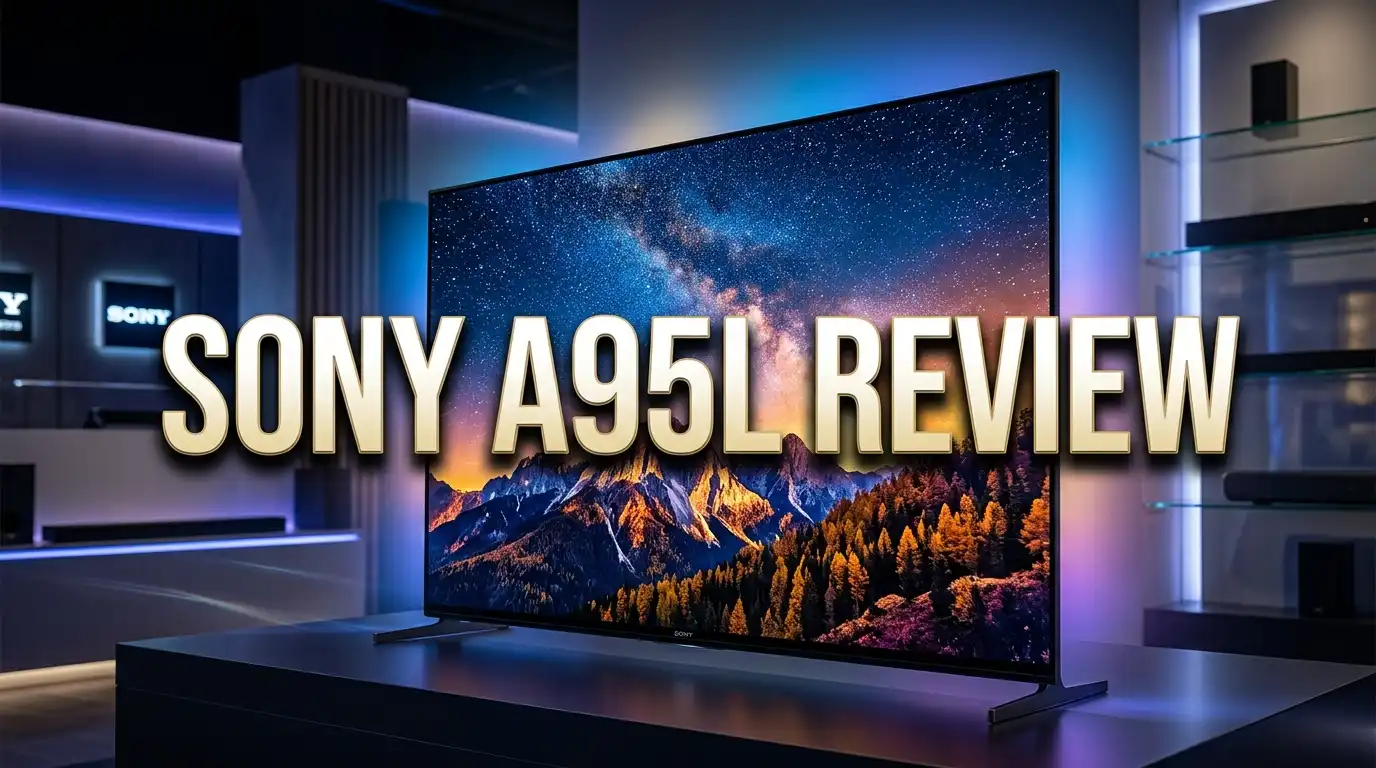
Sony A95L Review: QD OLED TV Still the King of Picture Quality?
Some televisions impress you for a week. The Sony A95L impresses you every single night you turn it on. This QD OLED flagship arrived as Sony’s statement piece, and it still shows up in “best picture quality” conversations years after launch.
You are probably here because the price has finally dropped. Maybe you saw a deal and wondered if a 2023 flagship can still beat a brand new midrange set. That is a fair question, and the answer is more interesting than a simple yes or no.
This review covers everything that matters. You will learn how bright the panel gets, how well it handles gaming, where Sony cut corners, and which alternatives deserve your attention. Let’s get into it.
In a Nutshell
Here is the short version for readers who want the verdict fast.
- Picture quality is the main reason to buy. The A95L pairs a QD OLED panel with Sony’s Cognitive Processor XR, and the result is perfect black levels next to searing highlights. Peak brightness measured around 1,400 to 1,500 nits on small highlights in accurate picture modes.
- Color performance sits near the top of the market. The panel covers roughly 100 percent of DCI P3 and close to 89 percent of BT.2020. Skin tones look natural, and gradients stay smooth without banding.
- Upscaling is Sony’s secret weapon. Old DVDs, low bitrate streams, and cable channels look noticeably cleaner here than on rival sets. If you watch a lot of older content, this alone justifies the purchase.
- Gaming works well but has one real limit. You get 4K at 120Hz, VRR, ALLM, and input lag near 9ms. The catch is that only two of the four HDMI ports run at full bandwidth, and one doubles as the eARC port.
- Sound quality beats almost every rival. Acoustic Surface Audio Plus vibrates the screen itself, so dialogue comes from the actor’s mouth instead of a box underneath.
- Value depends entirely on the deal you find. At original list price it was hard to justify. At current discounted prices it becomes one of the smartest premium buys available.
Sony A95L Overview: What You Are Actually Buying

- LIFELIKE PICTURE– The intelligent and powerful Cognitive Processor XR delivers a picture with wide dynamic...
- PURE BLACK PAIRED WITH OUR BEST COLOR– Thanks to QD-OLED and XR Triluminos Max, experience our widest...
Last update on 2026-08-20 / Affiliate links / Images from Amazon Product Advertising API
The Sony A95L is the flagship OLED in Sony’s Bravia XR family. It uses a QD OLED panel supplied by Samsung Display, which Sony then tunes with its own processing and calibration work.
QD OLED differs from regular OLED in one key way. It drops the white subpixel and the color filter, and adds quantum dots instead.
That change matters more than it sounds. Light passes through fewer layers, so colors stay purer and highlights hit harder.
Sony sells the A95L in three sizes. You get 55 inches, 65 inches, and 77 inches, with launch prices of $2,799, $3,499, and $4,999 respectively.
Because OLED panels are self lit, picture performance stays consistent across all three sizes. You are choosing based on room size and budget, not quality.
The set runs Google TV as its operating system. It supports Dolby Vision, HDR10, HLG, Dolby Atmos, and IMAX Enhanced.
Sony also includes the Bravia Cam in the box. This small camera clips to the top of the panel and adjusts picture and sound based on where you sit.
You can unplug the camera entirely if you find it unsettling. Nothing else stops working when you do.
Think of the A95L as a picture quality specialist rather than a spec sheet champion. Other brands list more features. Sony delivers a better image.
Design and Build Quality
Sony changed its stand design with the A95L, and the change solves a real problem. The previous A95K used a pedestal slab that made soundbar placement awkward.
The A95L instead uses two angular feet that sit near the panel corners. You can mount them in two different height positions.
The low position keeps the screen almost flush with your furniture. It looks clean and minimal, and the TV appears to float on the surface.
The high position lifts the panel several inches. This clears space for most soundbars without blocking the bottom of the screen.
The feet also slide inward or outward. That flexibility helps if your media console is narrower than the TV.
The panel itself feels premium. Sony used a uniform depth chassis with a crosshatch texture across the back, so the set looks tidy even when wall mounted in an open room.
This is not the thinnest OLED you can buy. Heat sinks and brightness boosting hardware add bulk, and Sony accepted that tradeoff for performance.
The bezels are very thin on all four sides. Nothing distracts from the image.
Sony’s remote deserves its own mention. It has backlit buttons, a comfortable shape, and a sensible button layout.
Very few brands still bother with backlighting, and you notice the difference during a dark movie night. Small touches like this signal where the money went.
Picture Quality: The Real Star of the Show
This is where the A95L earns its reputation. Every OLED gives you perfect blacks, but the A95L pairs those blacks with unusual punch.
Measured HDR contrast comes in around 359 nits against a black level of 0.0001 nits on a checkerboard pattern. That ratio is effectively infinite to your eye.
The result is depth. Night scenes show detail in shadows instead of collapsing into mush.
Sony handles near black content better than most rivals. Dark gray steps stay distinct rather than crushing together into one flat tone.
Highlights are the other half of the equation. Small bright objects such as fireworks, candle flames, or sun reflections hit roughly 1,400 to 1,500 nits in Professional mode.
Because the surrounding pixels sit at true black, those highlights feel far brighter than the numbers suggest. Contrast tricks your brain in the best possible way.
Full screen brightness is more modest at around 235 to 350 nits. That figure trails premium Mini LED sets by a wide margin.
In a dark or dim room, this never matters. In a bright sunroom with windows behind you, a Mini LED set will feel more comfortable during daytime viewing.
Motion handling is another Sony strength. The processing smooths judder without turning films into soap operas, and you can dial the effect down or off entirely.
Top 3 Alternative for Sony A95L
Not every buyer needs Sony’s processing. These three sets cover the most common reasons people shop elsewhere.

- SELF-LIT PIXELS: LG's signature OLED technology creates an incredible watching experience and stellar picture...
- BRIGHTNESS BOOSTER MAX: Discover a brighter more vivid picture. The LG OLED evo shines even brighter than...
Last update on 2026-08-28 / Affiliate links / Images from Amazon Product Advertising API

- OLED TECHNOLOGY: Discover pure blacks, bright whites and Pantone-validated color; Combined with detail and...
- OLED GLARE FREE: Watch everything you love with nearly no glare; Anti-glare technology limits light...
Last update on 2026-08-20 / Affiliate links / Images from Amazon Product Advertising API

- SELF-LIT PIXELS: LG's signature OLED technology creates an incredible watching experience and stellar picture...
- BRIGHTNESS BOOSTER: Our Brightness Boosting technology magnifies each individual pixel for luminous quality...
Last update on 2026-08-20 / Affiliate links / Images from Amazon Product Advertising API
The LG G4 is the pick for gamers and bright rooms. It uses a WOLED panel with Micro Lens Array technology and pushes very high peak brightness.
More importantly, all four HDMI ports run at full 4K 120Hz bandwidth. PC gamers also get support up to 144Hz.
The Samsung S95D shares the same QD OLED panel family as the A95L. Its headline feature is a matte anti glare coating that nearly erases reflections.
If your living room has windows on three walls, the S95D solves a problem no other OLED solves as well. The tradeoff is slightly raised black levels in very bright rooms.
The LG C4 is the value choice. It gives you around 80 percent of the flagship experience for a much lower price.
You lose peak brightness and some processing polish. You keep perfect blacks, four full bandwidth HDMI ports, and excellent gaming support.
Pick the G4 for gaming, the S95D for glare, and the C4 for your wallet. Pick the A95L if picture accuracy and processing matter most.
Brightness and HDR Performance
Brightness discussions get confusing fast, so let’s separate the numbers that matter. There are two figures worth tracking: peak highlight brightness and full screen brightness.
Peak highlight brightness measures small bright areas. The A95L reaches around 1,500 nits on a 5 percent window in accurate modes.
Push it into Vivid mode and it climbs closer to 2,000 nits. That mode sacrifices color accuracy, so most viewers should ignore it.
Full screen brightness measures a completely white image. Here the A95L manages roughly 235 nits in Professional mode, which is normal for OLED.
HDR content rarely uses full white screens. Real movies use bright highlights against darker backgrounds, and that is exactly where the A95L excels.
Tone mapping is handled well. The set follows HDR metadata closely without blowing out detail in the brightest parts of the image.
Sony supports Dolby Vision but skips HDR10 Plus. Netflix, Disney Plus, Apple TV Plus, and most 4K Blu rays use Dolby Vision, so the gap rarely bites.
Newer flagship OLEDs from 2025 and 2026 do beat these brightness figures. Four stack panel designs and improved QD OLED generations push past 2,000 nits in accurate modes.
That said, brightness has reached diminishing returns for dark room viewing. The A95L still looks spectacular with the lights off, and no amount of extra nits changes that.
Color Accuracy and Sony’s Processing Advantage
Color is where QD OLED separates itself from traditional OLED. Removing the color filter lets the panel produce purer, more saturated color at high brightness levels.
The A95L covers close to 100 percent of the DCI P3 gamut and around 89 percent of BT.2020. Those numbers place it at the top of consumer displays.
Numbers only tell half the story. Out of the box accuracy in Professional mode is exceptional, with average color error below the threshold most eyes can detect.
That means you can enjoy reference quality color without hiring a calibrator. Very few televisions can claim that.
Skin tones deserve special praise. Faces look like faces, not like orange or pink approximations.
Sony’s Cognitive Processor XR ties everything together. It analyzes the image the way human vision does, focusing detail where your eyes naturally look.
Upscaling is the standout skill. Feed the A95L a 480p DVD or a compressed streaming show, and it cleans up noise, sharpens edges, and rebuilds texture better than any rival.
Gradient handling is also excellent. Sunsets and foggy scenes render as smooth transitions instead of visible bands.
One small quirk exists. All QD OLED panels show faint green or magenta fringing at edges between dark and light, such as subtitle text.
You need to sit very close to notice it. From a normal viewing distance it disappears entirely.
Sound Quality: Acoustic Surface Audio Plus
Most flagship televisions have mediocre speakers. The A95L is a genuine exception, and the reason is clever engineering.
Sony uses Acoustic Surface Audio Plus, which turns the screen itself into a speaker. Actuators behind the panel vibrate the glass to produce sound.
Two subwoofers handle the low end. Total audio output measures 20W plus 20W plus 10W plus 10W.
The practical benefit is positional accuracy. When a character speaks on the left side of the frame, the sound genuinely comes from the left side of the screen.
Dialogue clarity is very good. You will not constantly reach for the remote during quiet conversation scenes.
Bass is present but limited by physics. A thin panel cannot move enough air for cinematic rumble, so explosions lack weight.
Sony includes XR Surround for virtual height and width effects. It widens the soundstage convincingly without external speakers.
If you own a compatible Sony soundbar, Acoustic Center Sync lets the television act as the center channel. Voices then stay locked to the screen while the soundbar handles everything else.
That feature is a real advantage for home theater builders. Most setups place dialogue below the picture, which never sounds quite right.
For casual viewing, the built in audio is good enough to skip a soundbar entirely. For movie nights with a subwoofer, add external speakers and use Acoustic Center Sync.
Gaming Performance on PS5 and Xbox Series X
Sony markets the A95L as a PlayStation 5 companion, and the pairing works well. Two exclusive features activate automatically when a PS5 connects.
Auto HDR Tone Mapping configures HDR settings during console setup. Auto Genre Picture Mode switches to low latency game mode when you launch a game and back to cinema settings for movies.
Core gaming specs are solid. You get 4K at 120Hz, VRR, ALLM, and input lag around 9ms at 4K 120Hz.
That responsiveness satisfies competitive shooters. Casual and single player gaming feels effortless.
The dedicated game menu is genuinely useful. It shows refresh rate, VRR status, and lets you add crosshairs or raise black levels for dark corners.
Now the weakness. Only two of the four HDMI ports support 4K at 120Hz, and one of those two is also the eARC port.
Imagine you own a PS5, an Xbox Series X, and a soundbar. One console gets demoted to a slower port, and you lose 120Hz on it.
An AV receiver with HDMI 2.1 passthrough solves the problem. Buyers who do not own one will feel the pinch.
The A95L also skips AMD FreeSync certification and 144Hz PC support. Console players will not care, but PC gamers should look at the LG G4 instead.
Google TV Smart Platform and Everyday Use
The A95L runs Google TV, which is one of the better smart platforms available. App support is comprehensive across every major streaming service.
Navigation is quick. Menus load fast, and the interface rarely stutters even after years of updates.
The home screen aggregates content from your subscriptions. It suggests shows across services rather than pushing you into individual apps.
The downside is advertising. Google TV displays a fair amount of sponsored content on the home row, which feels cheap on a flagship television.
You can reduce this with Apps Only mode. That setting strips the home screen down to a simple app grid.
Sony’s own settings menus are where the experience shines. Picture and sound controls are organized logically and unfold in clean layers.
You never hunt through five submenus to find one toggle. Compared with some rival interfaces, this is a refreshing amount of respect for the user.
Voice control works through Google Assistant and Amazon Alexa. Hands free voice activation is built in, and you can disable it with a physical switch.
Apple users get AirPlay 2 and HomeKit support. Casting from an iPhone or iPad takes one tap.
Software updates have continued steadily since launch. Sony has a reasonable track record of supporting flagship sets for several years.
Connectivity and Ports
Ports sit in a side facing cutout on the back of the panel. That placement makes cable management easier for wall mounted setups.
Here is what you get. Four HDMI inputs total, with two rated HDMI 2.1 at 4K 120Hz and two limited to HDMI 2.0 bandwidth.
HDMI 3 handles eARC duties. It is also one of the two high bandwidth ports, which creates the conflict discussed earlier.
You also get one USB 3.0 port and one USB 2.0 port. These handle external drives, USB recording in supported regions, and accessories.
An RF connector supports cable and antenna signals. The A95L includes an ATSC 3.0 tuner, so it can receive NextGen TV broadcasts where available.
Wired networking runs through an Ethernet port. Wireless uses dual band Wi Fi with Bluetooth for headphones and controllers.
A digital optical audio output serves older receivers. There is even an RS 232C port for custom installers running control systems.
The port selection is complete apart from that HDMI 2.1 limitation. Sony gave the A95L everything except the one thing enthusiasts asked for.
Plan your connections before setup. Put your primary gaming console and your audio system on the two fast ports, then run streaming boxes through the slower ones.
Streaming devices only need HDMI 2.0 bandwidth anyway. With a little planning, most households will never notice the shortfall.
Sony A95L Sizes, Pricing, and Current Value
- LIFELIKE PICTURE– The intelligent and powerful Cognitive Processor XR delivers a picture with wide dynamic...
- PURE BLACK PAIRED WITH OUR BEST COLOR– Thanks to QD-OLED and XR Triluminos Max, experience our widest...
Last update on 2026-08-20 / Affiliate links / Images from Amazon Product Advertising API
The A95L launched at premium pricing. The 55 inch model started at $2,799, the 65 inch at $3,499, and the 77 inch at $4,999.
Those figures made the A95L one of the most expensive televisions per inch in its launch year. Value was not the selling point.
Prices have moved considerably since then. Discounts appear regularly, and holiday sales have pushed the 65 inch model well below its original price.
That price movement changes the entire recommendation. A set that felt indulgent at list price becomes compelling at a discount.
Sony has since released successor models, including the Bravia 8 II. That newer set improves brightness while the A95L holds the price advantage.
Availability is now the main concern. Stock varies by size and retailer, and the 55 inch model tends to disappear first.
Consider the size carefully. The 65 inch version suits most living rooms at a viewing distance of eight to ten feet.
The 77 inch model transforms a dedicated home theater. It is also the version where the price gap versus rivals feels widest.
Check current listings before deciding. A discounted A95L competes directly with full price current generation models, and the picture quality still holds up.
Watch for extended warranty options too. OLED panels are reliable, but coverage brings peace of mind on a purchase this size.
Sony A95L vs LG G4 vs Samsung S95D
These three sets dominate premium OLED comparisons, and each wins in a different category.
Brightness goes to the LG G4. Its MLA equipped WOLED panel pushes higher full screen brightness, which helps in daylight.
Color volume goes to the A95L. Sony’s tuning of the QD OLED panel produces more lifelike and saturated color across the brightness range.
Glare handling goes to the Samsung S95D. Its matte coating nearly eliminates reflections, which no glossy panel can match.
Processing and upscaling goes to the A95L by a clear margin. Sony’s handling of low quality sources remains the best in the business.
Gaming goes to the LG G4. Four full bandwidth HDMI ports, 144Hz PC support, and broader VRR compatibility make it the enthusiast choice.
Built in audio goes to the A95L. Screen vibration technology beats conventional down firing speakers every time.
Out of the box accuracy goes to the A95L again. Professional mode needs almost no adjustment.
Value is situational. All three drop in price over time, and the best deal on any given week deserves attention.
Here is the simple decision rule. Choose the A95L if you watch movies and mixed quality content in a controlled room.
Choose the G4 if gaming and brightness lead your priorities. Choose the S95D if reflections are your biggest daily frustration.
Pros and Cons of the Sony A95L
Pros
- Reference level picture quality with perfect blacks and specular highlights near 1,500 nits that make HDR content genuinely dazzling
- Class leading color accuracy covering nearly all of DCI P3 and around 89 percent of BT.2020, with skin tones that look completely natural
- The best upscaling available, which rescues older DVDs, cable channels, and compressed streams from looking soft or noisy
- Excellent built in sound thanks to Acoustic Surface Audio Plus, which places dialogue precisely on screen instead of below it
- Smart, flexible design with adjustable feet that accommodate soundbars in the higher position and look minimal in the lower one
- Strong PS5 integration including Auto HDR Tone Mapping and Auto Genre Picture Mode that configure settings without user input
- Backlit remote control with an ergonomic shape and sensible layout, a rarity even at flagship prices
Cons
- Only two HDMI 2.1 ports, one of which handles eARC, which frustrates owners of multiple consoles plus a soundbar
- No HDR10 Plus support, though Dolby Vision covers nearly all major streaming and disc content
- No FreeSync certification or 144Hz PC gaming, making it a weaker choice for serious PC players
- Modest full screen brightness around 235 nits, so very bright rooms favor Mini LED or matte coated alternatives
- Google TV shows sponsored content on the home screen, which feels out of place on a premium set
- Newer flagship OLEDs are brighter, with 2025 and 2026 models pushing past 2,000 nits in accurate modes
Who Should Buy the Sony A95L
The A95L suits a specific type of viewer very well. If you fall into these groups, it deserves a spot on your shortlist.
Movie lovers get the most value here. Dark room film viewing is exactly what this panel and processor were built for.
Mixed content watchers benefit enormously from the upscaling. If your viewing includes older shows, sports broadcasts, and streaming at varied bitrates, Sony makes all of it look better than the competition does.
PlayStation 5 owners get automatic optimization features no other brand offers. The integration is genuinely seamless.
Buyers who hate fiddling with settings will appreciate Professional mode. It looks correct immediately, with no calibration required.
Apartment dwellers and small room owners get excellent sound without adding a soundbar. That saves space and money.
Now the people who should look elsewhere. PC gamers wanting 144Hz and FreeSync should choose the LG G4.
Owners of two consoles plus a soundbar will hit the HDMI limitation unless they own a capable receiver. Bright room viewers with heavy window glare should consider the Samsung S95D and its matte screen.
Budget conscious shoppers get most of the experience from an LG C4 at a much lower price.
The A95L is a picture quality purchase, not a checklist purchase. Buy it because of how it looks, and you will stay happy for years.
Final Verdict
The Sony A95L remains one of the finest televisions ever sold to consumers. Its combination of QD OLED hardware and Sony processing produces an image that still competes with newer flagships.
Contrast is flawless. Color is accurate and vivid. Upscaling has no equal.
The weaknesses are real but narrow. Two HDMI 2.1 ports is a genuine miss, and newer panels have surpassed its peak brightness.
Neither issue ruins the experience for most buyers. A movie watcher in a dim room will not notice either limitation.
Value has improved dramatically since launch. At its original price, the A95L asked for a leap of faith.
At today’s discounted prices, it delivers flagship performance for midrange money. That shift makes it far easier to recommend.
If you want the best possible picture without chasing the newest model year, the A95L answers that need. It is a television built by engineers who cared about how images actually look.
Buy it for movies, buy it for mixed viewing, and buy it if you own a PS5. Look elsewhere if you are a PC gamer or if sunlight floods your living room.
Our rating: 9.2 out of 10. A picture quality masterpiece with a small connectivity flaw.
Frequently Asked Questions
Is the Sony A95L still worth buying today?
Yes, especially at discounted prices. Picture quality holds up against current flagships, and Sony’s processing advantage has not been matched.
Newer models are brighter, but the difference is mainly visible in bright rooms. For dark room viewing, the A95L still performs at reference level.
How bright does the Sony A95L get?
Small highlights reach roughly 1,400 to 1,500 nits in Professional mode. Vivid mode pushes closer to 2,000 nits at the cost of accuracy.
Full screen white measures around 235 nits. That is typical for OLED technology.
Does the Sony A95L have burn in risk?
All OLED panels carry some theoretical risk. Sony includes pixel shifting and panel refresh routines to minimize it.
Normal varied viewing presents very little danger. Displaying static logos or news tickers for many hours daily raises the risk.
How many HDMI 2.1 ports does the A95L have?
Two of the four HDMI ports support 4K at 120Hz. HDMI 3 also serves as the eARC port, so audio equipment competes with gaming devices for that slot.
Is the Sony A95L good for gaming?
Yes for console gaming. You get 4K 120Hz, VRR, ALLM, and about 9ms input lag.
PC gamers should note the lack of 144Hz support and FreeSync certification. The LG G4 handles PC gaming better.
Does the Sony A95L support Dolby Vision?
Yes. It supports Dolby Vision, HDR10, and HLG.
It does not support HDR10 Plus. Since most premium content uses Dolby Vision, this rarely matters.
What sizes does the Sony A95L come in?
Three sizes: 55 inches, 65 inches, and 77 inches. Picture performance is identical across all three.
Do I need a soundbar with the Sony A95L?
Not necessarily. Acoustic Surface Audio Plus delivers clear dialogue and accurate on screen positioning.
Add a soundbar or subwoofer only if you want deep bass for action films. Sony soundbars can also use Acoustic Center Sync for better dialogue placement.

DK is a technology expert who specializes in AI tools, software, and tech gadgets. He writes for How to Tech Info, providing detailed reviews and practical guides. DK helps readers discover the best AI applications, navigate new software, and choose the right tech gadgets.


