
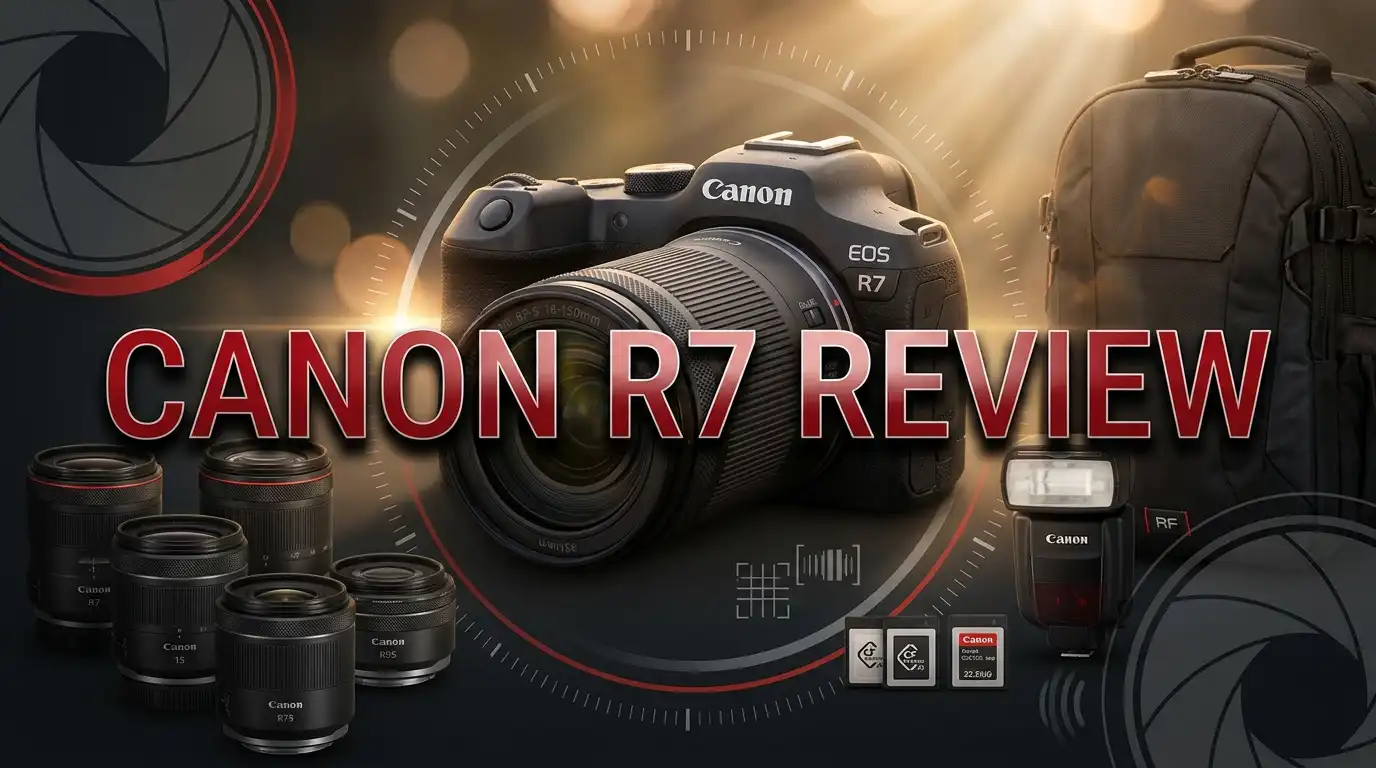
Canon R7 Review: Canon’s 32.5MP APS C Speed Machine Worth It?
The Canon EOS R7 arrived as a bold promise. Canon took the spirit of the beloved EOS 90D, dropped the mirror, and packed the result with technology borrowed from cameras that cost three times as much.
The result is a camera that shoots 32.5 megapixel stills at 15 frames per second, tracks birds in flight, records oversampled 4K video, and still fits comfortably in one hand. Wildlife shooters love it. Sports parents swear by it. Vloggers keep buying it.
But no camera is perfect, and the R7 carries a few quirks that deserve honest discussion. This review covers every part of the experience, from the sensor to the strange joystick, so you can decide if this camera belongs in your bag.
In a Nutshell
Here is the short version for readers who want answers fast.
- Speed is the headline feature. The R7 fires 15 frames per second with the mechanical shutter and 30 frames per second with the electronic shutter. The buffer holds roughly 100 compressed RAW files at 15 fps, which is deep enough for long action sequences.
- Autofocus punches far above the price. Canon borrowed subject detection from the flagship EOS R3, so the camera recognizes people, animals, and vehicles. Hit rates near 90 percent on moving subjects put it at the top of its class.
- Image quality is excellent, with one caveat. The 32.5 megapixel sensor captures more detail than most rivals and produces gorgeous Canon JPEG colors. RAW dynamic range trails Fujifilm and Sony sensors by a small margin.
- Video is strong but selective. Oversampled 4K at 24p and 30p looks superb. The 4K 60p modes either lose detail or demand a heavy crop, so choose your frame rate carefully.
- The body feels serious. Twin UHS II card slots, weather sealing, in body stabilization rated up to 8 stops with supported lenses, a headphone jack, and 660 shots per charge make this a proper enthusiast tool.
- Lens choice remains the weak point. Canon’s RF S range is small and slow, so most owners adapt EF glass or buy full frame RF lenses.
Canon EOS R7 Overview

- High Image Quality: Canon EOS R7 4K digital camera features a 32.5-megapixel APS-C CMOS sensor that's designed...
- Advanced Autofocus: Dual Pixel CMOS AF technology with up to 651 AF zones; uses every pixel on the imaging...

Last update on 2026-08-28 / Affiliate links / Images from Amazon Product Advertising API
The Canon EOS R7 sits at the top of Canon’s APS C mirrorless lineup. Canon launched it alongside the smaller EOS R10, and the two cameras share a family resemblance without sharing a target buyer.
The R7 uses a 32.5 megapixel APS C CMOS sensor paired with the DIGIC X processor. That processor also powers Canon’s full frame flagships, which explains the surprising speed.
The 1.6x crop factor turns a 400mm lens into a 640mm equivalent view. Wildlife and sports photographers treat this as free reach, and it remains one of the strongest arguments for the camera.
Canon built the body around the RF mount, so every RF lens fits directly. EF and EF S lenses work through a simple adapter with full autofocus support.
The feature list reads like a much more expensive camera. You get in body image stabilization, dual UHS II SD card slots, weather sealing, a fully articulating touchscreen, 10 bit HDR PQ stills, and C Log 3 video.
Canon set the launch price at 1,499 dollars for the body. Street prices have since settled lower, which turns an already strong value into a genuine bargain for action shooters.
The camera weighs 612 grams with battery and card. That is light enough for all day hikes yet heavy enough to balance a telephoto zoom.
Think of the R7 as a wildlife and sports specialist that happens to be a very capable hybrid camera. That framing explains almost every design decision Canon made.
Design and Build Quality
Pick up the R7 and your hand knows exactly what to do. Canon shaped the grip like a shrunken EOS R6, with a deep finger channel and a thumb rest that keeps heavy lenses stable.
The magnesium and polycarbonate shell feels dense rather than hollow. Canon added weather sealing across the seams, though the company avoids publishing a specific rating.
The control layout holds one genuine surprise. Instead of a large rear dial, Canon wrapped a vertical command dial around the autofocus joystick on the back plate.
This design saves space and lets your thumb adjust exposure and focus point from one spot. Some photographers adapt within a week, while others knock the dial while nudging the focus point.
The top plate carries a mode dial, a front command dial behind the shutter button, and a movie record button. Canon removed the pop up flash, which feels like a fair trade for the weather sealing.
The four way controller on the back accepts custom functions, unlike the fixed controller on the R10. Serious users will appreciate that flexibility.
Both memory card slots live behind a dedicated door on the right side. Tripod users will notice this immediately, because swapping cards no longer means removing the camera from a plate.
Ports include microphone in, headphone out, micro HDMI, and a fast USB C connection. The headphone jack alone separates this body from most cameras at the price.
Sensor and Image Quality
The 32.5 megapixel sensor delivers plenty of resolution for large prints and aggressive cropping. Detail capture matches even the 40 megapixel Fujifilm bodies in real world test scenes, which surprised many reviewers.
Canon’s color science remains a quiet superpower. Reds and yellows look punchy without turning fake, blues stay rich, and skin tones need almost no correction.
Straight out of camera JPEG files often need zero editing. Photographers who shoot events and want fast delivery will save hours every week.
RAW files respond well to shadow recovery. Push an underexposed frame three stops and the image holds together, especially with modern noise reduction software.
Honesty matters here, though. The R7 gives up a small amount of RAW dynamic range to Sony and Fujifilm sensors of the same generation.
At base ISO the noise levels sit right alongside rivals. As you climb past ISO 3200 the R7 grows slightly noisier than lower resolution competitors, since those 32.5 million pixels are packed tightly.
Pixel density cuts both ways. It gives incredible cropping freedom for distant birds, then asks for good light or fast glass when the sun drops.
The camera also shoots 10 bit HEIF files using the HDR PQ curve. Display those on an HDR television and the extra highlight range becomes obvious immediately.
For portraits, landscapes, wildlife, and everyday photography, the image quality sits firmly in the very good category. Only dedicated low light shooters will feel the limits.
Autofocus Performance
Autofocus is where the R7 earns its reputation. Canon fitted the camera with Dual Pixel CMOS AF II and subject detection technology from the professional EOS R3.
The system recognizes people, animals, and vehicles as separate subject types. You choose the category, and the camera hunts for eyes, faces, heads, or bodies automatically.
Animal detection covers dogs, cats, birds, and horses. Bird photographers report reliable eye locks even when a subject sits against a busy background.
Tracking now works inside every autofocus area mode for stills. That means you can start tracking from a single point, a small zone, or the whole frame, depending on how predictable your subject is.
Real world hit rates impress. Testing with an approaching cyclist at 15 frames per second produced keeper rates close to 90 percent with tracking enabled.
Once the system locks on, it holds on stubbornly. Passing distractions rarely steal focus, which builds real confidence during fast sequences.
Low light focusing reaches down to negative 5 EV with a fast lens. Indoor sports and dim wedding receptions remain workable.
Three customizable focus zones let you shape the active area to match your subject. A tall narrow zone suits a runner, while a wide flat zone suits a car crossing the frame.
Video autofocus is good but not equal to stills. Tracking only functions in Whole Area AF, and sudden subject movement can trigger a brief hunt.
Sony still holds a slight edge in eye detection consistency. Canon closes that gap with better tracking stickiness and a far deeper buffer.
Top 3 Alternative for Canon EOS R7
Every buyer deserves options. These three cameras compete directly with the R7 and each one wins in a different area.

- HIGH IMAGE QUALITY: Canon’s 24.2 Megapixel (APS-C) CMOS sensor delivers stunning resolution to fast-action...
- DIGIC X IMAGE PROCESSOR: Powers 4K video capture and reduces noise, so you can continuously shoot without...
Last update on 2026-08-22 / Affiliate links / Images from Amazon Product Advertising API

- 26.0MP APS-C format Exmor R back-illuminated CMOS sensor
- BIONZ XR processing power for exceptional image quality
Last update on 2026-08-22 / Affiliate links / Images from Amazon Product Advertising API

- X-S20 offers the perfect blend of power and portability to turn thoughts and ideas into reality. Weighing just...
- X-S20 combines powerful sensor and processor technologies to deliver a blistering performance for stills and...
Last update on 2026-08-22 / Affiliate links / Images from Amazon Product Advertising API
The Canon EOS R10 offers the same autofocus brain in a lighter, cheaper body. You lose in body stabilization, the second card slot, and weather sealing, but you keep the excellent subject detection.
The Sony a6700 answers with a modern backside illuminated 26 megapixel sensor. It delivers cleaner high ISO files, uncropped 4K 60p, and access to a huge third party lens catalog.
The Fujifilm X S20 targets hybrid creators. Its film simulation modes produce beautiful colors in camera, and battery life is outstanding for the size.
Choose the R10 to save money, the a6700 for lens choice and video, and the X S20 for creative color. Choose the R7 when reach, speed, and buffer depth matter most.
Burst Shooting and Buffer Depth
Speed defines this camera. The mechanical shutter fires at 15 frames per second with full autofocus and exposure tracking between frames.
Switch to the electronic shutter and the rate climbs to 30 frames per second. That number sat in professional territory only a few years ago.
Canon’s flagship EOS 1D X Mark III DSLR shoots just one frame per second faster than the R7 does mechanically. Read that sentence twice, then look at the price difference.
Buffer depth matters as much as raw speed. The R7 captures roughly 100 compressed RAW frames at 15 fps before slowing down.
At 30 fps you get around 65 RAW frames. That gives you two to three times the runway of the cheaper R10.
Dual UHS II card slots clear the buffer quickly. You can also assign one card to RAW and the other to JPEG, or use the second slot as an automatic backup.
Flash sync reaches 1/250 second with the mechanical shutter and 1/320 second in electronic first curtain mode. The fully electronic shutter does not support flash.
Rolling shutter appears in electronic mode with fast moving subjects. Golf swings and propeller blades will show skew, so stick with the mechanical shutter for those situations.
For birds taking flight, kids on a soccer pitch, or a dog charging across a field, this combination of speed and buffer feels liberating. You stop rationing frames and start capturing sequences.
In Body Image Stabilization
The R7 was Canon’s first APS C camera with in body image stabilization. Five axis sensor shift correction works alone or in coordination with stabilized lenses.
Canon rates the system at up to 8 stops of advantage with compatible RF lenses. Real world results vary by lens and technique, but sharp handheld shots at half a second become realistic.
Wildlife shooters gain the most. Long lenses magnify hand tremor, and coordinated stabilization tames that shake noticeably at 400mm and beyond.
Low light photography also improves. You can drop the shutter speed instead of raising ISO, which keeps files cleaner for static subjects.
Video stabilization tells a slightly different story. Static handheld shots look locked down, and slow pans look smooth and professional.
Walking footage is another matter. The system cannot fully remove the vertical bounce of footsteps, so a gimbal remains useful for moving shots.
Movie Digital IS adds electronic correction on top of the sensor movement. It crops the frame slightly, then delivers noticeably steadier results for handheld talking head clips.
Adapted EF lenses with optical stabilization also benefit. The camera coordinates lens and sensor movement rather than choosing one system.
Stabilization changes how often you leave the tripod at home. For travel photographers, that convenience is worth real money.
Video Features and 4K Quality
The R7 is a legitimate hybrid camera, but it rewards users who understand its video modes. Not every setting delivers the same quality.
Oversampled 4K uses the full 7K sensor width and downsamples to 3840 by 2160. This mode looks stunning and rivals the best APS C cameras available.
It records at 24p and 30p, with a recording limit around 30 minutes depending on temperature. Detail, color, and micro contrast all look excellent here.
4K 60p arrives in two flavors. The full width version skips sensor lines and loses noticeable detail, while the cropped version applies an additional 1.81x crop for sharper results.
That crop stacks on top of the existing APS C crop, so you end up using only a quarter of the sensor. Noise rises in anything less than good light.
Rolling shutter measures around 30 milliseconds in the oversampled mode. Fast pans will show the jello effect, so move the camera slowly.
Color options please serious editors. You get 10 bit HDR PQ for direct HDR delivery and 10 bit C Log 3 for full grading control.
Audio support includes a microphone input and a headphone output for monitoring. That pairing is rare at this price.
Full HD recording reaches 120 frames per second for slow motion. The fully articulating screen flips forward for solo creators.
Treat the R7 as a superb 4K 30p camera with situational 60p options. Approach it that way and the results will make you smile.
Viewfinder, Screen and Handling
The electronic viewfinder uses a 2.36 million dot OLED panel. That resolution is ordinary in 2026, yet the 1.15x magnification makes the image feel large and immersive.
Refresh remains smooth in the smoothness priority setting. Blackout during bursts stays short enough to follow erratic subjects.
Fujifilm and Sony rivals offer sharper viewfinder panels. Whether you notice depends on how much time you spend at your eye.
The rear screen measures 3.0 inches with 1.62 million dots and full articulation. It flips out, rotates forward, and folds inward for protection.
Touch control works throughout the interface. Tap to focus, swipe through images, and drag the focus point while looking through the viewfinder.
Canon’s menu system remains one of the friendliest in the industry. Color coded tabs, plain language labels, and a customizable My Menu tab keep everything findable.
The Q menu gives quick access to the settings you change most. Beginners can stay in Auto and grow into manual control at their own pace.
Custom shooting modes on the mode dial store complete camera setups. Wildlife shooters often save one for perched birds and another for flight.
The rear dial and joystick combination remains the one polarizing element. Handle the camera in a store before ordering if you can, because opinions genuinely split on this point.
Battery Life and Storage
Canon fitted the R7 with the LP E6NH battery used by the EOS R5 and R6. That means over twice the capacity of the small battery inside the R10.
CIPA ratings list 660 shots using the rear screen and 380 through the viewfinder. Power saving mode raises those figures to 770 and 500.
Real world results usually beat CIPA numbers by a wide margin. Burst shooters routinely pass 1,200 frames on a single charge.
The camera also accepts older LP E6N and LP E6 batteries. Anyone upgrading from a Canon DSLR probably owns a drawer full of them.
USB C charging works with a compatible power delivery adapter. You can top up from a power bank between sessions or during a car ride.
Storage uses two UHS II SD card slots. Choose backup recording, overflow recording, or file type separation.
Redundant recording is a professional feature that weddings and paid events demand. Few cameras near this price include it.
Fast V60 or V90 cards keep the buffer clearing quickly during long bursts. Slower cards still work, but they extend the wait after a big sequence.
Battery grip support is missing, which disappoints some portrait shooters. Carrying a spare battery solves the endurance question anyway.
Lens Options for the Canon EOS R7
Lens choice is the most discussed weakness of this system. Canon’s RF S range remains small and focused on affordable zooms.
The RF S 18 to 150mm STM makes a fine travel companion. It covers a 29mm to 240mm equivalent range in one compact package.
Fast, wide, and affordable RF S primes still do not exist in meaningful numbers. Landscape and astrophotography shooters feel this gap most.
Full frame RF lenses mount directly and perform beautifully. The RF 50mm f1.8 and RF 16mm f2.8 both cost little and stay compact.
Telephoto shooters have good options. The RF 100 to 400mm and RF 100 to 500mm turn the R7 into a serious wildlife rig with enormous effective reach.
EF and EF S lenses work through Canon’s mount adapter. Autofocus performance stays excellent, and used EF glass sells cheaply.
Third party autofocus lenses have slowly appeared for RF S, which improves the situation compared to the launch period. Availability still trails Sony and Fujifilm by a wide margin.
Before buying, list the lenses you actually need. Match that list against what Canon sells today rather than what might arrive later.
Who Should Buy the Canon EOS R7

- DIGIC X IMAGE PROCESSOR: Enhances performance for sharp photos and ultra-high definition videos
- CMOS SENSOR: Canon’s 32.5 mp APS-C CMOS sensor ensures images appear crisp
Last update on 2026-08-22 / Affiliate links / Images from Amazon Product Advertising API
Wildlife photographers should look hard at this camera. The crop factor, the burst rate, and the animal eye detection combine into a package that costs far less than a full frame equivalent.
Sports shooters get similar benefits. Fifteen frames per second with reliable tracking covers everything from youth soccer to motorsport.
Canon DSLR owners upgrading from a 70D, 80D, or 90D will feel at home instantly. The controls, the menus, and the grip all translate directly.
Hybrid creators who shoot both photos and video get real value. Oversampled 4K, C Log 3, in body stabilization, and a headphone jack cover most content needs.
Travel photographers benefit from the weight savings. A smaller sensor means smaller lenses for the same field of view.
Some buyers should look elsewhere. Photographers who shoot mostly in dim light will prefer a full frame body or a cleaner backside illuminated sensor.
Wide angle specialists face the lens gap directly. Landscape and interior shooters may find the available options limiting.
Anyone who prizes the absolute best RAW dynamic range will prefer certain Fujifilm and Sony sensors. For everyone else, the R7 delivers remarkable capability for the money.
Pros and Cons of the Canon EOS R7
Here is the balanced summary after weeks of use and testing.
Pros
- Blazing 15 frames per second mechanical burst with a deep buffer that handles roughly 100 RAW frames
- Excellent subject detection autofocus for people, animals, and vehicles inherited from the EOS R3
- 32.5 megapixels of detail with a 1.6x crop factor that adds free telephoto reach
- In body image stabilization rated up to 8 stops with supported lenses
- Beautiful Canon JPEG colors that often need no editing at all
- Oversampled 4K video with 10 bit C Log 3 and HDR PQ options
- Twin UHS II card slots with backup recording plus weather sealing
- Strong battery life using the widely available LP E6NH pack
- Microphone and headphone jacks for serious audio control
- Comfortable DSLR style grip that balances long lenses well
Cons
- Limited RF S lens selection, especially fast primes and wide angle glass
- RAW dynamic range trails the best APS C rivals by a small margin
- The rear dial wrapped around the joystick causes accidental adjustments for some users
- 4K 60p either loses detail or demands a heavy 1.81x additional crop
- Rolling shutter reaches 30 milliseconds in the best 4K mode
- Viewfinder resolution of 2.36 million dots feels dated
- Higher noise at very high ISO settings compared with lower resolution sensors
- No battery grip option from Canon
- Video autofocus tracking only works in Whole Area AF mode
Canon EOS R7 vs Canon EOS R10
These two cameras launched together, and buyers still compare them constantly. The differences matter more than the shared DNA suggests.
The R7 carries a 32.5 megapixel sensor while the R10 uses 24.2 megapixels. That extra resolution gives the R7 more cropping room for distant subjects.
In body image stabilization appears only on the R7. The R10 relies entirely on lens stabilization, which limits handheld shutter speeds.
Buffer depth separates them dramatically. The R7 holds two to three times more frames in a burst, which changes how you shoot sequences.
The R7 has two UHS II card slots while the R10 has one UHS II slot. Professionals who need backup recording have only one choice here.
Weather sealing on the R7 is more thorough. Rain, dust, and cold weather shooting favor the larger body.
Battery capacity more than doubles with the LP E6NH pack. The R10 uses the smaller LP E17.
Video specs favor the R7 too, with 10 bit C Log 3 and oversampled 4K 30p. The R10 caps out with less flexible options.
The R10 wins on weight, size, and price. It also includes a pop up flash, which some casual shooters genuinely use.
Buy the R10 for travel and family photography, and buy the R7 when performance matters more than pocket space.
Price and Value for Money
Canon launched the R7 at 1,499 dollars for the body and 1,899 dollars with the RF S 18 to 150mm lens. Prices have dropped considerably since then.
Frequent sales push the body well below its launch figure. That price movement transforms the value equation.
Compare it against full frame options with similar speed. Those cameras cost double or more, and their telephoto lenses cost far more again.
A 400mm lens on the R7 frames like a 640mm lens on full frame. Buying that reach optically on a full frame body would cost thousands.
Kit bundles add memory cards, bags, and spare batteries. Read the contents carefully, because value varies between sellers.
Used prices have also become attractive. The camera has been on the market long enough that clean second hand bodies appear regularly.
Budget for lenses when you plan a purchase. The body alone rarely reflects true system cost.
For action photography per dollar spent, the R7 remains one of the strongest values available. Few cameras deliver this much speed and autofocus intelligence at this price.
Final Verdict
The Canon EOS R7 is a specialist that pretends to be a generalist, and it pulls off the disguise convincingly. It shoots faster, tracks better, and reaches farther than almost anything near its price.
Wildlife and sports photographers should treat this camera as a serious recommendation. The combination of 15 frames per second, deep buffer, subject detection, and crop factor reach solves real problems.
Hybrid creators get genuine value too, provided they shoot most video at 24p or 30p and accept the crop for 60p work.
The weaknesses are real but manageable. RAW dynamic range sits slightly behind rivals, high ISO noise creeps in earlier, and the rear dial design divides opinion.
The lens gap remains the biggest consideration. Check that Canon or a third party makes the glass you need before committing to the system.
For photographers stepping up from a Canon DSLR, this transition feels natural and rewarding. Your EF lenses work, your muscle memory works, and your keeper rate climbs.
Rate it as an easy recommendation with clear eyes about the tradeoffs. The Canon EOS R7 remains one of the most capable APS C cameras you can buy for the money.
Frequently Asked Questions
Is the Canon EOS R7 good for beginners?
Yes, but it offers more camera than most beginners need. Full Auto mode and Canon’s friendly menus make it approachable, and the camera grows with you for years.
Does the Canon EOS R7 have in body image stabilization?
Yes. The R7 uses five axis sensor shift stabilization rated up to 8 stops of advantage with compatible RF lenses.
Can the Canon EOS R7 use EF lenses?
Yes. Canon’s EF to RF mount adapter allows EF and EF S lenses to work with full autofocus and stabilization support.
Is the Canon EOS R7 good for wildlife photography?
It is one of the best value wildlife cameras available. The 1.6x crop factor, 15 frames per second burst, deep buffer, and animal eye detection form a strong combination.
How long can the Canon EOS R7 record 4K video?
The oversampled 4K Fine mode records for roughly 30 minutes per clip depending on temperature. Other modes carry no listed thermal limit.
Does the Canon EOS R7 shoot 4K 60p?
Yes, in two ways. One version uses the full sensor width with line skipping, and the other applies a 1.81x crop for more detail.
How many shots does the Canon EOS R7 battery deliver?
CIPA ratings list 660 shots using the rear screen and up to 770 in power saving mode. Real world burst shooting often exceeds those figures.
Is the Canon EOS R7 weather sealed?
Yes. Canon sealed the body more thoroughly than the R10, though the company does not publish a specific rating.
Does the Canon EOS R7 have two card slots?
Yes. It includes two UHS II SD card slots that support backup, overflow, and separate file type recording.
Is the Canon EOS R7 still worth buying today?
Yes, especially at current discounted prices. Its speed, autofocus, and reach still compete strongly with newer APS C cameras.

DK is a technology expert who specializes in AI tools, software, and tech gadgets. He writes for How to Tech Info, providing detailed reviews and practical guides. DK helps readers discover the best AI applications, navigate new software, and choose the right tech gadgets.


