
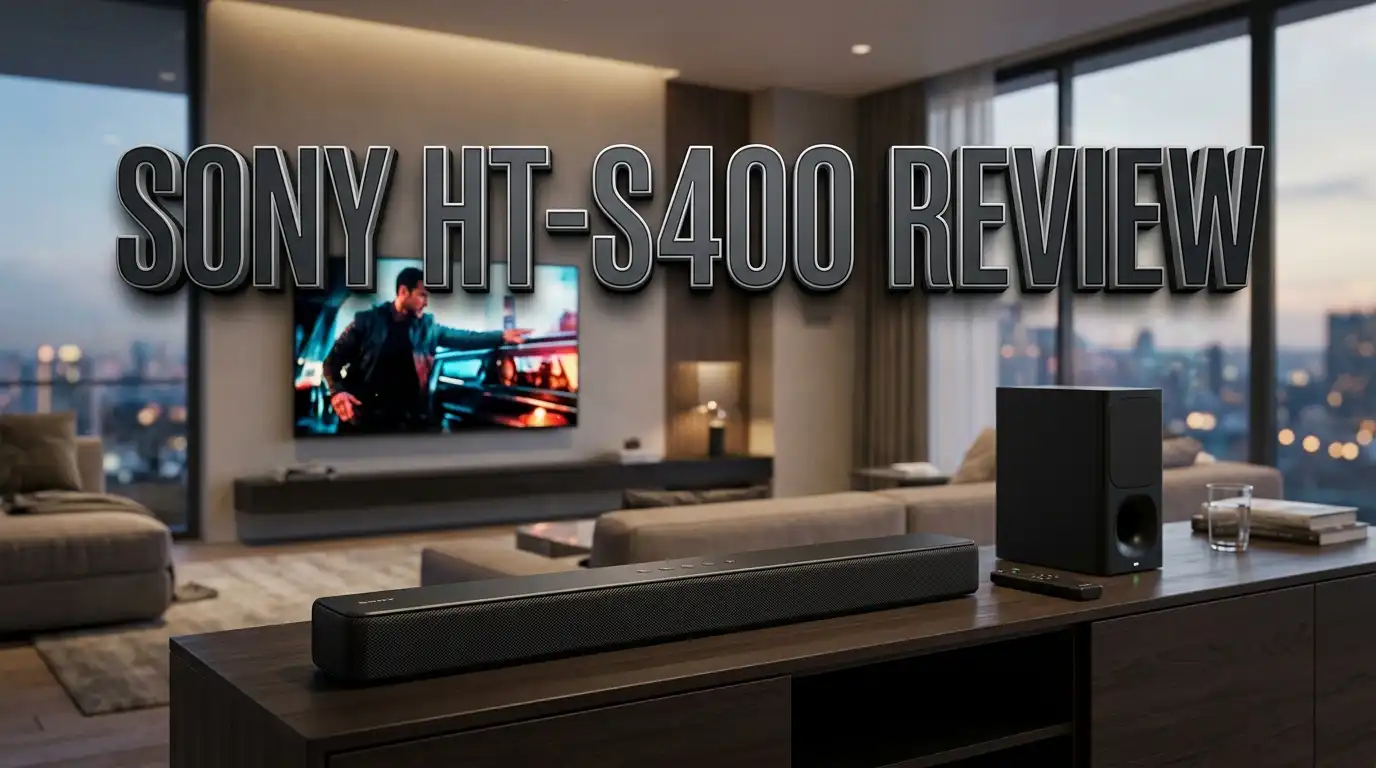
Sony HT-S400 Review: Big Bass, Simple Setup & Honest Value
Your new TV looks stunning. The sound, though, feels thin and flat.
That gap between picture and audio pushes most people toward their first soundbar. The Sony HT-S400 sits right in that sweet spot for buyers who want better sound without wires everywhere.
This 2.1 channel system pairs a slim bar with a large wireless subwoofer. Sony rates the pair at 330W total power and skips the complicated extras.
I studied the specs, the lab measurements, professional reviews, and owner feedback to build this guide. You will learn how it sounds, where it stumbles, and whether it still deserves your money in 2026.
Let us break it all down.
In a Nutshell: Sony HT-S400 Quick Verdict
Short on time? These points cover the essentials.
- Sound profile leans warm and bass heavy. The wireless subwoofer digs deep and gives movies real weight. Explosions, engines, and thunder land with force. Midrange detail stays the weak spot, so vocals and instruments can sound slightly hollow.
- Setup takes about five minutes. You connect one cable, plug in the subwoofer, and the pair links automatically. Sony includes an optical cable in the box. No app, no account, no Wi Fi setup screens.
- Connectivity stays minimal. You get one HDMI ARC port, one optical input, and Bluetooth 5.0. There is no HDMI passthrough, no Wi Fi, no AirPlay, and no Chromecast.
- Dolby Atmos is missing. The bar decodes Dolby Digital and uses S-Force PRO Front Surround for a wider stage. It widens sound nicely but never places audio above you.
- Build quality feels solid for the class. The bar measures 35.5 inches wide and just 2.63 inches tall, so it fits under most TVs. The subwoofer is unusually large at over 15 inches deep.
- Value depends on the price you pay. At the $299.99 list price it feels expensive. Around $200 or less, it becomes a genuinely strong buy.
Sony HT-S400 Overview and Key Specs

- IMMERSIVE SURROUND SOUND: S-Force PRO Front Surround and Dolby Digital create cinematic style surround sound.
- ENJOY CLEAR DIALOGUE AND POWERFUL SOUND: Powerful audio technology, such as the X-Balanced Speaker Unit and...

Last update on 2026-08-20 / Affiliate links / Images from Amazon Product Advertising API
Sony launched the HT-S400 in early 2022 as an entry level home audio upgrade. It replaced the older HT-S350 and kept the same simple formula.
The system uses a 2.1 channel layout. Two full range drivers sit inside the bar, and a separate wireless subwoofer handles low frequencies.
Sony rates total output at 330W. That number comes from Sony’s own measurement method, so treat it as marketing shorthand rather than a lab figure.
The bar body measures 35.5 by 2.63 by 3.5 inches and weighs about 5 pounds 5 ounces. The subwoofer measures 7.63 by 15.25 by 15.75 inches and weighs roughly 16 pounds.
Inside, Sony uses its S-Master digital amplifier. This is the same amplifier family found in pricier Sony bars, tuned here for a budget price.
Audio format support covers Dolby Digital, Dolby Dual Mono, and LPCM 2 channel. Dolby Atmos and DTS decoding are absent, which matters if you watch a lot of Blu ray discs.
Sound features include S-Force PRO Front Surround, Night Mode, and Voice Mode. A small OLED display behind the grille shows your input, volume, and bass level.
Sony also sells a near identical version at Costco under the model name HT-SC40. The hardware is the same, so pricing is the only real difference.
Design and Build Quality
Sony keeps the look plain, and that works in its favor. The bar wears a textured black plastic body with a light gray metal grille across the front.
Nothing here shouts for attention. It disappears in front of a TV, which is exactly what most people want.
Height is the important number. At just over 2.5 inches tall, the bar clears the bottom bezel of most TVs and will not block the screen.
Width suits screens of 40 inches and larger. On a 65 inch TV it looks perfectly proportioned.
The subwoofer is the surprise. It stands more than 15 inches tall and runs 15.75 inches deep, making it one of the biggest subs in this price class.
That size pays off in bass output but demands floor space. Plan a corner or a spot beside your media unit before you buy.
Sony uses a front firing driver with a protected cone. You can lay the subwoofer on its side if vertical space is tight, which adds welcome flexibility.
Wall mounting is easy. Keyhole slots sit on the back panel, and Sony supplies a paper template plus small plastic standoffs for a near flush fit.
One thoughtful touch stands out. An infrared repeater on the back passes remote signals through to your TV if the bar blocks the sensor.
Build feels sturdy for the money. Nothing rattles, panels fit tightly, and the grille resists dents from casual bumps.
Setup and Connectivity Options
Setup ranks among the simplest in the category. You plug the bar into your TV, plug the subwoofer into a wall outlet, and power both on.
The subwoofer pairs with the bar automatically. There is no button sequence to memorize and no app to download.
You get two wired ways to connect. One HDMI ARC port and one optical input sit in a recessed bay on the rear panel.
Sony includes the optical cable but not an HDMI cable. Budget a few dollars for one if you prefer HDMI.
Audio quality is identical across both connections. The real difference is control.
HDMI ARC enables HDMI CEC, so your TV remote adjusts soundbar volume. Optical cannot do that, though it frees an HDMI port on your TV.
Here is the important limitation. There is no HDMI input for passthrough, so you cannot route a game console or Blu ray player through the bar.
You also cannot use the unused port as a second source. Whichever cable you skip stays useless.
The USB port on the back only handles firmware updates. It will not play music from a thumb drive.
Bluetooth 5.0 works as a receiver for phones and tablets. Sony even lets compatible TVs with the A2DP profile connect wirelessly, though sound quality drops noticeably.
Wi Fi, AirPlay, Chromecast, and voice assistants are all missing. If multiroom audio matters to you, look elsewhere.
Top 3 Alternative for Sony HT-S400

- Feel every note with a 600W power output
- Get the best seat in the house with 5.1ch real surround sound
Last update on 2026-08-20 / Affiliate links / Images from Amazon Product Advertising API

- Meet the SR-C30A compact sound bar with compact subwoofer: a compact duo that strives to fit in, not stand...
- We know size matters. But we’re not sacrificing sound. The C30 is packed with virtual 3D surround sound...
Last update on 2026-08-20 / Affiliate links / Images from Amazon Product Advertising API

- Loud and Clear The 96dB sound pressure level and 50Hz – 20kHz frequency range deliver dynamic and accurate...
- DTS Virtual:X: Enhances any content with room-filling, floor-to-ceiling virtualized 3D sound.
Last update on 2026-08-20 / Affiliate links / Images from Amazon Product Advertising API
The Sony HT-S40R gives you real 5.1 surround at a similar price. It adds a center channel, plus two rear speakers that connect wirelessly to a small amplifier box.
You still run a wire from that box to each rear speaker. The payoff is genuine surround effects that no virtual processing can match.
The Yamaha SR-C30A suits small rooms and desks. The bar measures only 23 inches wide, so it fits bedrooms, dorms, and monitor setups where the Sony would overwhelm.
It ships with its own compact wireless subwoofer. Clear Voice mode handles dialogue well, and the whole package costs less than the Sony in most listings.
The Vizio V Series V21-H8 delivers the most features per dollar. It includes DTS Virtual:X, multiple inputs, and a wireless subwoofer for a lower asking price.
Vizio also includes an HDMI cable in the box. Sony does not.
Each alternative solves a specific HT-S400 weakness. Choose the HT-S40R for surround, the Yamaha for compact spaces, and the Vizio for input flexibility and price.
Sound Quality for Movies and Shows
Movies are where this system earns its keep. The jump from TV speakers to the HT-S400 is dramatic and immediate.
Action scenes gain scale. Growling engines, rolling thunder, and heavy footsteps arrive with real physical weight.
The subwoofer drives most of that improvement. It reaches low enough to make blockbuster scenes feel cinematic rather than tinny.
Treble clarity impresses too. Gunshots, breaking glass, and squealing tires cut through with sharp definition.
The midrange is the compromise. Complex scenes with layered voices and machinery can sound slightly hollow and thin.
You notice this most in dense soundtracks where dialogue, score, and effects compete. Simpler scenes hide the issue completely.
Sony gives you no equalizer. Bass level is the only adjustment, which limits your ability to fix that midrange dip.
Maximum volume is generous. The bar fills a medium living room without strain and only hardens slightly at the top of its range.
Night Mode compresses dynamics for late viewing. It keeps quiet dialogue audible while taming loud crashes, which apartment dwellers will appreciate.
For sports, the crowd noise spreads wide and commentary stays clear. For streaming shows and news, it simply works with no fiddling.
Think of it as a large upgrade over TV audio rather than a home theater replacement.
Bass Performance and the Wireless Subwoofer
The subwoofer is the star of this package. Sony clearly spent a large chunk of the budget here.
Its size explains the performance. A cabinet this big moves air that smaller budget subs cannot touch.
Bass extends deep enough for movie rumble. Low frequency effects land with authority instead of a vague thud.
The tuning leans warm. High bass gets extra emphasis, which adds boom to music and explosions alike.
Some listeners love that character. Others find it heavy, especially in small rooms where bass builds up in corners.
Sony anticipated this. A dedicated bass rocker on the remote lets you dial subwoofer level up or down in steps.
That single control solves most complaints. Drop the level two notches in a small bedroom and the balance improves right away.
Placement changes results too. Pushing the sub into a corner boosts output, while moving it into open floor space tightens the response.
The wireless link stays stable in normal use. A few owners report interference with crowded 2.4 GHz networks, so keep the sub away from your router if you notice dropouts.
Do not expect chest thumping theater bass. The sub will not shake your sofa or rattle windows.
For the price and for typical room sizes, it delivers more low end than almost any competing bar under $300.
Dialogue Clarity and Voice Mode
Clear speech ranks as the top reason people buy soundbars. The HT-S400 handles this well without special settings.
Voices sit forward in the mix. Even during busy scenes you rarely reach for the remote to rewind.
There is no dedicated center channel. Sony blends dialogue into the two front drivers, and the result stays surprisingly focused.
Voice Mode adds extra help. It lifts the upper frequency range where consonants live, sharpening speech against background noise.
Some reviewers found they almost never needed it. Others with hearing difficulties switch it on permanently.
The mode has a small side effect. Pushing those frequencies up can make voices sound slightly thin on some content.
Try it both ways with your favorite show. Your ears and your room decide the right setting.
Night Mode also helps dialogue at low volume. It pulls loud peaks down so you can keep speech audible without disturbing anyone.
Bass level affects clarity too. Heavy bass masks lower vocal tones, so trimming the sub often improves speech more than Voice Mode does.
Compared to a 3.1 bar with a real center channel, the HT-S400 gives up some precision. The Sony HT-G700 and Samsung HW-B650 both edge it out here.
For everyday TV, news, and streaming, dialogue performance is more than adequate. Most owners never complain about it.
S-Force PRO Front Surround Explained
S-Force PRO Front Surround is Sony’s virtual surround technology. It has appeared in Sony products for years and does real work here.
The idea is straightforward. Sony processes the signal so your ears perceive sound coming from beyond the physical speakers.
The effect widens the soundstage. Audio spreads past the edges of the bar and gains a small sense of depth.
It never sounds overprocessed. Unlike some virtual modes that smear dialogue, this one keeps voices intact.
You toggle it with the Sound Field button on the remote. One press switches between processed and plain stereo.
Most listeners prefer it on. The plain stereo mode sounds noticeably flat by comparison.
Set your expectations correctly, though. Virtual surround cannot replace real rear speakers.
Nothing appears behind you. Nothing appears above you either, since Dolby Atmos support is absent.
What you get is a wider, more open front stage. That alone makes movies feel bigger than TV speakers ever could.
The bar downmixes 5.1 signals to 2.1 before processing. Surround channels are folded in rather than discarded.
If true surround matters to you, the Sony HT-S40R with wireless rear speakers is the logical step up. For everyone else, S-Force PRO is a pleasant bonus rather than a headline feature.
Remote Control and Daily Use
The included remote is small, light, and easy to grip. Sony kept the button count low on purpose.
A large volume rocker sits in the center. A smaller bass rocker and a mute button fall right under your thumb.
The Input button cycles between TV and Bluetooth. With only two sources, a dedicated Bluetooth button would be redundant.
Three feature buttons complete the layout. Night, Voice, and Sound Field each toggle their function with one press.
The remote is not backlit. Finding buttons in a dark room takes a few seconds of feeling around.
You may rarely need it anyway. With HDMI ARC and CEC enabled, your TV remote handles power and volume.
The OLED display behind the grille deserves praise. It scrolls readable text for input, volume steps, bass level, and sound field status.
That beats the colored LED dot systems used by some rivals. You never need a legend card to decode what the bar is doing.
You can dim the display or turn it off. Top mounted buttons on the bar handle those settings.
Daily operation is dependable. Power on the TV and the bar wakes with it.
Standby power draw sits at 0.5W for each unit. Running power is 35W for the bar and 20W for the subwoofer, so it costs almost nothing to keep in use.
Sony HT-S400 vs Sony HT-S40R
These two models often appear side by side at similar prices. The differences are significant.
The HT-S400 is a 2.1 system. The HT-S40R is a true 5.1 system with a three channel bar, a subwoofer, and two rear speakers.
Sony rates the HT-S40R at 600W total. It also includes a discrete center channel that the HT-S400 lacks.
Dialogue benefits from that center channel. Speech locks to the screen instead of floating between two drivers.
Rear speakers change the experience entirely. Ambient effects, rain, crowds, and passing vehicles genuinely move around the room.
Setup takes longer, though. The rear speakers connect wirelessly to a small amplifier box, but you still run speaker wire from that box to each rear.
If you cannot run wires to the back of your room, the HT-S400 wins by default.
The HT-S400 also sounds tidier for music. Two channel content plays without the processing that a 5.1 system applies.
Bass output is comparable. Both use a large wireless subwoofer with a similar warm tuning.
Neither supports Dolby Atmos. Both stop at Dolby Digital decoding.
Choose the HT-S400 for simplicity and clean placement. Choose the HT-S40R if you want real surround and accept the extra cables.
Music Performance and Bluetooth Streaming
Music is the HT-S400’s weakest use case. It plays loud and clean but lacks tonal balance.
The bass heavy tuning dominates. Kick drums and bass lines push forward while vocals sit slightly recessed.
That hollow midrange becomes obvious on music. Acoustic guitars and piano lose some body and warmth.
Rock and electronic tracks fare best. The energy and low end suit those genres.
Jazz, classical, and singer songwriter material expose the gaps. Detail is present, but richness is thin.
Trimming the subwoofer level helps a lot. Two or three steps down brings vocals back into focus.
Bluetooth 5.0 handles wireless streaming. It works with any phone, tablet, or laptop.
Codec support is basic. Sony includes only SBC, with no AAC and no aptX, which limits fidelity on Apple and Android devices alike.
Range is solid across an average room. Pairing takes seconds and reconnection is automatic.
Bluetooth is also the only way to play music without turning on your TV. That convenience matters for background listening.
There is no Spotify Connect, no AirPlay, and no Chromecast built in. Multiroom fans should consider a Sonos Beam or a Wi Fi enabled bar instead.
For casual listening while cooking or cleaning, the HT-S400 does the job. For serious music sessions, it falls short of dedicated speakers at the same price.
Pros and Cons of the Sony HT-S400
Here is the honest balance sheet after weighing specs, reviews, and owner reports.
Pros
- Powerful wireless subwoofer that outperforms most subs bundled at this price, delivering deep movie rumble and satisfying weight.
- Setup takes minutes with automatic subwoofer pairing, an included optical cable, and no app or account required.
- Clean, low profile design that fits under nearly any TV of 40 inches or larger without blocking the screen.
- Clear treble and forward dialogue that make TV shows, news, and sports easy to follow without constant volume changes.
- S-Force PRO Front Surround widens the stage noticeably and never sounds artificial or smeared.
- Readable OLED display shows input, volume, and bass level in plain text instead of cryptic LED colors.
- Bass rocker on the remote lets you tune low end to your room in seconds.
- Sony reliability and a one year warranty back the purchase.
Cons
- Weak midrange definition leaves music and dense movie scenes sounding slightly hollow.
- No Dolby Atmos or DTS support, so height effects and DTS discs are off the table.
- Only two inputs total, with no HDMI passthrough for consoles or Blu ray players.
- No Wi Fi, AirPlay, Chromecast, or voice assistant support of any kind.
- Bluetooth uses SBC only, with no AAC or aptX for better wireless quality.
- No equalizer beyond subwoofer level, so you cannot correct the midrange dip.
- Very large subwoofer needs real floor space in small rooms.
- List price feels high compared to feature rich rivals from Vizio and Samsung.
Price and Value in 2026
Sony still lists the HT-S400 at $299.99. Almost nobody pays that today.
Street prices swing widely. Recent Amazon listings have hovered near the $250 mark, with frequent dips well below that.
Price tracking data shows deep discounts appearing several times a year. Waiting for a sale changes the value equation completely.
At full list price, the math is hard to defend. Vizio and Samsung offer more inputs and virtual Atmos for less money.
At $200 or under, the picture flips. You get a Sony built system with a subwoofer that outclasses anything else near that figure.
The Costco version, sold as the HT-SC40, sometimes undercuts retail pricing. The hardware is identical, so it is worth checking.
Consider longevity too. Sony products tend to last, and firmware updates arrive rarely but install easily by USB.
There are no subscription costs and no app that can be discontinued. A simple product cannot be broken by a bad software update.
Resale value stays reasonable as well. Used units move quickly in local listings.
Think about what you actually watch. If your viewing is mostly streaming TV, sports, and casual movies, the missing Atmos support costs you nothing.
If you own a 4K Blu ray player or a modern console, the lack of HDMI passthrough will frustrate you. That single limitation should drive your decision more than price does.
Who Should Buy the Sony HT-S400
- IMMERSIVE SURROUND SOUND: S-Force PRO Front Surround and Dolby Digital create cinematic style surround sound.
- ENJOY CLEAR DIALOGUE AND POWERFUL SOUND: Powerful audio technology, such as the X-Balanced Speaker Unit and...
Last update on 2026-08-20 / Affiliate links / Images from Amazon Product Advertising API
This soundbar suits a specific buyer very well. Recognize yourself in these descriptions and the choice becomes easy.
Buy it if you want a first soundbar. The upgrade over TV speakers is enormous and the setup takes minutes.
Buy it if you value simplicity. No app, no network setup, and no accounts means nothing to troubleshoot later.
Buy it if you love bass. The subwoofer punches far above its price and makes movies feel big.
Buy it if your TV handles all your sources. Modern smart TVs run apps and route consoles, so HDMI passthrough becomes irrelevant.
Buy it if you watch mostly streaming content. Netflix, Prime Video, and YouTube deliver Dolby Digital, which this bar handles fully.
Skip it in other cases. If you want Dolby Atmos height effects, this bar cannot deliver them.
Skip it if you need multiple HDMI inputs. Gamers with several consoles will run out of TV ports fast.
Skip it if music is your priority. The midrange dip and SBC only Bluetooth hold it back.
Skip it if your room is tiny. That large subwoofer overwhelms small bedrooms and takes real floor space.
Skip it if you want Wi Fi streaming or voice control. Those features simply are not here at any setting.
Final Verdict on the Sony HT-S400
The Sony HT-S400 does a small number of things and does them well. That focus is both its strength and its ceiling.
You get big, confident bass from a subwoofer that shames most bundled units. You get clear treble and dialogue that stays easy to follow.
You get a five minute setup with zero software friction. For a huge number of households, that is exactly what a soundbar should be.
The compromises are real, though. Midrange definition is thin, Dolby Atmos is missing, and connectivity stops at two inputs plus basic Bluetooth.
None of those flaws ruin the experience. Each one simply defines who this product is for.
Judged as a home theater system, it falls short. Judged as a large upgrade over TV speakers, it succeeds easily.
Price decides the rest. At $299.99 it faces stiff competition and loses on features.
At $200 or below it becomes one of the better simple soundbars you can buy. Watch the price and strike during a sale.
If you need surround, step up to the Sony HT-S40R. If you need a small room fit, look at the Yamaha SR-C30A.
If you want maximum features per dollar, the Vizio V21-H8 answers that. For everyone who just wants better TV sound with no fuss, the HT-S400 remains a safe, satisfying choice in 2026.
Frequently Asked Questions
Does the Sony HT-S400 support Dolby Atmos?
No. The HT-S400 decodes Dolby Digital, Dolby Dual Mono, and LPCM 2 channel audio only.
It uses S-Force PRO Front Surround to widen the soundstage instead. That processing adds width but never places sound above you.
Can I connect a game console directly to the Sony HT-S400?
No. There is no HDMI input for passthrough on this model.
Connect your console to the TV instead. The TV then sends audio to the bar through HDMI ARC or optical.
Is HDMI or optical better for the Sony HT-S400?
Audio quality is identical on both. HDMI ARC adds CEC control so your TV remote adjusts soundbar volume.
Optical saves an HDMI port on your TV. Choose based on which ports you have free.
How big is the Sony HT-S400 subwoofer?
It measures 7.63 by 15.25 by 15.75 inches and weighs about 16 pounds. That makes it one of the largest subs in this price range.
You can lay it on its side if vertical space is limited. The driver sits on the front and stays protected.
Does the Sony HT-S400 have Wi Fi?
No. Wireless connectivity is limited to Bluetooth 5.0 as a receiver.
There is no AirPlay, Chromecast, Spotify Connect, or voice assistant support. Look at a Wi Fi enabled bar if multiroom audio matters.
Can the Sony HT-S400 play music from a USB drive?
No. The USB port on the rear panel handles firmware updates only.
Stream music over Bluetooth from your phone or laptop instead. That is the only way to play music without your TV.
Is the Sony HT-S400 the same as the HT-SC40?
Yes, in practice. The HT-SC40 is the Costco version of the same hardware.
Specifications, features, and performance match. Only pricing and packaging differ.
Will the Sony HT-S400 work with any TV?
Yes, as long as your TV has an HDMI ARC port or an optical output. Almost every TV made in the last decade has at least one.
Some TVs with the A2DP Bluetooth profile can also connect wirelessly. Sound quality drops noticeably on that connection.

DK is a technology expert who specializes in AI tools, software, and tech gadgets. He writes for How to Tech Info, providing detailed reviews and practical guides. DK helps readers discover the best AI applications, navigate new software, and choose the right tech gadgets.


