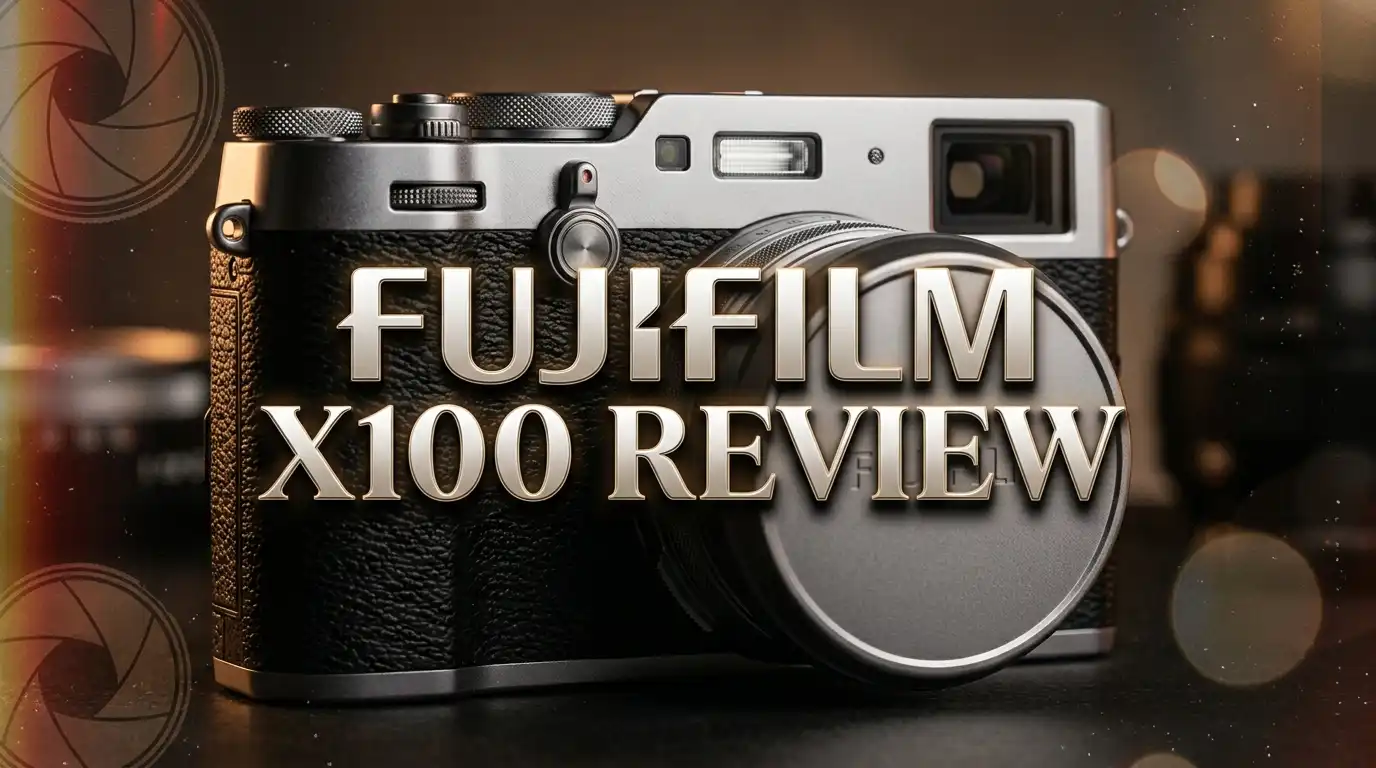
Fujifilm X100VI Review: Compact Camera Worth $1,599 in 2026?
The Fujifilm X100VI has become the camera everyone talks about. Photographers queued for months to get one. Street shooters swapped their big mirrorless kits for it. Travel bloggers built entire feeds around its colors.
So the real question is simple. Does this camera actually deserve the hype, or is it just a beautiful object with a price tag to match?
I spent time with the X100VI to answer that. This review covers the sensor, the lens, the stabilization, the famous hybrid viewfinder, and the honest weak spots nobody mentions in the launch videos. By the end, you will know if this is your next camera or a very expensive distraction.
Let us get into it.
In a Nutshell
Short on time? Here is the quick version of the whole review.
- The sensor is a big step up. The X100VI packs a 40.2MP APS-C X Trans CMOS 5 HR sensor, the same one found in the X T5 and X H2. It captures more detail than the 26MP chip in the X100V, and files hold up well when you crop.
- Stabilization changes how you shoot. Fujifilm added in body image stabilization rated at 6 stops. That means handheld shots at 1/8 second become realistic. This is the single most useful upgrade in the camera.
- The lens is charming, not clinical. The fixed 23mm F2 lens gives a 35mm equivalent view. It renders beautifully in normal light but softens when shot wide open at close range. Sharpness fans will notice. Most shooters will not care.
- Autofocus is improved but still the weak link. Subject recognition now detects animals, birds, cars, and more. The lens motor simply cannot keep pace with fast movement, so continuous focus stays average.
- The colors sell the camera. Twenty film simulation modes, including Reala ACE, produce JPEGs you can post straight from the camera. This saves hours of editing.
- It costs $1,599 and is worth it for the right person. Street, travel, and everyday shooters will love it. Sports, wildlife, and video professionals should look elsewhere.
Fujifilm X100VI Overview

- 40.2MP X-Trans CMOS 5 HR Sensor
- Up to 6.0 stops In-Body Image Stabilization
Last update on 2026-08-23 / Affiliate links / Images from Amazon Product Advertising API
The Fujifilm X100VI is the sixth generation of a camera series that started back in 2011. It is a fixed lens compact camera with a large APS-C sensor inside a body that looks like a 1960s rangefinder.
Fujifilm launched it in February 2024 to mark the company’s 90th anniversary. Demand exploded almost immediately. Backorders stretched for months in many countries.
The core recipe has not changed in fifteen years. One sensor, one lens, one clear purpose. You get a 35mm equivalent field of view and a set of physical dials that control everything that matters.
What is new in this generation matters a lot, though. The sensor jumped to 40.2MP. Image stabilization arrived for the first time in the series. The processor moved to X Processor 5, which brought machine learning focus modes and better video.
The camera weighs 521 grams with battery and card. It measures roughly 128mm wide, 75mm tall, and 55mm deep. That is small enough for a jacket pocket, though not a jeans pocket.
Fujifilm also kept the features that made older models special. The hybrid optical and electronic viewfinder is still here. The built in 4 stop neutral density filter is still here. The leaf shutter with flash sync at high speeds is still here.
Price at launch was $1,599 in the United States, which was $200 more than the X100V. Street prices have stayed close to that figure, and demand has kept discounts rare.
Design, Build, and Handling
Pick up the X100VI and the first thing you notice is density. The top and bottom plates are milled from aluminium. The finish feels expensive because it is.
Fujifilm offers two colors. Silver looks classic and hides wear well. Black looks discreet and disappears on the street. Both use the same body.
The control layout is the star here. You get an aperture ring on the lens, a shutter speed dial on top, a dedicated exposure compensation dial, and an ISO dial nested inside the shutter dial.
This means you can set your entire exposure before the camera even wakes up. Turn any dial to A and the camera takes over that setting. Turn it to a number and you take control back.
The ISO dial is the one weak point. You lift and twist the outer collar while turning the inner ring. It works, but it is fiddly enough that most owners assign ISO to a command dial instead.
The rear screen tilts up and down. It now angles 45 degrees downward, up from 30 degrees on the X100V, and it pulls slightly away from the body when tilted up. Small change, genuinely useful in crowds.
Two command dials sit on the front and back. Both press inward to cycle through assigned functions.
One warning. The focus mode switch on the left side gets knocked easily in a bag. Many owners just ignore it or check it before every session.
Weather sealing is optional, not standard. You need the AR X100 adapter ring plus a protective filter to seal the front element. Budget around $80 for that combination.
Image Quality from the 40MP Sensor
The 40.2MP X Trans CMOS 5 HR sensor is the headline spec, and it delivers real detail.
Compared to the 26MP sensor in the X100V, you gain about 24 percent more linear resolution. In practice that means cropping to a 50mm or 75mm equivalent view still leaves you with a usable file.
Fujifilm built digital teleconverter modes around this idea. You get 1.4x and 2x crops that output JPEGs at 20MP and 10MP. These are surprisingly practical for a fixed lens camera.
Base ISO is 125. Files at that setting hold enormous shadow detail, and highlight recovery in RAW is generous.
Noise performance is where expectations need adjusting. At the pixel level, a 40MP APS-C sensor shows more grain than a 26MP one. View both at the same print size and the difference nearly vanishes.
ISO 1600 stays clean. ISO 3200 is fully usable. ISO 6400 works for street photography with some noise reduction. Above that, quality drops quickly.
Dynamic range sits around 13 stops in RAW at base ISO. That is competitive with most APS-C cameras on the market.
The JPEG engine deserves special mention. Fujifilm applies sharpening, noise reduction, and color science that many photographers prefer over their own RAW edits.
One practical note. Files are large. A single RAW runs about 80MB, and compressed RAW cuts that roughly in half. Buy fast, high capacity cards before your first trip.
X Trans sensors also use a nonstandard color filter pattern. Some RAW converters handle this better than others. Capture One, Lightroom, and Iridient all produce different results, so test your favorite.
Top 3 Alternative for Fujifilm X100VI
The X100VI is not the only serious compact camera. Here are three strong options worth comparing before you spend $1,599.
Ricoh GR IIIx offers a 40mm equivalent lens and a 24MP APS-C sensor in a body that genuinely fits a pocket. It has no viewfinder, but street photographers love its speed and snap focus system.

- GR with a 40mm angle of view: A focal length of 40mm provides a highly versatile angle of view that is close...
- The ultimate snapshot camera-GR unchanging concept: High image quality, Quick response, Portability, and...

Last update on 2026-09-02 / Affiliate links / Images from Amazon Product Advertising API
Fujifilm X T50 gives you the same 40MP sensor and film simulation dial with interchangeable lenses. You lose the hybrid viewfinder and the fixed lens simplicity, but you gain complete flexibility.

- Dedicated Film Simulation dial offering fast access to 20 Film Simulations (including REALA ACE mode)
- 40.2-megapixel X-Trans CMOS 5 HR sensor
Last update on 2026-09-02 / Affiliate links / Images from Amazon Product Advertising API
Sony RX100 VII trades sensor size for reach. Its 1 inch 20MP sensor pairs with a 24mm to 200mm equivalent zoom, and its autofocus tracking beats the Fujifilm easily.

- 20. 1MP 1. 0 Type stacked CMOS sensor, Zeiss Vario Sonnar T 24 200 millimeter F2. 8 F4. 5 large aperture high...
- 0. 02 sec. High AF speed, 357 point focal plane Phase detection AF and 425 point contrast detection AF
Last update on 2026-08-22 / Affiliate links / Images from Amazon Product Advertising API
Each of these solves a different problem. The Ricoh wins on pocketability. The X T50 wins on flexibility. The Sony wins on zoom range and focus speed.
The X100VI wins on the shooting experience itself. That sounds vague until you use one. The dials, the viewfinder, and the colors combine into something the others do not replicate.
Choose based on what you actually shoot, not on what looks best on a shelf.
The 23mm F2 Lens Up Close
The X100VI uses the same eight element lens Fujifilm introduced with the X100V in 2020. It is a 23mm F2 design, giving a 35mm equivalent field of view.
That focal length is the classic reportage view. Wide enough for context, tight enough to avoid distortion on faces. It is the reason so many photographers gravitate to this series.
Optically, the lens is good rather than exceptional. Center sharpness at F4 and F5.6 is excellent, and it resolves the 40MP sensor well.
Wide open at F2, things soften noticeably at close focus distances. Shoot a subject at half a metre at F2 and you get a dreamy, slightly hazy look. Some people love it. Others find it frustrating.
Corners stay softer than the center across the aperture range. There is mild vignetting in RAW files and some lateral chromatic aberration, both easy to correct.
Minimum focus distance is 10cm in macro mode. That is close, though the softness at F2 limits how sharp those shots get.
Build quality is excellent for the size. The aperture ring clicks in third stop increments and feels precise.
The built in neutral density filter is a genuinely great feature. It cuts 4 stops of light, which lets you shoot at F2 in bright sunlight without stacking filters.
The leaf shutter is another quiet advantage. It syncs with flash at up to 1/2000 second at narrow apertures, and it is nearly silent in operation.
Two optional converters exist. The WCL X100 II gives a 28mm equivalent view. The TCL X100 II gives a 50mm equivalent view. Both are sharp but bulky.
In Body Image Stabilization in Real Use
This is the upgrade that changes daily shooting. The X100VI includes a five axis in body stabilization unit rated at 6 stops of correction.
Fujifilm managed to fit this into a body only 2mm deeper and 43 grams heavier than the X100V. That is impressive engineering for a camera this small.
In practice, I found handheld shots at 1/15 second reliable and 1/8 second usable most of the time. Some frames at 1/4 second came out sharp with careful technique.
This matters more on a 40MP sensor than you might think. High resolution punishes small movements, so stabilization protects the detail you paid for.
Interesting quirk. Fujifilm rates stabilization at 6 stops when using the electronic viewfinder or screen, and 5.5 stops when using the optical viewfinder. The company has never explained the difference publicly.
Low light photography benefits the most. Instead of pushing ISO to 6400, you can drop shutter speed and stay at ISO 1600. The image quality gain is obvious.
Video also improves. The stabilization smooths handheld walking shots, and you can add digital correction on top for further smoothing at the cost of a crop.
There are limits. Stabilization fights camera shake, not subject motion. A moving person at 1/15 second still blurs.
The system stays quiet and does not drain the battery noticeably. You can set it to work always or only during exposure, and the second option saves power.
The Hybrid Viewfinder
The hybrid viewfinder is what makes an X100 an X100. No other camera on sale offers this combination.
Flip the front lever and you switch between three modes. Fully optical, fully electronic, or optical with a small electronic inset in the corner.
The optical view shows roughly 95 percent coverage with bright frame lines. You see outside the frame, which helps enormously when tracking people walking into your composition.
The electronic mode uses a 3.69 million dot OLED panel with 0.66x magnification. It is sharp, responsive, and shows your exposure and film simulation live.
Both modes have real advantages. The optical finder feels immediate and consumes less power. The electronic finder shows exactly what the sensor records.
There are limitations worth knowing. Parallax affects the optical finder at close distances, since the finder sits above and left of the lens.
Fujifilm added tools to manage this. A corrected focus point indicator shows where focus will land at close range. A bright frame position memory setting keeps the frame where you last focused.
The bigger catch is autofocus. Face detection, eye detection, and subject recognition all switch off in optical mode. You get a single focus point size and basic tracking only.
That is a genuine compromise. The camera’s most distinctive feature blocks some of its smartest features.
Most owners settle into a pattern. Optical for street and candid work where anticipation matters. Electronic for portraits, close focus, and anything needing precise focus confirmation.
Autofocus Performance
Autofocus is the most improved and the most disappointing part of the X100VI at the same time.
The camera inherits the subject recognition system from the X H2S. It detects animals, birds, cars, motorcycles, bicycles, airplanes, and trains.
Detection itself works well. Point the camera at a dog and it locks onto the dog. Point it at a cyclist and it finds the cyclist.
The problem is mechanical. The 23mm lens uses unit focusing, which means the whole optical group moves. That assembly is heavy, and it simply cannot travel fast enough for quick focus changes.
So subject recognition tells the camera exactly where to focus, and the lens takes too long to get there. Continuous autofocus on moving subjects stays unreliable.
Single point autofocus in good light is fast and accurate. This is where the camera lives, and it performs well.
Low light focus works down to about negative 5 EV, which is better than most compacts. Speed drops noticeably in dim conditions, though.
Face and eye detection sits in a separate menu from subject recognition. Switching between photographing people and photographing animals means reassigning a custom button. That is clumsy design.
The camera has 425 selectable focus points with phase detection across most of the frame.
Practical advice from experience. Learn to prefocus and anticipate. Set a zone focus distance, choose F5.6, and shoot. This technique served street photographers for a century, and it works better here than trusting continuous tracking.
Treat the X100VI as a camera you work with rather than a camera that works for you.
Film Simulations and Color
Film simulations are the reason many people buy Fujifilm cameras, and the X100VI has the fullest set yet.
You get 20 modes in total, counting the color filter variations of the monochrome options. That includes 14 distinct simulations.
Reala ACE arrives here from the GFX 100 II. It gives faithful color with gentle shadow contrast, and it has become my default for travel work.
Classic Chrome remains the street photography favorite. It mutes saturation and deepens shadows for a documentary look.
Classic Negative produces punchy, slightly shifted color that looks like consumer film. It flatters overcast days and city scenes.
Velvia pushes saturation hard for landscapes. Astia softens skin tones for portraits. Pro Neg Hi and Pro Neg Std handle studio work.
Nostalgic Neg gives warm amber tones inspired by 1970s American photo books. Eterna and Eterna Bleach Bypass target video and high contrast stills.
Acros is the standout monochrome mode, with grain structure that changes across the tonal range. Available in standard, yellow, red, and green filter versions.
You can also fine tune everything. Grain effect, color chrome effect, color chrome blue, white balance shift, highlight tone, shadow tone, sharpness, and clarity all adjust independently.
Save your favorite combinations to seven custom slots. This is how people build the recipes shared across photography forums.
The practical benefit is time. Shoot JPEG, transfer to your phone, post. No editing needed.
You can also apply simulations later using in camera RAW conversion, which lets you try different looks without a computer.
Video on the X100VI
Video is far better than any previous X100, though this remains a stills camera first.
Specifications match the X T5 closely. You get 6.2K at up to 30p from a 1.23x crop, which equals a 45mm view.
Standard 4K at up to 30p uses the full sensor width. That gives roughly a 37mm equivalent view, and it uses line skipping, so fine detail suffers slightly.
There is also 4K at 50p and 60p from a 1.14x crop, plus a high quality 4K mode downsampled from the 6.2K capture.
Recording supports 10 bit 4:2:2 internally with F Log and F Log2 profiles. That gives real grading flexibility.
The main limit is the card slot. It is UHS I only, capping bitrates at 200Mbps. The X T5 goes higher with UHS II.
Rolling shutter is noticeable in the 6.2K modes at around 25 milliseconds. Fast pans show skew.
Audio options are limited. There is a 2.5mm microphone socket, which needs an adapter, and headphone monitoring requires a USB C dongle.
Autofocus in video has improved with tap to track, and it holds subjects reasonably well. Focus pulls are slow, though, because of that heavy lens group.
The stabilization helps a lot for handheld work. The built in neutral density filter is also genuinely handy, letting you keep a 1/50 shutter in bright sun.
Verdict on video. Good enough for travel clips, family footage, and casual content. Not the right tool for paid video projects.
Battery Life, Storage, and Connectivity
The X100VI uses the NP W126S battery, the same 8.2Wh unit as previous models.
Fujifilm rates it at 450 shots using the optical viewfinder and 310 shots using the electronic viewfinder. Real world results usually beat those numbers.
In mixed shooting, I regularly got 500 to 600 frames per charge with the optical finder. Heavy screen use and video drop that fast.
Buy a spare battery. Two batteries cover a full day of travel comfortably.
Charging happens over USB C inside the camera. No external charger comes in the box, which follows the industry trend of reducing waste.
You can also power the camera continuously from a power bank while shooting. That is useful for time lapse work.
Storage uses a single SD card slot, and it is UHS I only. This is the most obvious cost saving in the camera. UHS II would have improved buffer clearing and video bitrates.
Connectivity is much better than earlier models. WiFi and Bluetooth pairing with the Fujifilm XApp is reliable, and transfers are quick.
The X100VI is also Fujifilm’s first camera with direct camera to cloud support. It uploads photos and video straight to Adobe Frame.io over WiFi.
You can set it to upload automatically or select files manually. You can also filter by file type, so it sends only JPEGs and leaves the RAW files on the card.
Frame.io offers a free tier with 2GB of storage for two users. That is enough for a casual backup workflow.
Fujifilm X100VI vs X100V: Should You Upgrade
This is the comparison most people actually need, and the answer depends on what frustrates you now.
The X100VI adds four meaningful things. A 40MP sensor instead of 26MP. In body stabilization. X Processor 5 with subject recognition. Camera to cloud upload.
Everything else stays close. Same lens. Same hybrid viewfinder. Same battery. Same control layout. Same UHS I card slot.
If you own an X100V and shoot mostly in good light, the upgrade is hard to justify. The resolution gain is real but not dramatic in normal viewing.
If you shoot in low light regularly, stabilization alone may be worth the switch. Handheld shooting at 1/8 second opens up situations the X100V simply cannot handle.
Photographers who crop heavily also benefit. The extra pixels plus digital teleconverter modes give real reach from a fixed lens.
Used X100V prices have become interesting. As more owners moved to the newer model, used prices settled well below the X100VI, sometimes by several hundred dollars.
For a first X100, the newer camera makes more sense at similar prices. The stabilization and processor are worth the difference.
Buyers coming from a phone will find either model transformative. The dials, the sensor size, and the film simulations produce a completely different result.
One honest observation. The X100VI is the best X100 ever made, but it is an evolution rather than a reinvention. The character of the series survives intact.
Pros and Cons
Here is the honest summary after extended use.
Pros
- Excellent image quality in both JPEG and RAW, with 40MP giving real cropping freedom
- In body stabilization rated at 6 stops transforms low light and slow shutter shooting
- Twenty film simulation modes produce finished colors straight out of camera
- The hybrid optical and electronic viewfinder is unique on the market and genuinely useful
- Physical dials for aperture, shutter, exposure compensation, and ISO make settings fast and tactile
- Built in 4 stop neutral density filter lets you shoot at F2 in bright sunlight
- Aluminium body feels premium and holds up to daily carry
- Leaf shutter is nearly silent and syncs flash at high speeds
- Battery life beats most compacts, often exceeding official ratings
- Camera to cloud and phone app both work reliably
Cons
- The lens focuses too slowly to use the new subject recognition properly
- Face detection, eye detection, and subject recognition all disable in optical viewfinder mode
- Face and eye detection sit in a separate menu from subject recognition, making switching awkward
- The lens softens visibly at F2 at close distances and corners stay soft throughout
- Weather sealing needs a $80 adapter ring and filter purchase
- ISO dial design is fiddly enough that most owners bypass it
- Single UHS I card slot limits video bitrates and buffer clearing
- Focus mode switch gets knocked accidentally in bags
- Fixed 35mm equivalent lens limits flexibility by design
- Not all RAW converters handle X Trans files equally well
Price, Value, and Who Should Buy It

- 40.2MP X-Trans CMOS 5 HR Sensor
- Up to 6.0 stops In-Body Image Stabilization
Last update on 2026-09-02 / Affiliate links / Images from Amazon Product Advertising API
The X100VI launched at $1,599 in the United States. That is $200 above the X100V launch price.
Demand kept prices firm. Unlike most cameras, this one rarely discounts, and third party sellers sometimes charge well above retail during shortages.
Is that fair value? Look at what else $1,599 buys. You could get a capable mirrorless body and two lenses for similar money.
That comparison misses the point, though. You are paying for a specific experience in a specific size, and nothing else offers it.
Who should buy it. Street photographers get a discreet, quiet camera with a classic focal length and a viewfinder that shows context outside the frame.
Travel photographers get one camera that fits in a jacket pocket and produces finished JPEGs without a laptop.
Documentary and everyday shooters get something they carry daily, which matters more than any spec sheet.
Photographers who want to shoot more often find this camera does that job. Simplicity removes decisions.
Who should skip it. Sports and wildlife shooters need faster autofocus and longer lenses. Video creators get more capability for less money elsewhere.
Anyone who needs zoom flexibility should look at an interchangeable lens system. Anyone on a tight budget should consider a used X100V or a Ricoh GR III.
Buy it with your heart, understand it with your head. That combination produces happy owners.
Final Verdict
The Fujifilm X100VI is not the most capable camera at its price. It is the most enjoyable.
The 40MP sensor delivers detail. The stabilization delivers confidence in low light. The film simulations deliver colors you actually want to share.
The autofocus stays average and the lens is not clinically sharp. Both facts are true, and neither ruined a single day of shooting.
What this camera does best is get used. It sits on a table, goes in a jacket, and comes out constantly. Big camera bags do not do that.
Fifteen years of iteration produced something coherent. Every control does one job. Every dial has a purpose.
If the fixed 35mm equivalent view suits how you see, this camera will make you happier with photography. That is worth more than a spec sheet victory.
If you need flexibility, speed, or zoom, buy something else and be glad you did.
Frequently Asked Questions
Is the Fujifilm X100VI worth the money in 2026?
Yes, for the right photographer. If you shoot street, travel, or everyday documentary work, the X100VI earns its $1,599 price through image quality, portability, and the shooting experience. If you need fast autofocus, zoom range, or serious video, that money buys more capability elsewhere.
Does the X100VI have weather sealing?
Not by default. You need the AR X100 adapter ring plus a protective filter to seal the front element. Once fitted, the camera handles rain and dust well. Budget around $80 extra for that combination.
How much better is 40MP compared to the X100V’s 26MP?
You gain about 24 percent more linear resolution. In normal viewing the difference is modest, but cropping ability improves noticeably. The digital teleconverter modes at 1.4x and 2x become genuinely useful because of the extra pixels.
Can you change the lens on the X100VI?
No. The 23mm F2 lens is permanently fixed. Fujifilm sells two converters that screw on the front, the WCL X100 II for a 28mm equivalent view and the TCL X100 II for a 50mm equivalent view.
Is the X100VI good for beginners?
It can be excellent for beginners who want to learn. The physical dials teach exposure faster than any menu system. The fixed lens also removes gear decisions. The price is high for a first camera, though, so consider a used X100V instead.
How is battery life on the X100VI?
Fujifilm rates it at 450 shots with the optical viewfinder and 310 with the electronic viewfinder. Real world use often exceeds those figures. Carry one spare battery for a full day of shooting, and charge over USB C when convenient.
Does the X100VI shoot good video?
It shoots capable video with 6.2K at 30p, 10 bit recording, and F Log2 support. The single UHS I card slot caps bitrates at 200Mbps, and autofocus pulls slowly. Fine for travel clips and family footage, not ideal for professional video work.

DK is a technology expert who specializes in AI tools, software, and tech gadgets. He writes for How to Tech Info, providing detailed reviews and practical guides. DK helps readers discover the best AI applications, navigate new software, and choose the right tech gadgets.