
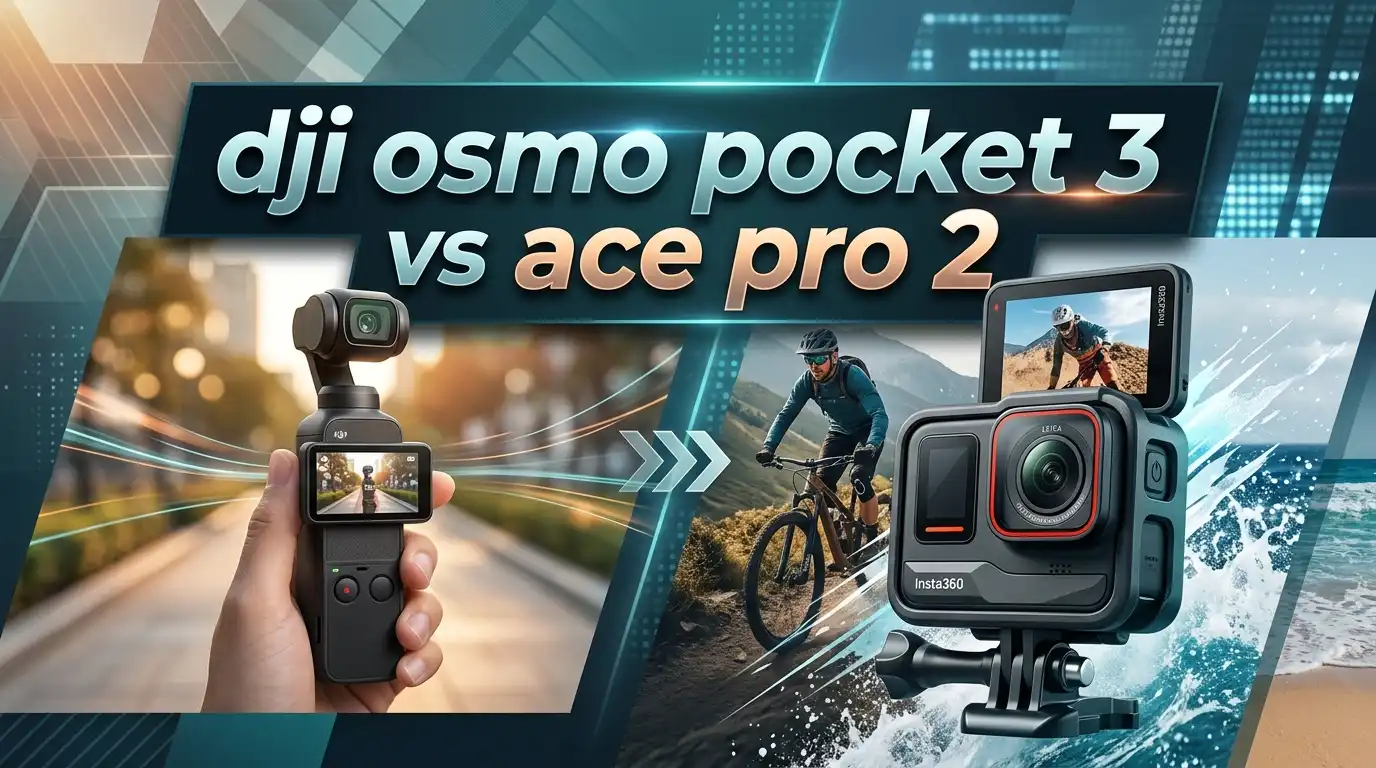
DJI Osmo Pocket 3 vs Insta360 Ace Pro 2: Which Camera Wins?
Are you stuck choosing between the DJI Osmo Pocket 3 and the Insta360 Ace Pro 2? You are not alone. These two cameras dominate the portable video market right now. One is a pocket gimbal camera with silky smooth footage. The other is a rugged action camera with 8K recording and a Leica lens.
Both cameras target content creators, vloggers, and travelers. Yet they take very different approaches to video capture. The Osmo Pocket 3 uses a 3-axis mechanical gimbal and a large 1-inch sensor. The Ace Pro 2 relies on electronic stabilization, a 1/1.3-inch sensor, and waterproof construction. Your ideal pick depends on how and where you shoot.
This comparison breaks down every detail that matters. You will learn about video quality, stabilization, battery life, low light performance, portability, audio, and value for money. By the end, you will know exactly which camera fits your style. Let’s dive right in.
Key Takeaways
- The DJI Osmo Pocket 3 uses a larger 1-inch CMOS sensor that delivers better image quality and low light performance. It records 4K at up to 120fps with 10-bit color depth.
- The Insta360 Ace Pro 2 shoots up to 8K at 30fps and captures 50MP photos. It uses a Leica Summarit lens with a 1/1.3-inch sensor and dual AI chips.
- Stabilization differs greatly between the two. The Pocket 3 uses a mechanical 3-axis gimbal. The Ace Pro 2 uses advanced electronic image stabilization called FlowState.
- The Ace Pro 2 is waterproof to 33 feet (10 meters) without a case. The Pocket 3 is only splash-resistant and cannot be submerged.
- Battery life favors the Ace Pro 2 with an 1800mAh removable battery rated for up to 180 minutes. The Pocket 3 has a built-in 1300mAh battery rated for about 166 minutes.
- The Pocket 3 is the better choice for vlogging and talking-head content. The Ace Pro 2 excels in action sports, outdoor adventures, and wide-angle shooting.
DJI Osmo Pocket 3 Overview

- Capture Stunning Footage - This vlogging camera features a 1-inch CMOS sensor and records in 4K resolution at...
- Effortlessly Frame Your Shots - Get the ideal composition with Osmo Pocket 3's expansive 2-inch touch screen...
Last update on 2026-07-01 / Affiliate links / Images from Amazon Product Advertising API
The DJI Osmo Pocket 3 launched in October 2023 and quickly became a favorite among vloggers. It packs a 1-inch CMOS sensor into a device that weighs just 179 grams. The camera sits on a 3-axis mechanical gimbal that keeps footage incredibly smooth.
The device records 4K video at 120fps and supports D-Log M color profiles for post-production flexibility. It has a 20mm equivalent focal length with an f/2.0 aperture. This wide aperture pulls in plenty of light for indoor and evening shooting.
A 2-inch rotatable touchscreen lets you switch between landscape and portrait mode instantly. This makes the Pocket 3 excellent for TikTok and Instagram Reels. The screen is bright at 700 nits, so you can see your framing clearly outdoors.
DJI includes ActiveTrack 6.0 for face and object tracking. The camera locks onto your face and follows your movements as you walk and talk. This tracking feature works reliably and makes solo filming much easier. The Pocket 3 also supports fast charging and can reach 80% battery in about 16 minutes.
Insta360 Ace Pro 2 Overview

- Flagship 1/1.3" 50MP Sensor and 5nm AI Chip: Armed with a larger, premium sensor, Ace Pro 2 allows you to...
- Wide-Angle Leica f/2.6 Lens: Leica brings its legendary expertise in optical design and state-of-the-art...
Last update on 2026-06-17 / Affiliate links / Images from Amazon Product Advertising API
The Insta360 Ace Pro 2 arrived in October 2024 as a major upgrade to the original Ace Pro. It features a 1/1.3-inch sensor co-engineered with Leica. The Leica Summarit lens brings a distinctive look to footage that many creators love.
This camera shoots 8K video at 30fps and 4K at 60fps as standard settings. It captures 50MP still photos with impressive detail. The dual AI chip system handles noise reduction and image processing in real time.
The Ace Pro 2 has a 2.5-inch flip-up touchscreen that rotates upward. This design helps you frame shots from low angles or when the camera is mounted on a helmet. The screen is sharp and responsive.
Waterproofing to 33 feet (10 meters) makes this camera ready for rain, snow, swimming, and water sports. The body is compact at 71.9 x 52.2 x 38mm and weighs just 177 grams. A removable 1800mAh battery provides up to 3 hours of recording time. PD fast charging gets the battery to 80% in about 18 minutes.
Video Quality Comparison
Video quality is the biggest reason most people buy either camera. The DJI Osmo Pocket 3 maxes out at 4K/120fps with support for 10-bit D-Log M. This gives colorists plenty of room to grade footage in post-production. The 1-inch sensor produces clean, detailed images with natural color rendition.
The Insta360 Ace Pro 2 offers a higher resolution ceiling at 8K/30fps. However, most creators will use the 4K/60fps mode for daily shooting. The 8K mode eats through storage quickly and requires powerful hardware to edit. At 4K, the Ace Pro 2 produces vibrant, punchy footage with a signature Leica color science.
Side-by-side, the Pocket 3 often looks more cinematic. Its larger sensor produces a subtle background separation that action cameras cannot match. Colors appear more natural with less processing. The Ace Pro 2, meanwhile, delivers a more vivid and saturated look straight out of the camera.
For 4K quality, the Pocket 3 has the edge in detail and dynamic range. The Ace Pro 2 compensates with its wider field of view and the option to crop 8K footage down to a steady 4K frame. Both cameras produce footage that looks professional on YouTube, Instagram, or TikTok.
Top 3 Alternatives for DJI Osmo Pocket 3

- High Dynamic Range Video plus Photo: HERO12 Black takes its best-in-class image quality to the next level with...
- Unbelieveable Image Quality: With 5.3K video that gives you 91% more resolution than 4K and an incredible...
Last update on 2026-06-17 / Affiliate links / Images from Amazon Product Advertising API

- Pro-Grade Night & Dynamic Imaging - Discover breathtaking imaging quality with Osmo Action 5 Pro action camera...
- Always Centered, Always Focused - Achieve pinpoint accuracy with our advanced 4nm chip. DJI Osmo Action 5 Pro...
Last update on 2026-06-17 / Affiliate links / Images from Amazon Product Advertising API

- Ultra-wide 18-50mm1 zoom lens gets it all in the frame
- Large 1.0-type sensor for professional results even in low-light

Last update on 2026-07-01 / Affiliate links / Images from Amazon Product Advertising API
Stabilization and Gimbal vs EIS
Stabilization separates these two cameras more than any other feature. The DJI Osmo Pocket 3 uses a mechanical 3-axis gimbal. This gimbal physically moves the camera sensor to counteract shakes and tilts. The result is butter-smooth footage even while walking on cobblestone streets or climbing stairs.
The Insta360 Ace Pro 2 uses FlowState electronic image stabilization (EIS). This system crops into the sensor to digitally smooth out vibrations. FlowState is one of the best EIS systems on the market. It handles most movements well, including running, biking, and skateboarding.
The gimbal approach wins for walking and talking videos. There is zero crop penalty. Your full field of view stays intact. The footage looks naturally smooth without any digital artifacts. For vloggers and filmmakers, the Pocket 3’s gimbal is hard to beat.
EIS works better for extreme action. A gimbal has moving parts that can break under impact. The Ace Pro 2’s FlowState handles drops, crashes, and high-G forces without damage. The camera also offers horizon leveling up to 360 degrees, which keeps your footage perfectly level even if the camera spins.
Low Light Performance
Low light shooting reveals the sensor size difference between these cameras. The DJI Osmo Pocket 3’s 1-inch CMOS sensor captures significantly more light than the Ace Pro 2’s 1/1.3-inch sensor. Combined with the f/2.0 aperture, the Pocket 3 produces cleaner images in dim conditions.
In evening street scenes and indoor settings, the Pocket 3 retains more detail with less noise. Colors stay accurate and shadows contain usable information. The D-Log M profile preserves even more dynamic range for later editing.
The Ace Pro 2 fights back with its dual AI chip system. The dedicated Pro Imaging Chip handles real-time noise reduction. This AI-based approach cleans up grainy footage directly on the camera. Results are impressive for an action camera, but side-by-side tests show the Pocket 3 still leads.
If you often shoot at night, during golden hour, or in poorly lit rooms, the Osmo Pocket 3 is the clear winner. The Ace Pro 2 performs well enough for most situations but struggles more in very dark environments. The sensor size advantage is real and visible.
Design, Build Quality, and Portability
Both cameras are remarkably portable, but they take different design paths. The DJI Osmo Pocket 3 has a tall, slim stick-like form factor. It measures 139.7 x 42.2 x 33.5mm and fits into most pants pockets. The exposed gimbal sits at the top, so you need to be careful when storing it.
The Insta360 Ace Pro 2 has a compact, boxy action camera shape. It measures 71.9 x 52.2 x 38mm and is even smaller overall. The flip-up screen adds versatility without adding bulk. The body uses durable materials that resist bumps and drops.
Build quality differs based on intended use. The Pocket 3 feels premium but fragile. The gimbal mechanism requires gentle handling. You would not toss this camera into a backpack without a protective case. The Ace Pro 2, by contrast, is built like a tank. It can handle rough treatment, water submersion, and dusty environments.
For everyday carry, the Pocket 3 wins on quick-draw shooting. Pull it from your pocket, power on, and start filming in seconds. The Ace Pro 2 needs a mount for most action scenarios, which adds setup time. For grab-and-go vlogging, the Pocket 3 format is unbeatable.
Battery Life and Charging
Battery life matters on long shoot days. The Insta360 Ace Pro 2 packs an 1800mAh removable battery rated for up to 180 minutes of recording. The removable design means you can carry spare batteries and swap them in seconds. This is a huge advantage for travel and all-day events.
The DJI Osmo Pocket 3 has a built-in 1300mAh battery rated for about 166 minutes at 1080p/24fps. At 4K/60fps, real-world battery life drops to about 116 minutes. You cannot swap the battery, so you need to charge the device itself or use a power bank.
Both cameras support fast charging. The Pocket 3 reaches 80% in about 16 minutes. The Ace Pro 2 reaches 80% in about 18 minutes. These fast charge speeds mean a quick break between sessions gets you back to full power.
The Ace Pro 2 wins the battery round overall. Its larger capacity, longer rated life, and swappable battery design give it a practical edge. The Pocket 3’s fast charging partially offsets its fixed battery, but carrying a spare Ace Pro 2 battery is simply more convenient.
Audio Quality
Good audio separates amateur content from professional-looking videos. The DJI Osmo Pocket 3 has three built-in microphones that capture clean stereo sound. The Creator Combo includes a DJI Mic 2 wireless transmitter for even better audio quality during vlogs and interviews.
The Insta360 Ace Pro 2 has two built-in microphones with AI noise reduction. The AI system filters out wind noise and background sounds effectively. Audio quality is solid for an action camera, but it lacks the depth and clarity of the Pocket 3’s three-mic setup.
For vloggers who talk to camera, the Pocket 3 delivers noticeably better audio. Voices sound fuller and more natural. Wind noise handling is decent but not perfect. The optional DJI Mic 2 solves this problem completely and provides broadcast-level audio.
The Ace Pro 2’s audio works well for action footage where ambient sound matters more than voice clarity. If audio quality is a top priority, the Pocket 3 with its Creator Combo is the stronger choice. The Ace Pro 2 handles audio adequately but cannot match a dedicated three-microphone system.
Field of View and Lens
The lens and field of view affect how your footage looks and how much of the scene you capture. The DJI Osmo Pocket 3 has a 20mm equivalent lens with an f/2.0 aperture. This provides a moderately wide field of view that flatters faces and works well for vlogging.
The Insta360 Ace Pro 2 has a Leica Summarit lens with a 16mm equivalent focal length and f/2.6 aperture. The wider 16mm lens captures significantly more of the scene. The maximum field of view reaches up to 157 degrees, which is ideal for action sports and landscape shots.
The wider lens on the Ace Pro 2 comes with trade-offs. A 16mm focal length causes more barrel distortion near the edges of the frame. The f/2.6 aperture lets in less light than the Pocket 3’s f/2.0. However, the wider coverage captures dramatic action footage that a 20mm lens simply cannot.
For talking-head content and standard vlogs, the Pocket 3’s 20mm lens looks more natural. It avoids the fisheye distortion common in action cameras. For sports, outdoor adventures, and group shots, the Ace Pro 2’s ultra-wide lens is the better tool.
Touchscreen and User Interface
Both cameras feature touchscreens, but the experience differs. The DJI Osmo Pocket 3 has a 2-inch rotatable OLED touchscreen with 556×314 resolution and 700 nits brightness. The screen rotates from landscape to portrait mode, which automatically changes the recording orientation.
The Insta360 Ace Pro 2 features a 2.5-inch flip-up touchscreen that tilts upward. This design lets you see the screen when the camera is mounted on a chest harness or placed at a low angle. The screen is responsive and offers quick access to settings through swipe gestures.
The Pocket 3’s rotating screen is better for vlogging. A simple twist switches between horizontal and vertical recording. You can monitor your framing while holding the camera at arm’s length. The compact screen size keeps the device pocketable.
The Ace Pro 2’s flip screen is better for action camera use cases. It works great on helmet mounts, bike handlebars, and chest mounts where the camera faces forward. Swiping down from the top gives quick access to HDR, resolution, and frame rate settings. Both interfaces are intuitive and easy to learn.
Waterproofing and Durability
This category creates the biggest gap between the two cameras. The Insta360 Ace Pro 2 is waterproof to 33 feet (10 meters) without any additional housing. You can take it swimming, surfing, snorkeling, or use it in heavy rain without worry.
The DJI Osmo Pocket 3 is only splash-resistant. It can handle light rain or a few water drops, but submersion will damage it. The exposed gimbal mechanism is particularly vulnerable to water and debris. You need to treat the Pocket 3 with care around water.
If your activities involve water or extreme conditions, the Ace Pro 2 is the only real option. It also handles dust, sand, and impact better than the Pocket 3. The sealed body and lack of moving external parts make it far more durable.
For indoor use, city vlogging, and controlled shooting environments, the Pocket 3’s limited weather resistance is acceptable. However, travelers who visit beaches, go hiking in rain, or shoot near pools will appreciate the Ace Pro 2’s worry-free waterproofing.
Smart Features and Software
Both cameras offer intelligent features powered by their companion apps. The DJI Osmo Pocket 3 supports ActiveTrack 6.0 for face and object tracking. It follows subjects smoothly as they move across the frame. The DJI Mimo app provides editing tools, firmware updates, and remote camera control.
The Insta360 Ace Pro 2 brings AI-powered features through its dual chip system. Gesture control lets you start and stop recording with hand signals. The Insta360 app provides AI editing tools that automatically select highlights and assemble clips into polished videos.
The Ace Pro 2’s AI editing is a standout feature. It saves hours of manual editing by finding the best moments in your footage. The app also supports Auto Frame for reframing 8K footage into perfectly cropped 4K clips. This is useful for creators who shoot first and compose later.
The Pocket 3 focuses more on real-time shooting intelligence. ActiveTrack keeps subjects centered during filming. Glamour Effects smooth skin tones for beauty vlogging. Both ecosystems are mature and reliable, but the Ace Pro 2 offers more post-capture flexibility.
Pricing and Value for Money
Price plays a big role in this decision. The DJI Osmo Pocket 3 starts at around $519 for the standard version. The Creator Combo, which includes the DJI Mic 2, runs about $709. This combo offers significant value if you need wireless audio.
The Insta360 Ace Pro 2 starts at around $399 for the standalone camera. Bundle options with extra batteries and mounts range up to about $499. This makes the Ace Pro 2 the more affordable option by a noticeable margin.
Dollar for dollar, the Ace Pro 2 offers more features per dollar spent. You get 8K recording, waterproofing, a larger battery, a Leica lens, and AI features at a lower price. The Pocket 3 costs more but delivers a mechanical gimbal, a larger sensor, and superior audio.
The right value depends on your needs. If you want the best vlogging experience with smooth footage and great audio, the Pocket 3 Creator Combo is worth the premium. If you need a versatile action camera that handles everything from surfing to street vlogging, the Ace Pro 2 is an excellent deal.
Who Should Buy the DJI Osmo Pocket 3?
The Osmo Pocket 3 is built for a specific type of creator. If you record talking-head vlogs, travel diaries, or YouTube content where you speak directly to camera, this device shines. The 3-axis gimbal makes walking shots look professional. The 1-inch sensor handles various lighting conditions with ease.
Solo content creators benefit most from the Pocket 3’s design. You can hold it in one hand, track your face automatically, and switch between portrait and landscape instantly. The compact size means you always have a capable camera ready in your pocket.
Filmmakers who value cinematic footage will appreciate the D-Log M profile, 10-bit color, and 4K/120fps slow motion. The Pocket 3 produces footage that looks closer to a dedicated mirrorless camera than any action camera on the market. If image quality and stabilization are your top priorities, this is your camera.
Who Should Buy the Insta360 Ace Pro 2?
The Ace Pro 2 serves a broader range of use cases. If you enjoy surfing, skiing, mountain biking, skydiving, or any outdoor sport, this camera can keep up. The waterproof body, durable build, and FlowState stabilization handle rough conditions with confidence.
Adventure travelers who face unpredictable weather and environments will love the Ace Pro 2. You do not need to worry about rain, splashes, or dust. Mount it on a helmet, bike, or chest strap and capture your experience hands-free.
Creators who want AI-powered editing will save significant time with the Insta360 app. The ability to shoot 8K and reframe later provides creative flexibility. The removable battery and affordable price make it a practical choice for anyone who shoots frequently in varied conditions.
Frequently Asked Questions
Is the DJI Osmo Pocket 3 better than the Insta360 Ace Pro 2 for vlogging?
Yes, the DJI Osmo Pocket 3 is generally better for vlogging. Its 3-axis gimbal provides smoother footage for walk-and-talk videos. The 1-inch sensor delivers superior image quality, and the three built-in microphones capture cleaner audio. The rotating screen also makes switching between portrait and landscape modes fast and simple.
Can the Insta360 Ace Pro 2 be used underwater?
The Insta360 Ace Pro 2 is waterproof to 33 feet (10 meters) without any additional case. You can use it for swimming, snorkeling, and water sports right out of the box. For deeper dives, Insta360 sells a dedicated dive case that extends the depth rating further.
Which camera has better low light performance?
The DJI Osmo Pocket 3 performs better in low light. Its larger 1-inch sensor and wider f/2.0 aperture capture more light than the Ace Pro 2’s 1/1.3-inch sensor with f/2.6 aperture. The Ace Pro 2 uses AI noise reduction to compensate, but the Pocket 3 produces cleaner footage in dim conditions.
Does the DJI Osmo Pocket 3 shoot 8K video?
No, the DJI Osmo Pocket 3 does not shoot 8K video. It maxes out at 4K resolution at 120fps. The Insta360 Ace Pro 2 shoots 8K at 30fps, but most creators use the 4K modes for everyday content because 8K files are very large and demanding to edit.
Can I swap the battery on the DJI Osmo Pocket 3?
No, the DJI Osmo Pocket 3 has a built-in battery that cannot be removed or swapped. You need to recharge the device directly using a USB-C cable or power bank. DJI does offer a Battery Handle accessory that extends recording time. The Insta360 Ace Pro 2 has a removable battery, which allows easy swaps.
Which camera is better for YouTube content?
Both cameras work well for YouTube. The DJI Osmo Pocket 3 is better for sit-down videos, vlogs, and cinematic B-roll thanks to its gimbal and larger sensor. The Insta360 Ace Pro 2 is better for action-oriented YouTube channels that focus on sports, outdoor adventures, and travel. Your content style should guide your choice.

DK is a technology expert who specializes in AI tools, software, and tech gadgets. He writes for How to Tech Info, providing detailed reviews and practical guides. DK helps readers discover the best AI applications, navigate new software, and choose the right tech gadgets.


