
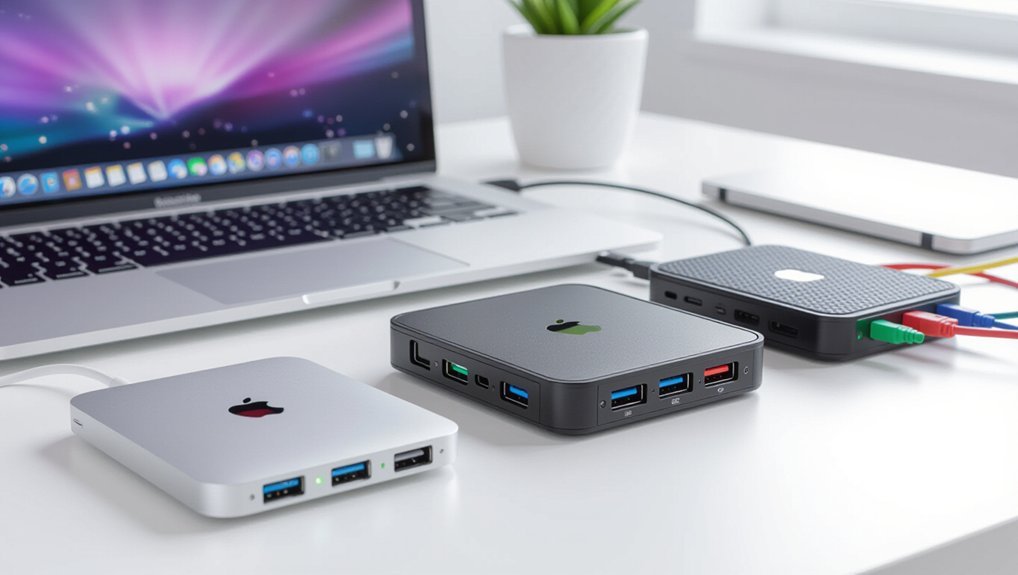
3 Best USB-C Hubs for MacBook Users in 2026 – Our Top Picks
When selecting USB-C hubs for your MacBook in 2025, you want options that blend power, versatility, and portability, whether boosting productivity at your desk or streamlining on-the-go workflows. From massive chargers with rapid multi-port charging and high wattage output, to docking stations that support dual 4K displays and extensive data connections, the right hub can transform your setup. Curious which models hit the mark? Let’s explore the best picks—you might just find your perfect match.
760W USB C Charger Block, 10 Port Fast Charging Station Hub

- 【Fast Charging Station and Travel Charger】 It with total 800 watt SIX 120w 100W PD PPS. 10- port charging station .6 USB C port and 4 USB A .700W Power...
- 【10 IN 1 USB C Charger Block】: With 6 USB-C Power Delivery port and 4 USB A . 120W x 6 USB C and 4 USB A 20W. you’re ready to charge ten of your devices...
- 【Universal USB C Charger Compatibilityand Portable charger】: Charge virtually all your mobile and tablet Laptop devices at maximum speed with USB-C and...

If you want a charger that can power all your devices at once, the 760W USB-C Charger Block is a good choice. It has 10 ports in total. Four of these ports can deliver 120W each, and one port can give 100W. This means it can charge your devices very quickly, up to three times faster than a regular charger. The station has six USB-C ports and four USB-A ports. It works with many devices like MacBooks, iPhones, Galaxy phones, tablets, and more.
The charger is small and sturdy. It also has safety features built in to protect your devices. Its size makes it easy to take with you when you travel or work at home or in the office. The charger can handle high-demand devices very well. However, if you only need to charge a few devices, this charger might be bigger and more expensive than needed. Also, it is a bit heavier than simple chargers, which can be less convenient for travel. The charger shares power among its ports, but the exact limits for each port are not clearly shown. This may affect charging speeds if many devices are connected at once.
WAVLINK USB 3.0 and USB-C Laptop Docking Station with 65W, Dual 4K HDMI/DisplayPort, USB and Ethernet

- [Wavlink docking station 13 in 1] one USB port expands your laptop to 13 ports, making this a powerful laptop docking station! This usb docking station have e 2...
- [Dual Display Docking Station] Laptop docking stations supports up to 5k@60Hz single display, or dual 4K@60Hz display (insert any of the dual display and dual...
- [Max 100W Power Charging] The computer docking station support 65W power delivery, no matter connected to a Thunderbolt 3 or USB C laptop, no need of extra...
The WAVLINK USB 3.0 and USB-C Laptop Docking Station with 65W power gives you more space and more options to connect your devices. It works well with MacBooks and other laptops. It has 13 ports in total, letting you connect two high-resolution screens with either HDMI or DisplayPort. You also get USB-A and USB-C ports, Ethernet for internet, a headphone jack, and a microphone input.
This dock can run two monitors at 60Hz, so your screens stay clear and smooth. Its tall, slim shape helps keep your desk neat and tidy. A bright LED light shows if everything is connected properly. While it can’t charge your MacBook directly, it helps you add extra screens and fast data transfer slots to your workspace.
Best For: People who want a small, handy dock that connects multiple screens and devices, especially if they use a MacBook or similar laptop.
Pros:
- Shows two 4K screens at 60Hz, making videos and work look sharp.
- Offers many ports: HDMI, DisplayPort, USB-A, USB-C, Ethernet, and audio jacks.
- Tall, slim design saves desk space. Bright light makes it easy to see if connected.
Cons:
- It can’t power or charge a MacBook by itself; you need a separate charger.
- Some users find that the connection drops sometimes or is slow, but restarting usually fixes it.
- The USB-A port feels a little fragile and might not last long with heavy use.
Anker 555 USB-C Hub (8-in-1) with 85W Power Delivery

- Flawless 4K Video via HDMI: Enjoy crystal-clear visuals with 4K@60Hz output when using a DP 1.4 laptop, or 4K@30Hz with a DP 1.2 laptop—perfect for...
- Massive Expansion: Equipped with a USB-C Power Delivery input port, a built-in 7.48″ USB-C cable, a USB-C data port, 2 USB-A data ports, 1 HDMI port, an...
- High-Speed, High-Def: USB-C and USB-A data ports provide file transfer at speeds up to 10 Gbps, while an HDMI port supports media display at resolutions up to...
The Anker 555 USB-C Hub (8-in-1) is a great choice for MacBook users. It helps you connect all your devices easily. The hub is small, just 4.76 inches long, and weighs only 4.5 ounces. That makes it easy to carry in your bag, so you can take it anywhere.
This hub has eight ports. It includes Power Delivery with 85W so your MacBook can charge fast. It also has a 4K HDMI port that shows sharp video at 60Hz. You can connect to the internet with the Ethernet port. For storage, it has SD and microSD card readers. Plus, it offers multiple data options with USB-C and USB-A ports. A built-in 7.48-inch cable keeps things tidy, but some users say the port placement can make cable management tricky.
Overall, this hub is versatile and sturdy. It gives you reliable, high-speed connections wherever you go. The size and features make it a solid choice for busy professionals and travelers.
Best For: MacBook users who want a small, dependable hub for fast connections everywhere.
Pros:
- Portable and lightweight, ideal for travel.
- Supports 4K video at 60Hz and 85W fast charging.
- Offers many ports: Ethernet, SD/microSD, USB-C, and USB-A.
Cons:
- Some ports are close to each other, making cable management hard.
- Power delivery may not work perfectly with some chargers like the Anker PD4 at 100W.
- It can get warm after long use and might not work well with Linux systems.
This hub helps you stay connected easily. It’s simple, practical, and ready to work for you wherever you are.
Factors to Consider When Choosing USB-C Hubs for MacBook Users
When choosing a USB-C hub for your MacBook, you’ll want to consider the compatibility of ports, including whether it supports Thunderbolt, HDMI, or SD cards, so you don’t end up with a bunch of useless adapters. Power delivery capacity is essential too — a hub that can’t supply enough wattage may leave your MacBook feeling drained rather than charged, especially during heavy use. Finally, pay attention to build quality, connection speeds, and video output support; after all, nobody wants a sluggish transfer or blurry video when you’re trying to get work done or unwind with some Netflix.
Port Compatibility Options
Choosing the right USB-C hub for your MacBook means checking port compatibility carefully. First, make sure it supports your favorite video outputs like HDMI or DisplayPort. This is important if you want to connect multiple monitors or watch movies on a bigger screen. Next, look for a hub that gives at least 85W power delivery. This helps your MacBook stay charged during busy work or streaming. If you still use older USB devices, find a hub that has both USB-C and USB-A ports. That way, you won’t need extra adapters. Also, check the transfer speed. Look for speeds of 10Gbps or higher. This makes copying files or using external drives faster and easier. Lastly, confirm that the hub works well with macOS. It should be easy to use without needing special drivers. A plug-and-play hub makes your setup simple and hassle-free.
Power Delivery Capacity
A USB-C hub that can deliver enough power is very important. It keeps your MacBook charged and ready to use. Look for a hub that provides 85 watts or more. This amount matches or beats most MacBook chargers. When your hub has this power, it can charge your MacBook quickly and stay charged even if you’re doing heavy work. If the hub offers less power, like 60 watts, it might slow down charging or stop charging when you’re using demanding apps. Good power delivery is not just about speed. It also makes sure the power flows safely and reliably. This helps keep your MacBook’s battery healthy over time. Choosing a hub with the right power capacity is key for working smoothly and keeping your MacBook charged all day.
Display Output Support
Make sure your USB-C hub can send a clear picture to many screens. Look for hubs that can display two 4K screens at 60Hz through HDMI or DisplayPort. This keeps your images sharp and smooth. Check if the hub works with your MacBook’s special display features, like DP Alt Mode. Some MacBooks need this to show full high-quality pictures.
Test if the hub can show multiple screens at the same time without lag. This is helpful for editing photos or videos. Also, look at the ports inside the hub. They should support the resolution and refresh rate your MacBook can handle. You don’t want a frozen or flickering picture.
Some hubs might need software updates or new drivers. Pick a hub that has good support for its software. This helps it work well for a long time.
Good display output makes your work easier and your videos look better. It can also make your movies and games more fun to watch.
Build and Port Design
When choosing a USB-C hub for your MacBook, focus on how it feels and how the ports are set up. A good hub is made from strong materials like metal or tough plastic. This makes sure it won’t break easily when you plug in or carry it around. The placement of ports is also important. Ports that are easy to reach and positioned well can make it simple to connect your devices. This helps keep your cables tidy and prevents tangled wires. Fewer reaches and smoother connections make your work easier.
Think about how many ports you need. Make sure the hub has the right types of ports for your devices. It’s good if the most-used ports are easy to reach without unplugging other things. A small, light hub is easier to carry with your MacBook, so you can take it everywhere.
The way the ports are arranged matters too. Proper placement reduces connection problems when you use multiple devices at once.
In short, look for a hub that’s strong, easy to use, and has a good port setup. This helps you stay organized and makes your workspace look neat.
Connection and Data Speed
If you want fast data transfer speeds, check the specs on your USB-C hub. USB 3.0 hubs transfer data at up to 5Gbps. USB 3.1 can go faster, up to 10Gbps. This is good for quick file sharing and backups. But it might still feel slow if you work with big media files like videos or photos. For really fast speeds, look for hubs with Thunderbolt 3 or 4 ports. These can reach up to 40Gbps. They are great for editing high-res videos or large photo collections.
Keep in mind, moving two 4K screens needs high-bandwidth ports. You also need good quality cables that support 4K at 60Hz if you want smooth video. Otherwise, you might see stuttering or lag.
Data speed also depends on where the ports are on your hub, the quality of your cables, and how many devices you connect at once. Picking a hub with the right specs for your device makes everything run faster and smoother.
Device Power Needs
Choosing a USB-C hub for your MacBook isn’t just about faster data transfer; it also depends on how much power it can provide. Look for a hub that can deliver at least 85W of power. This way, your MacBook can charge quickly, even when you’re doing heavy tasks like video editing. Make sure the hub can charge multiple devices at the same time without hurting your MacBook’s charge. You don’t want your MacBook to die because the hub isn’t giving enough power. Watch out for hubs that only give 65W or less. These might slow down your charging or cause your MacBook to run slowly when you use many peripherals. Also, check if the hub works well with your MacBook’s power adapter and charging needs. A higher wattage will help keep everything running smoothly, making your work easier and more reliable.
Size and Portability
Size and portability matter a lot when choosing a USB-C hub. A big, heavy hub can feel like a drag and make your bag harder to carry. Smaller hubs, less than 5 inches long, are easier to fit into your bag or pocket. If you move around a lot, look for lightweight options under 200 grams. They won’t add much weight and won’t tire your arm. Compact designs with few protruding ports help prevent snagging or damage while carrying your hub. Some hubs have foldable or retractable cables, so they stay neat and don’t tangle. The right size depends on how much you travel or move around. Pick a hub that is small and light enough to carry easily. This way, your MacBook stays portable and ready to use anywhere. Nobody wants a hub that becomes a burden instead of a helpful tool.
FAQs
Are USB-C Hubs Compatible With All Macbook Models?
You should check your MacBook model’s specifications, but most USB-C hubs are compatible across recent models. Keep in mind that older MacBook versions might have limited port types, so verify compatibility before purchasing for seamless use.
Can USB-C Hubs Support Multiple 4K Monitors Simultaneously?
You can connect multiple 4K monitors with USB-C hubs that support multiple video outputs and high bandwidth. Make certain the hub explicitly states it supports dual or triple 4K displays to avoid compatibility issues.
Do All USB-C Hubs Provide Sufficient Power Delivery for Macbooks?
Not all USB-C hubs provide enough power delivery for MacBooks. You need to check their wattage ratings, ensuring they offer at least 60W, preferably 85W, to keep your MacBook charged while using power-intensive accessories.
Are USB-C Hubs Future-Proof for Upcoming Macbook Port Changes?
You should consider that USB-C hubs may not remain fully compatible with future MacBook port changes. While they can handle current needs, relying on adaptable or updated hubs guarantees you stay connected as ports evolve.
How Do I Ensure Data Transfer Speeds Are Optimized With a Hub?
To optimize data transfer speeds with a hub, guarantee your device supports the fastest USB standards like USB 3.1 or Thunderbolt 3/4, keep cables high-quality, minimize simultaneous device use, and regularly update your hub’s firmware.

DK is a technology expert who specializes in AI tools, software, and tech gadgets. He writes for How to Tech Info, providing detailed reviews and practical guides. DK helps readers discover the best AI applications, navigate new software, and choose the right tech gadgets.
Last update on 2026-01-14 / Affiliate links / Images from Amazon Product Advertising API This site is a participant in the Amazon Services LLC Associates Program, an affiliate advertising program designed to provide a means for sites to earn advertising fees by advertising and linking to Amazon.com.

